Packaging Participation: Non-dominant Minorities in Power-Sharing - - PowerPoint PPT Presentation
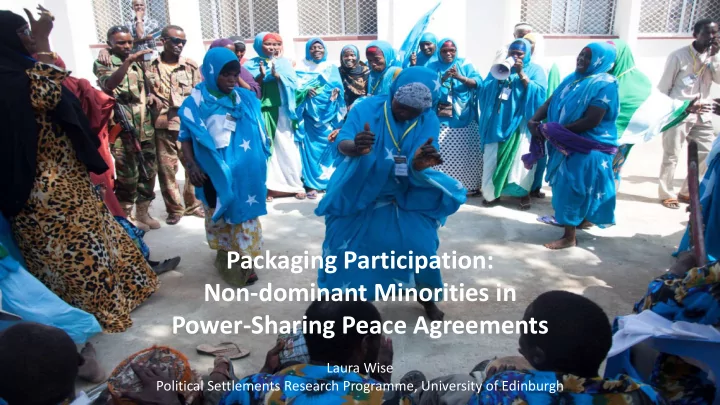
Packaging Participation: Non-dominant Minorities in Power-Sharing Peace Agreements Laura Wise Political Settlements Research Programme, University of Edinburgh Non-Dominant Minorities Dilemma The moment one community comprises above 50% of
Non-Dominant Minorities Dilemma
‘The moment one community comprises above 50%
- f the total population, that unit becomes
theirs…minority rights might be respected, yet community preference will be the rule rather than the exception. In this respect, ‘minorities’ (nationally) do not ‘behave’ better than the ‘majority’ where they are locally dominant’ (Ragaru, 2008: 25)
www.politicalsettlements.org
Minority Provisions in Power-Sharing Peace Agreements
- General/aspirational
- Rights-based institutions
- Rights-based mechanisms/processes
- Promises of effective participation
- Specific inclusion mechanisms
(Lekha Sriram, 2013)
www.politicalsettlements.org
https://thegoose20.github.io/pax/
www.politicalsettlements.org
Country/Entity Elements of sub-state power sharing with explicit reference to non-aligned minorities Bangladesh / Chittagong Hills Tract Proportionality in legislature Bosnia and Herzegovina / Federation of Bosnia and Herzegovina Executive coalition, proportionality in legislature India / Bodoland Executive coalition, proportionality in legislature , segmental autonomy India / Darjeeling Proportionality in legislature Philippines / Mindanao Proportionality in legislature Somalia / Jubba / Mudug / Galadug Executive coalition, proportionality in legislature
Final Agreement on the Implementation of the 1976 Tripoli Agreement between the Government of the Philippines and the Moro National Liberation Front, 2nd September 1996
www.politicalsettlements.org
- A. 25. There shall be sectoral representatives in the Legislative Assembly
[of the Autonomous Region of Muslim Mindanao] whose number shall not exceed 15% of the total number of elected Members of the Legislative Assembly coming from the labor, disabled, industrial, indigenous cultural communities, youth, women, non-government
- rganizations, agricultural and other such sectors…
Annex on Power-Sharing to the Framework Agreement on the Bangsamoro, 8th December 2013
Part Two, 2. The Bangsamoro Assembly shall be representative of the Bangsamoro’s constituent political units, as well as non-Moro indigenous communities, women, settler communities and other sectors. The Bangsamoro Basic Law shall ensure that representation in the assembly reflects the diversity of the Bangsamoro.
Agreement between the National Committee
- n Chittagong Hill Tracts, 2nd December 1997
www.politicalsettlements.org
B) (Kha) 3. “Non-tribal permanent residents” shall mean a person who is not a tribal but has legal land in the hill district and generally lives in the hill district at a specific address. B) (Kha) 4. d)…Whether a person is a non-tribal shall be determined, along with the identity of non-tribal community to which he belongs, by the concerned Circle Chief on the provision of submission of certificate from concerned Headman/Pourasabha chairman/Union Parishad chairman and no person can be a candidate for the office of the non- tribal member without a certificate from the concerned Circle Chief in this regard.
The LTTE’s Proposal for an Agreement to Establish an Interim Self-Governing Authority for the Northeast, 31st October 2003
www.politicalsettlements.org
2.2. The composition of the ISGA shall be: 2.2.a. Members appointed by the LTTE, 2.2.b. Members appointed by the GOSL, and 2.2.c. Members appointed by the Muslim community in the
- NorthEast. 2.3. The number of members will be
determined to ensure: 2.3.a. An absolute majority
- f the LTTE appointees in the ISGA. 2.3.b. Subject
to (a) above, the Muslim and Sinhala Communities in the NorthEast shall have representation in the ISGA.
- 6. Prohibition against Discrimination The ISGA
shall ensure that there is no discrimination on grounds of religion, race, caste, national or regional origin, age or gender in the NorthEast.
Conclusion
www.politicalsettlements.org
- Non-dominant minorities are barely noticeable in
power-sharing peace agreements; however, there are some cases where they are explicitly included in sub-state institutions with substantive equality provisions
- Participation packages heavily reflect ethno-
national cleavages (except for non-discrimination
- n the basis of sex or gender)
- Forms early inquiry into broader inclusion of