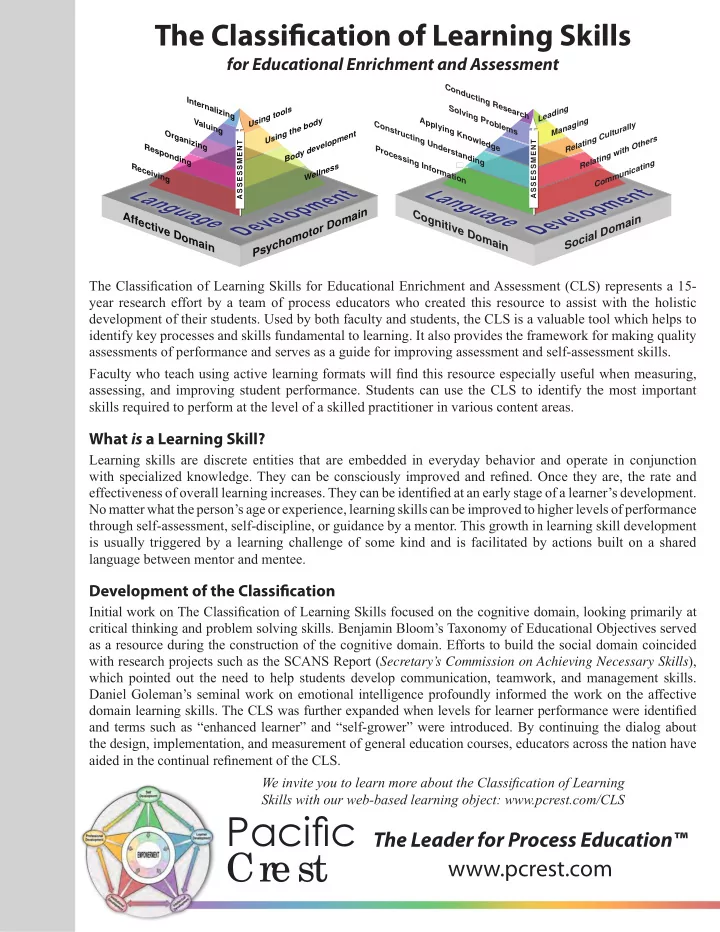

Affective Domain Psychomotor Domain
I n t e r n a l i z i n g V a l u i n g O r g a n i z i n g R e s p
- n
d i n g R e c e i v i n g Using tools Using the body Body development Wellness
A S S E S S ME N T
Cognitive Domain Social Domain
Processing Information Constructing Understanding Applying Knowledge Solving Problems C
- n
d u c t i n g R e s e a r c h
A S S E S S ME N T
Leading Relating Culturally Relating with Others Communicating Managing
Pacifjc Cre st
The Classifjcation of Learning Skills
for Educational Enrichment and Assessment
The Classifjcation of Learning Skills for Educational Enrichment and Assessment (CLS) represents a 15- year research effort by a team of process educators who created this resource to assist with the holistic development of their students. Used by both faculty and students, the CLS is a valuable tool which helps to identify key processes and skills fundamental to learning. It also provides the framework for making quality assessments of performance and serves as a guide for improving assessment and self-assessment skills. Faculty who teach using active learning formats will fjnd this resource especially useful when measuring, assessing, and improving student performance. Students can use the CLS to identify the most important skills required to perform at the level of a skilled practitioner in various content areas.
What is a Learning Skill?
Learning skills are discrete entities that are embedded in everyday behavior and operate in conjunction with specialized knowledge. They can be consciously improved and refjned. Once they are, the rate and effectiveness of overall learning increases. They can be identifjed at an early stage of a learner’s development. No matter what the person’s age or experience, learning skills can be improved to higher levels of performance through self-assessment, self-discipline, or guidance by a mentor. This growth in learning skill development is usually triggered by a learning challenge of some kind and is facilitated by actions built on a shared language between mentor and mentee.
Development of the Classifjcation
Initial work on The Classifjcation of Learning Skills focused on the cognitive domain, looking primarily at critical thinking and problem solving skills. Benjamin Bloom’s Taxonomy of Educational Objectives served as a resource during the construction of the cognitive domain. Efforts to build the social domain coincided with research projects such as the SCANS Report (Secretary’s Commission on Achieving Necessary Skills), which pointed out the need to help students develop communication, teamwork, and management skills. Daniel Goleman’s seminal work on emotional intelligence profoundly informed the work on the affective domain learning skills. The CLS was further expanded when levels for learner performance were identifjed and terms such as “enhanced learner” and “self-grower” were introduced. By continuing the dialog about the design, implementation, and measurement of general education courses, educators across the nation have aided in the continual refjnement of the CLS. We invite you to learn more about the Classifjcation of Learning Skills with our web-based learning object: www.pcrest.com/CLS