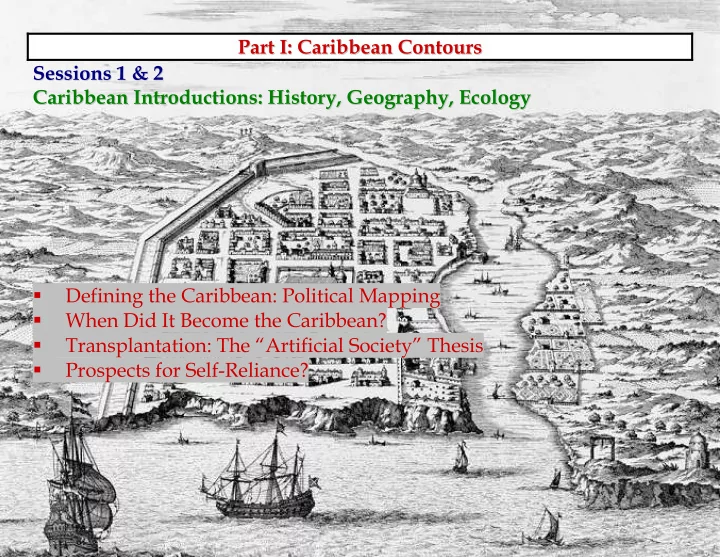
SLIDE 1 1
P Pa ar rt t I I: : C Ca ar ri ib bb be ea an n C Co
nt to
ur rs s S Se es ss si io
ns s 1 1 & & 2 2 C Ca ar ri ib bb be ea an n I In nt tr ro
du uc ct ti io
ns s: : H Hi is st to
ry y, , G Ge eo
gr ra ap ph hy y, , E Ec co
lo
gy y
De ef fi in ni in ng g t th he e C Ca ar ri ib bb be ea an n: : P Po
li it ti ic ca al l M Ma ap pp pi in ng g
Wh he en n D Di id d I It t B Be ec co
me e t th he e C Ca ar ri ib bb be ea an n? ?
Tr ra an ns sp pl la an nt ta at ti io
n: : T Th he e “ “A Ar rt ti if fi ic ci ia al l S So
ci ie et ty y” ” T Th he es si is s
Pr ro
sp pe ec ct ts s f fo
r S Se el lf f-
Re el li ia an nc ce e? ?
SLIDE 2
2
Defining the Caribbean: Political Mapping CARICOM
http://www.caricom.org/jsp/community/member_states.jsp?menu=community
ACS
http://www.acs-aec.org/index.php?q=about/members-and-associate-members http://en.wikipedia.org/wiki/Association_of_Caribbean_States
Insular Caribbean—Caribbean archipelago Greater Caribbean—Caribbean Basin Initiative Our Maps
1) http://thecaribbeansite.files.wordpress.com/2013/09/caribbean_2006.jpg 2) http://goo.gl/maps/DTXfs 3) Indigenous Caribbean: http://thecaribbeansite.files.wordpress.com/2013/09/cacscopeg.gif
SLIDE 3
3
From the Bahamas to Trinidad, and the mainland territories of Belize, Guyana, Suriname, and French Guiana Defining the extent of the Caribbean has long been a contentious subject. “the Caribbean” is not just a place, it is a sociohistorical category a cultural zone many Caribbeans “West Indies” or “Caribbean”? 1940s-1960s West Indies Federation, West Indies Cricket Team, University of the West Indies, British West Indian Airways, etc. US expansion, redefinition Anglo-American Caribbean Commission in 1942 US President Ronald Reagan’s Caribbean Basin Initiative Caribbean Free Trade Association (CARIFTA) in the 1960s, and CARICOM, and the Caribbean Development Bank in the 1970s. there is no one “correct” definition: content depends on context
SLIDE 4 4
Spanish-speaking “Caribbean”: Hispanic or African? Edgardo Rodríguez Julio (1987): “For us Puerto Ricans the term Antillean has clear significance, but not the terms Caribbean or Caribbeanness. The former makes us part
- f the historical and cultural experience of the Greater Antilles, the
latter ... imposes on us a suprahistorical category, an invented object
- f a sociological, anthropological and ethnological character that is
Anglophone in origin, and that functions against the colonized person.” French-speaking Caribbean: Antillean http://en.wikipedia.org/wiki/Antillia The Dutch islands: “Antilles” Fragmented and heterogeneous region.
SLIDE 5
5
37 million people 28 distinct political entities 16 independent states 22 countries have populations of under one million Although the majority of Caribbean entities are English speaking, the majority of the population is Spanish speaking, with French being second in importance. Independent states: Antigua, the Bahamas, Barbados, Belize, Cuba, Dominica, the Dominican Republic, Grenada, Guyana, Haiti, Jamaica, Saint Lucia, Saint Kitts-Nevis, Saint Vincent and the Grenadines, Suriname, and Trinidad and Tobago. French “departments”: French Guiana, Guadeloupe, and Martinique Netherlands: Saba, Saint Martin (shared with the French), Saint Eustatius, Curaçao, Bonaire, and Aruba
SLIDE 6
6
USA: Puerto Rico is associated with the United States; U.S. Virgin Islands UK colonies: The British Virgin Islands, the Cayman Islands, Montserrat, and the Turks and Caicos islands
SLIDE 7
7
When Did It Become the Caribbean? The Caribs Caribe, Cariba, Canibal, and Caribal Caribbee, Charibbee, Galibi, Calinago, Carifuna, and Garifuna Resistancedemonizationenslavement anthropophagy cannibalism, derived from Carib/Caniba/Canibal
SLIDE 8
8
Evolution of the political naming of the region: 1507, “Western Ocean”, Latin:
http://www.caribmap.org/index.php?id=wies&link=1507-wi-waldseemuller&src=&sub=
1513, “Western Ocean”, Latin:
http://www.caribmap.org/index.php?id=wies&link=1513-wi-waldseemuller&src=&sub=
1579, “Carib Gulf”, Italian map in Latin:
http://www.caribmap.org/index.php?id=wies&link=1579-wi-ortelius&src=&sub=
1635, “American Islands in the Northern Ocean”, Dutch map in Latin:
http://www.caribmap.org/index.php?id=wies&link=1635-wi-blaeu&src=&sub=
1656, “The Antillean Islands, between the Lucayans and Caribs”, French:
http://www.caribmap.org/index.php?id=wies&link=1635-wi-blaeu&src=&sub=
1659, “West Indies”, Dutch:
http://www.caribmap.org/index.php?id=wies&link=1659-westindies-doncker&src=&sub=
1659, “Carib Islands”, Dutch:
http://www.caribmap.org/index.php?id=wies&link=1659-wi-doncker&src=&sub=
1680, “Caribe Islands”, English:
http://www.caribmap.org/index.php?id=wies&link=1680-westindies-thornton&src=&sub=
1680, “Islands in America, of the Spanish, French, English, Dutch, and of the natives of the country”, Italian:
http://www.caribmap.org/index.php?id=wies&link=1680-wi-freschot&src=&sub=
SLIDE 9
9
1703, “Antilles Islands” (with Caribs and Lucayans), French:
http://www.caribmap.org/index.php?id=wies&link=1680-wi-freschot&src=&sub=
1703, “West Indies”, English:
http://www.caribmap.org/index.php?id=wies&link=1703-westindies-seller&src=&sub=
1710, “Mexican Archipelago, Antilles, Carib Islands”, Dutch map in Latin:
http://www.caribmap.org/index.php?id=wies&link=1710-westindies-schenck&src=&sub=
1715, “A map of the West-Indies or the islands of America in the North Sea”, English:
http://www.caribmap.org/index.php?id=wies&link=1715-westindies-moll&src=&sub=
1717, “Antilles Islands in the Archipelago of Mexico”, French:
http://www.caribmap.org/index.php?id=wies&link=1717-westindies-anonymous&src=&sub=
1723, “Terra Firma (Caribana) and the Caribbé Islands”, English:
http://www.caribmap.org/index.php?id=wies&link=1723-westindies-moll&src=&sub=
1740, “West Indies” (Leeward, Windward, Caribbe Islands), English:
http://www.caribmap.org/index.php?id=wies&link=1740-westindies-seale&src=&sub=
1750, “North Sea”:
http://www.caribmap.org/index.php?id=wies&link=1750-westindies-bowen&src=&sub=
1762, “Caribbean Sea,” “Caribbee Islands”, English:
http://cartweb.geography.ua.edu:9001/StyleServer/calcrgn?cat=Middle%20America&item=Caribbean/Mex _Carib1762b.sid&wid=500&hei=400&props=item(Name,Description),cat(Name,Description)&style=simple/vi ew-dhtml.xsl
SLIDE 10 10
1767, “North Sea, Caribbee Islands, West Indies”, English:
http://www.caribmap.org/index.php?id=wies&link=1767-westindies-salmon&src=&sub=
1778, “Caribbean Sea”, English:
http://www.caribmap.org/index.php?id=wies&link=1778-westindies-jefferys&src=&sub= to
be found again in 1783: http://www.caribmap.org/index.php?id=wies&link=1783-
westindies-cary&src=&sub=
1782, “Antilles, Northern Sea” (and notes on Indigenous inhabitants), French:
http://www.caribmap.org/index.php?id=wies&link=1782-westindies-delatour&src=&sub=
1784, “A Chart of the Antilles, or Charibbee, or Caribs Islands” (noting islands with a Carib Indian presence), English:
http://www.bl.uk/onlinegallery/onlineex/carviews/a/022ktop00000123u06800000.html
1804, “Mer des Caribes” and “Indes Occidentales”, English mapmaker, French publisher:
http://www.caribmap.org/index.php?id=wies&link=1804-westindies-pinkerton&src=&sub=
1857, “Caribbean Sea”, USA:
http://www.davidrumsey.com/luna/servlet/detail/RUMSEY~8~1~200105~3000083:A-New-Map-Of-The-Union,-With-The- Ad?sort=Pub_List_No_InitialSort%2CPub_Date%2CPub_List_No%2CSeries_No&qvq=w4s:/where/Caribbean;sort:Pub_List_No_InitialSort %2CPub_Date%2CPub_List_No%2CSeries_No;lc:RUMSEY~8~1&mi=0&trs=45
Part 1: photographic prints, photocopies and facsimiles: http://yorkspace.library.yorku.ca/xmlui/handle/10315/13674
SLIDE 11
11
Transplantation: The “Artificial Society” Thesis CL.R. James, Michael Lieber, “Westernization” “a vacuum of indigenousness” “history of imported peoples” David Lowenthal’s West Indian Societies: “artificial societies” Edouard Glissant: fallacy of the primitive paradise, the mirage of Africa, and the illusion of a metropolitan identity. Stuart Hall: ruptures and discontinuities centrifugal tendencies Decline of the Indigenous?
SLIDE 12
12
Transplanted crops, and transplanted peoples: Europeans (Spanish, Dutch, French [including Corsicans], British [Welsh, Scottish, Irish, English], Danish), Americans, Africans (mostly West African), Asians (India, Indonesia, China), Middle Eastern (Syrian-Lebanese, Palestinian, Christian and Jewish) Nearly half of all African slaves brought to the Americas, ended up in the islands of the Caribbean, 1500s-1870s The region has constantly been shaped, and reshaped, by external demands The abolition of slavery In Haiti, 1791-1804 Dominican Republic, 1822 British Caribbean, Abolition Act of 1807, Emancipation Act of 1834, collapse of the apprenticeship system in 1838 France, 1848 The Netherlands, 1863 Spain: Puerto Rico, 1873; Cuba, 1886
SLIDE 13
13
Between 1838 and 1917 nearly half a million East Indians came to work on the British West Indian sugar plantations British Guiana: 238,000 Trinidad: 145,000 Jamaica: 21,500 Grenada: 2,570 Saint Vincent: 1,820 Saint Lucia: 1,550. Between 1853 and 1879 British Guiana imported more than 14,000 workers from China Between 1841 and 1867, 32,000 indentured Africans in the Caribbean. Cuba imported more than 100,000 Chinese between 1847 and 1873, plus importation of migrant workers from the Yucatan Venezuelan migrant workers to Trinidad 1870s-1920s
SLIDE 14 14
The Sugar Revolution: transplanted mode of production transplanted labour force long-term structural impacts, external
external dependency:
SLIDE 15
15
Prospects for Self-Reliance? The natural resources of the Caribbean are extremely limited Limited support for agriculture Industrialization Taste for foreign goods, plus impact of globalization on currencies and trade