
SLIDE 1
P3: WISCONSIN’S TRADING MARKETPLACE
Establishing More Pollution Prevention Partnerships
Presentation by: Toni Herkert Policy Analyst for Senator Robert Cowles
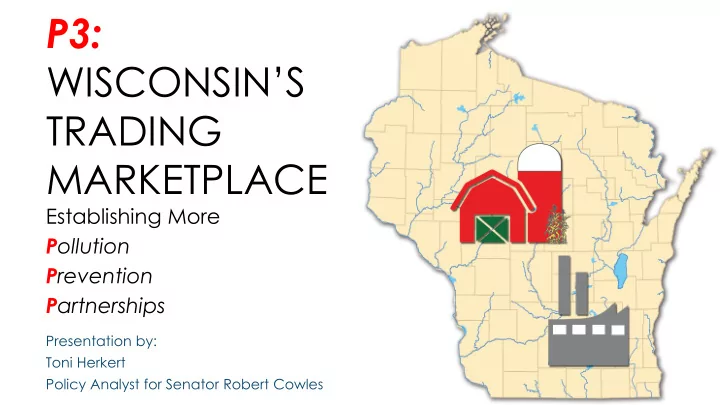
P3: WISCONSINS TRADING MARKETPLACE Establishing More P ollution P - - PowerPoint PPT Presentation
P3: WISCONSINS TRADING MARKETPLACE Establishing More P ollution P revention P artnerships Presentation by: Toni Herkert Policy Analyst for Senator Robert Cowles BACKGROUND ON SENATOR COWLES State Senator for the 2 nd District covering
Presentation by: Toni Herkert Policy Analyst for Senator Robert Cowles
State Senator for the 2nd District covering
portions of Brown, Outagamie, Shawano, and Waupaca Counties in Northeast Wisconsin
Chair, Natural Resources and Energy Co-Chair, Joint Legislative Audit Committee Member, Transportation, Veterans and
Military Affairs
Member, Speaker’s Task Force on Water
Quality
Strong focus on natural resource issues and
issues related to government accountability and transparency
One ‘tool in the toolbox’ championed by Senator Cowles to assist point
sources that otherwise need expensive infrastructure upgrades to comply with more stringent phosphorus discharge standards.
2013 Wisconsin Act 378 and 2015 Wisconsin Act 205 allow affected
sources that cannot meet current discharge limits without making major facility upgrades to seek a determination of infeasibility from DOA regarding the impact from the expense of the required upgrades.
If a determination of infeasibility is granted, the discharger will pay $50
per pound of phosphorus into nonpoint remediation account or distribute to certain projects as they work to come into compliance with new phosphorus discharge limits over the course of twenty years.
With payments made by the affected source, county conservationists,
the discharger, or a third party may implement nonpoint source mitigation project to achieve the same water quality goals.
2019 Senate Bill 91
Introduced on March 13th Natural Resources & Energy Committee
Action – Substitute Amendment 1 – Passed 5-0 on March 27th
Passed the Senate on a Voice Vote on
May 15th
2019 Assembly Bill 113
Introduced on March 22nd Heard by the Assembly Committee on
Local Government on June 19th – Awaiting Executive Action
Another ‘tool in the toolbox’ to help
point sources comply in a more economical manner with more stringent discharge standards while also benefiting nonpoint sources and water quality
Retains the existing water quality trading program which
allows a WPDES permit holder to marginally increase a pollutant discharge in their permit if they purchase credits from a point source and adds two new options for facilitating trades from: (1) a statewide clearinghouse, or; (2) another third-party broker, certified by the DNR.
The clearinghouse will have a contract with DOA approved
by the DNR, and third-party brokers will need to have approval from the DNR to begin operating.
The clearinghouse would become the statewide broker and
the credit bank, responsible for the management of buying and selling water pollution credits and maintaining a registry of credits from all third-party operators in the state.
The clearinghouse will develop and maintain an online
platform to provide information on the location of potential buyers, available credits, and other information that will facilitate credit transactions.
Credits are produced through practices by nonpoint
sources and developed through technology tables and modeling which is reviewed and approved by the DNR.
The production and purchase of credits must result in an
improvement in water quality.
To help ensure a benefit to water quality is achieved,
credits are generated at a ratio of 1.0 credit of increased pollution from a point-source to a minimum reduction of 1.2 credits of reduced nonpoint-source pollution.
NOTE: Depending on the specific practice, greater ratios
may be required to account for uncertainty.
Pollutants traded must involve the same pollutant and
watershed) as established by the DNR, typically for the course of a WPDES permit cycle.
Requires the clearinghouse to establish a
maintenance schedule for credits and to verify credits with the DNR, subject to a DNR 45 day review prior to making the credits available for sale.
Hold harmless clause – the bill specifies that if the
clearinghouse ceases to function, the DNR will continue to administer all credits that are in effect until a new clearinghouse is established or contracts expire.
Directs the DNR to consult with the EPA regarding the
possibility of allowing long-term or permanent credits in more situations than currently allowed in areas subject to an EPA-approved total maximum daily load (TMDL).
Finally, this legislation requires the DNR to evaluate the
clearinghouse within 4 years.
Over 50 bipartisan co-authors Over 40 appearances or registrations
in-favor at legislative hearings
Over 30 groups registered in-favor of
the P3: Wisconsin’s Trading Marketplace legislation on the Wisconsin Ethics Commission Eye on Lobbying website
P3 Support – Representing Diverse Interest Groups
EPA Looks to Advance Water Quality Trading
Visit legis.wisconsin.gov and type in ‘SB91’
and Legislation’
Visit legis.wisconsin.gov/senate/02/cowles
to review this PowerPoint (under the ‘Legislation’ tab) or sign-up for Senator Cowles’ periodic ‘Updates from the State Senate’ e-newsletter
Follow Senator Rob Cowles on Facebook,
Twitter (@SenRobCowles), or Instagram (@SenRobCowles)
Call Toni at (608) 266-0484 or send an
email to Toni.Herkert@legis.wisconsin.gov