P. Vavassori -IKERBASQUE, Basque Fundation for Science and CIC - - PowerPoint PPT Presentation

p vavassori
SMART_READER_LITE
LIVE PREVIEW

P. Vavassori -IKERBASQUE, Basque Fundation for Science and CIC - - PowerPoint PPT Presentation

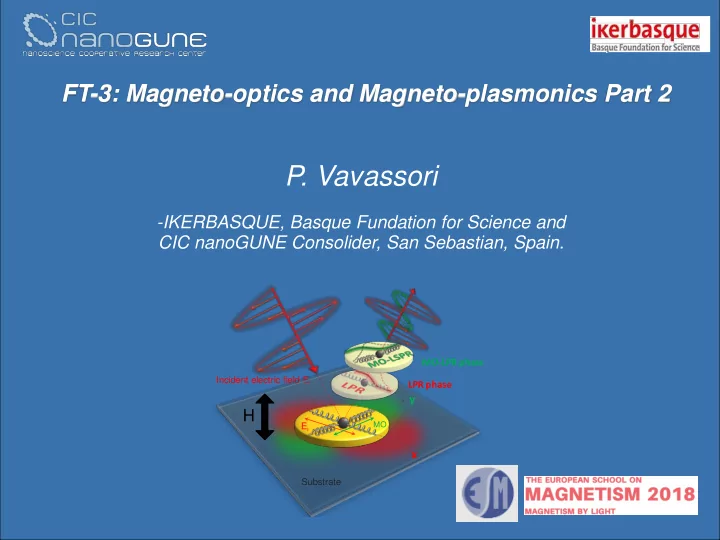
FT-3: Magneto-optics and Magneto-plasmonics Part 2 P. Vavassori -IKERBASQUE, Basque Fundation for Science and CIC nanoGUNE Consolider, San Sebastian, Spain. MO-LPR phase Incident electric field E i LPR phase y H MO l


slide-1
SLIDE 1
  • P. VAVASSORI European School on Magnetism (ESM-2018), Krakow 17-28 September 2018

FT-3: Magneto-optics and Magneto-plasmonics Part 2

  • P. Vavassori
  • IKERBASQUE, Basque Fundation for Science and

CIC nanoGUNE Consolider, San Sebastian, Spain.

 

 



Incident electric field Ei

MO-LPR phase

y x

Ei

MO

H

LPR phase

Substrate

l’

slide-2
SLIDE 2
  • P. VAVASSORI European School on Magnetism (ESM-2018), Krakow 17-28 September 2018

Outline

NANOANTENNAs COMBINING MAGNETIC AND PLASMONIC FUNCTIONALITITES ➢ Localized surface plasmons & Magneto-optical Kerr effects (MOKE): Introduction ➢ Physical picture and modeling ➢ LSPR-based sensing: Towards molecular sensing ➢ Photonics technology: control of the non-reciprocal light propagation MAGNETOPLASMONIC METAMATERIALS ➢ Surface lattice resonances in arrays of nanoantennae ➢ Arrays of elliptical nanoantennae ➢ Magnetoplasmonic gratings: arrays of antidots CONCLUSIONS

slide-3
SLIDE 3
  • P. VAVASSORI European School on Magnetism (ESM-2018), Krakow 17-28 September 2018

Localized surface plasmon resonances (LSPRs)

Small d for excitation

  • f

a LSPR in the

  • ptical

visible range (air, glass….)

Subwavelength localization

  • f electromagnetic energy

G

0.5 1 1.5 2 0.2 0.4 0.6 0.8 1

Localized surface plasmon resonances (LSPRs or LSPs) collective oscillations of conduction electrons in metallic nano structures.

G

axx

wavelength frequency

p

phase

F(t)

( ) ( )

t F t x

xx

~ = a

( )

t x ~

p

d < l/2

+50

  • 50

12 10 8 6 4 2 d=150nm h=32nm Au Air Glass

  • 100

+100

  • 100

+100 [nm] [nm] λ=717nm λ=663nm |E|2 [V2·m2] (a) (b)

Ellipsoid

          =

zz zy zx yz yy yx xz xy xx

a a a a a a a a a a ~

slide-4
SLIDE 4
  • P. VAVASSORI European School on Magnetism (ESM-2018), Krakow 17-28 September 2018

p

Electric field lines due to an electric dipole oscillating vertically at the origin. Near the dipole, the field lines are essentially those of a static dipole. At a distance of the order of half wavelength or greater, the field lines are completely detached from the dipole

q

 

a  Im

ext  2

a  

sca

Scattering and absorption remove energy from the incoming EM Absorption Scattering

Extinction Wavelength

abs sca ext

   + =

sample spectrometer

EM field irradiated by an oscillating dipole

slide-5
SLIDE 5
  • P. VAVASSORI European School on Magnetism (ESM-2018), Krakow 17-28 September 2018

Extinction Wavelength

LSPR

Localized surface plasmon resonances (LSPRs)

Size

Red-shift

Embedding medium

Red-shift

 

a  Im

ext  2

a  

sca

Scattering and absorption remove energy from the incoming EM Absorption Scattering

abs sca ext

   + =

 

a  Im

abs 

λ λ=663nm (b)

sample spectrometer

slide-6
SLIDE 6
  • P. VAVASSORI European School on Magnetism (ESM-2018), Krakow 17-28 September 2018

G displacement k

m

Displacement in phase with E Displacement in anti-phase with E Displacement 90°

  • ut of phase with E

F

Phase

( )

t x ~

( )

t x ~

Phase (px) Im(a) (a.u.) LSPR Frequency

wavelength frequency

[ ]  a

Polarizability phase Phase (px)

1.0 0.5 0.0 amplitude

G

[ ]  a

LSPR as a damped harmonic oscillator

slide-7
SLIDE 7
  • P. VAVASSORI European School on Magnetism (ESM-2018), Krakow 17-28 September 2018

Magnetoplasmonics

(SPPs MKSPP → K’SPP = KSPPKSPP) Control of MO activity Control of plasmon properties

G.Armelles , A. Cebollada , A. García-Martín , and M. Ujué González, Adv. Optical Mater. 2013, 1, 10–35

slide-8
SLIDE 8
  • P. VAVASSORI European School on Magnetism (ESM-2018), Krakow 17-28 September 2018
  • Adv. Mater. 19, 4297 (2007)

➢ Large areas ➢ Disordered distribution ➢ Insulating substrates ➢ Low concentration to avoid interactions Chalmers

Hole-Mask Colloidal Lithography

slide-9
SLIDE 9
  • P. VAVASSORI European School on Magnetism (ESM-2018), Krakow 17-28 September 2018

E-beam lithography on glass

Au

nanoGUNE – Aalto – Stockholm – Singapore

slide-10
SLIDE 10
  • P. VAVASSORI European School on Magnetism (ESM-2018), Krakow 17-28 September 2018

Negative e-beam lithography on glass

nanoGUNE – Aalto – Stockholm – Singapore

slide-11
SLIDE 11
  • P. VAVASSORI European School on Magnetism (ESM-2018), Krakow 17-28 September 2018

650 nm 490 nm 350 nm

Ni nanoantennas

LSPR LSPR LSPR

Disks 60x30 nm Disks 100x30 nm Disks 160x30 nm

Extinction Extinction Extinction

Hole-Mask Colloidal Lithography (Ni disks on glass)

  • Adv. Mater. 19, 4297 (2007)
slide-12
SLIDE 12
  • P. VAVASSORI European School on Magnetism (ESM-2018), Krakow 17-28 September 2018

Is the effect due to a LSPR?

In press on Small Small 7, 2341 (2011)

Scanning Near-Field Optical (SNOM) microscopy: amplitude and phase!

Exticntion

In the NF, electric field is like the one produced by a static electric dipole Intense E fields of opposite sign (p out of phase)

  • p/2

+p/2

+p/2

  • p/2
slide-13
SLIDE 13
  • P. VAVASSORI European School on Magnetism (ESM-2018), Krakow 17-28 September 2018

A real LSPR?

In press on Small Small 7, 2341 (2011)

Scanning Near-Field Optical (SNOM) microscopy: amplitude and phase!

sample spectrometer

60 nm 160 nm 100 nm

slide-14
SLIDE 14
  • P. VAVASSORI European School on Magnetism (ESM-2018), Krakow 17-28 September 2018

qK,F K,F

  • P. Vavassori, APL 77, 1605 (2000)

Magnetic characterization

Magneto-Optical Kerr effect configurations

slide-15
SLIDE 15
  • P. VAVASSORI European School on Magnetism (ESM-2018), Krakow 17-28 September 2018

Spectroscopic Polar MOKE

H

sample

x,y,z Supercontinuum Source (400-2000 nm) AO Monochrom (400-800 nm) 5mW 1nm Lock-in ref (w, 2w)

I

PEM (w) pol photodiode pol lens lens

DC

w 2w

q(H) (H)

I0

  • P. Vavassori, APL 77 1605 (2000)

Modulation polarization technique for recording the longitudinal and polar Kerr effects, both q and .

H

sample

x,y,z Supercontinuum Source (420-2000 nm) AO filter (420-2000 nm) 5mW 1nm ref (w,2w) PEM (w) pol photodiode pol lens lens Lock-in

(H) q(H)

t 

H

  • H

 l < l l > l l

q q,

H

y x Ei

Ei

SO

M

Er qK K Et qF F

slide-16
SLIDE 16
  • P. VAVASSORI European School on Magnetism (ESM-2018), Krakow 17-28 September 2018

Polar MOKE spectra: polarization of reflected light linked to the LSPR position

➢ Maximum of qK and crossing

  • f K follow the LSPR position

Film – no crossings in the visible range

Ni film

450 600 750 900

  • 2.0

0.0 2.0 4.0

Ni film qk k

Angle (mrad) Wavelenght (nm)

650 nm

LSPR

Extinction

450 500 550 600 650 700 750 800

  • 4,0x10
  • 3
  • 2,0x10
  • 3

0,0 2,0x10

  • 3

4,0x10

  • 3

Experimental Disks 100 nm

Pol P q  Pol S q 

Angle (rad) Wavelength (nm) 450 500 550 600 650 700 750 800

  • 3,0x10
  • 3
  • 2,0x10
  • 3
  • 1,0x10
  • 3

0,0 1,0x10

  • 3

2,0x10

  • 3

3,0x10

  • 3

Experimental Disks 60 nm

Pol S q  Pol P q 

Angle (rad) Wavelength (nm)

450 500 550 600 650 700 750 800

  • 5,0x10
  • 3
  • 2,5x10
  • 3

0,0 2,5x10

  • 3

5,0x10

  • 3

Experimental Disks 160 nm

Pol P q  Pol S q 

Angle (rad) Wavelength (nm)

350 nm

LSPR

Extinction 490 nm

LSPR

Extinction

qK K P-MOKE Extinction Refence Ni film

  • P. Vavassori, Appl. Phys. Lett. 77, 1605 (2000)
  • Phys. Rev. Lett. 111, 167401 (2013)

650 nm

2.0 1.0 0.0

  • 1.0
slide-17
SLIDE 17
  • P. VAVASSORI European School on Magnetism (ESM-2018), Krakow 17-28 September 2018

0.5 1 1.5 2 0.2 0.4 0.6 0.8 1

Damped harmonic oscillator Phase contribution

Simple physical picture: two coupled damped harmonic oscillators!!!

➢ Damped H.O.: confinement ➢ S.O. coupling: material property

Phase (p) Amplitude

Fundamental hypothesis here: linear and perturbative regime

slide-18
SLIDE 18
  • P. VAVASSORI European School on Magnetism (ESM-2018), Krakow 17-28 September 2018

Induced electric dipoles

➢ MO enhancement depends only on ayy (shape can improve enhancement) ➢ Relative phase on both ayy and yx

  • 1. Oscillator along x
  • 3. Oscillator along y
  • 2. S.O. Coupling

E PMO M

py

S.O. = cyx Ex i = yx Ex i

px = cxx Ex

i = ( – m) Ex i

Ex

i = E0 – Ex d

Ey

S.O. = py S.O./cyy = py S.O./( –m)

py = ayy Ey

S.O. = Ex i (ayy yx) / ( – m)

( )2

m yy yx x y

p p   a  − =

px = axx E0

Gives the polarization of the far-field radiated in the z-direction by these two mutually

  • rthogonal oscillating electric dipoles
slide-19
SLIDE 19
  • P. VAVASSORI European School on Magnetism (ESM-2018), Krakow 17-28 September 2018

Simple physical picture: two S.O. coupled damped harmonic

  • scillators: relative phase

➢ Damped H.O.: confinement ➢ S.O. coupling: material property Kerr Faraday 0<  < p/2 p/2 <  < p

qK = 0

K K

 = p/2  = p  = 0

 

  ( )

 

yy m yx x y x y

p p p p a          +       − = = − =       = 

2

~ ~ ~ ~

Polarization of the radiated field

Wavelength

( )2

m yx x y

p p    − =

ayy

  • Phys. Rev. Lett. 111, 167401 (2013)

z

E(z, t)

S.O.

slide-20
SLIDE 20
  • P. VAVASSORI European School on Magnetism (ESM-2018), Krakow 17-28 September 2018
  • N. Maccaferri et al., Opt. Express 21, 9875-89 (20113)

p = ( – m) Ei ; Ei = E0 + Ed

External field Depolarizing field Internal field

Oblate ellipsoid Cilindrical disk

E0 Ed p + + +

  • Embedding medium

˜

Depolarizing field is the key

slide-21
SLIDE 21
  • P. VAVASSORI European School on Magnetism (ESM-2018), Krakow 17-28 September 2018

Static depolarization: the sphere case

p E L

m d

 1 − =

p N E ~ 1

m d

 − =

3 1 = L More in general, for an ellipsoid:

Ei = E0 + Ed

~E p a =

( )

i m E

ε p  − = ~

( ) ( )

2 ~ ~ 3 E ε ε p

m m m

   + − =

( ) ( ) ( ) ( )

3

2 ~ ~ 4 2 ~ ~ 3 E E ε ε E ε ε P a    p    = + − = + − =

m m m m m m

a V

( ) ( )

I N I I I ε α ~ ~ ~ ~ ~ ~ ~ ~

m m m m

     − + − =

( ) ( ) ( )

1 3 1 2 2 2 2 2 2

2

i j k i i j k

a a a L q a q a q a dq

 − − −

= + + +

Nii = Li ak ai aj a

Clausius-Mossotti

Internal and depolarizing fields: quasi static approx

slide-22
SLIDE 22
  • P. VAVASSORI European School on Magnetism (ESM-2018), Krakow 17-28 September 2018

Wavelength dependent corrections to polarizability: modified long-wavelength approximation (MLWA)

  • N. Maccaferri et al., Opt. Express 21, 9875-89 (20113)

Oblate ellipsoid Cilindrical disk

p p 6 4

3 2

Vk i D Vk L N

ii ii ii

− − =

p N E ~ 1

m d

 − =

z y x x dV r r x D

i V i i

, , ;

2 2 2

= + =

( )

3 2 3

ˆ ˆ 3 ˆ ˆ 2 ( ) 3 2

d d

P d i k k dV r r    −  = = + +      

 

u P u P u P u E E

k is the light wave vector modulus, r the distance from the center of the ellipsoid, and a unit vector in the direction of r.

u ˆ

Static depolarization due to a uniform E0 (shape of the nanoparticle) → Li Radiative reaction due to the recoil force (Abraham– Lorentz force) acting on an

  • scillating dipole emitting

electromagnetic radiation Dynamic depolarization arising from de-phasing

  • f the radiation emitted

by different points in the ellipsoid

Di Li

slide-23
SLIDE 23
  • P. VAVASSORI European School on Magnetism (ESM-2018), Krakow 17-28 September 2018

400 600 800 1000

  • 0.5

0.0 0.5 1.0

Wavelength (nm)

0.0 D = 160 nm

 

x y

p p ~ / ~ 

. .O S

 

yy

a 

 

yy

a Im

 [ py/ px] (p)

 

Im[ayy]

It is a phase business

350 400 450 500 550 600 650 700 750 800 850 900

  • 8,0x10
  • 3
  • 6,0x10
  • 3
  • 4,0x10
  • 3
  • 2,0x10
  • 3

0,0 2,0x10

  • 3

4,0x10

  • 3

6,0x10

  • 3

8,0x10

  • 3

Pol P q  Pol S q 

NF Calculated Disks 160 nm

Angle (rad) Wavelength (nm)

( )

 

yy

O S yy m yx x y

p p

a

  a        + = +       − =       = 

. . 2

( )2

~ ~

m yy yx x y

p p   a  − =

The polarization

  • f

the far-field radiated in the z-direction by these two mutually orthogonal oscillating electric dipoles is given by the ratio

z

Kerr rotation and ellipticity spectra for an isolated nanostructure

qK= Re[py/px] and K= Im[py/px].

qK Eox

E(z,t)

K = 0 qK = 0

=      

x y

p p  2 p  =      

x y

p p

Phase difference between the two radiating dipoles px and py

  • Phys. Rev. Lett. 111, 167401 (2013)
slide-24
SLIDE 24
  • P. VAVASSORI European School on Magnetism (ESM-2018), Krakow 17-28 September 2018
  • 5.0
  • 2.5

0.0 2.5

K

70 nm 100 nm 160 nm

Angle (mrad)

450 600 750 900

  • 2.0

0.0 2.0 4.0

Wavelength (nm)

qK

70 nm 100 nm 160 nm

Angle (mrad)

It is a phase business

400 600 800 1000

  • 0.5

0.0 0.5 1.0

Wavelength (nm)

0.0

70 nm 100 nm 160 nm 100 nm 160 nm 70 nm

Im[ayy]

 [ py/ px] (p)

 

( )

 

yy

O S yy m yx x y

p p

a

  a        + = +       − =       = 

. . 2

~ ~

( )2

~ ~

m yy yx x y

p p   a  − =

qK = 0

2 ~ ~ p   =      

x y

p p

qK Eox

E(z,t)

K = 0

~ ~ =      

x y

p p 

  • Phys. Rev. Lett. 111, 167401 (2013)
slide-25
SLIDE 25
  • P. VAVASSORI European School on Magnetism (ESM-2018), Krakow 17-28 September 2018

Model system

400 500 600 700 800 900 1000 Absorption (arb. units)

Wavelength (nm)

m Glass substrate, g Ambient, o

d

Glass substrate, g

d

EMA

Modeling the spectra

Our system

slide-26
SLIDE 26
  • P. VAVASSORI European School on Magnetism (ESM-2018), Krakow 17-28 September 2018
  • D. Stroud, Phys. Rev. B 12 (8), 3368 (1975)
  • M. Abe, Phys. Rev. B 53 (11), 7065 (1996)
  • M. Abe and T. Suwa, Phys. Rev. B 70, 235103 (2004)
  • M. Schubert, T. E. Tiwald and J. A. Woollam, Applied Optics 38 (1), 177 (1999)
  • J. Zak, E. R. Mook, C. Liu and S. D. Bader, JMMM 89, 107 (1990)
  • S. Visnovsky et al., Optics Express 9 (3), 121 (2001)

Step 2 (far-field)

qK K

       

pp sp

r r Re

     

ss ps

r r Re

       

pp sp

r r Im

     

ss ps

r r Im Fictitious MO film

Step 3 (far-field including substrate)

qK K

       

pp sp

r r Re

     

ss ps

r r Re

       

pp sp

r r Im

     

ss ps

r r Im Complete system

Transfer matrix method (multilayers) Effective medium approximation (EMA)

Modeling the spectra: steps 2&3

  • N. Maccaferri et al., Opt. Express 21, 9875-89 (2013)
  • N. Maccaferri et al., Phys. Stat. Solidi (a) (2014)
slide-27
SLIDE 27
  • P. VAVASSORI European School on Magnetism (ESM-2018), Krakow 17-28 September 2018

450 500 550 600 650 700 750 800

  • 4,0x10
  • 3
  • 2,0x10
  • 3

0,0 2,0x10

  • 3

4,0x10

  • 3

Experimental Disks 100 nm

Pol P q  Pol S q 

Angle (rad)

450 500 550 600 650 700 750 800 850

  • 3,0x10
  • 3
  • 2,0x10
  • 3
  • 1,0x10
  • 3

0,0 1,0x10

  • 3

2,0x10

  • 3

3,0x10

  • 3

Calculated Disks 100 nm

Pol S q  Pol P q 

Angle (rad)

450 500 550 600 650 700 750 800

  • 5,0x10
  • 3
  • 2,5x10
  • 3

0,0 2,5x10

  • 3

5,0x10

  • 3

Disks 160 nm

Pol P q  Pol S q 

Angle (rad) Wavelength (nm)

450 500 550 600 650 700 750 800

  • 3,0x10
  • 3
  • 2,0x10
  • 3
  • 1,0x10
  • 3

0,0 1,0x10

  • 3

2,0x10

  • 3

3,0x10

  • 3

Experimental Disks 60 nm

Pol S q  Pol P q 

Angle (rad) Wavelength (nm) 450 500 550 600 650 700 750 800 850 900

  • 5,0x10
  • 3
  • 2,5x10
  • 3

0,0 2,5x10

  • 3

5,0x10

  • 3

Pol P q  Pol S q 

Calculated Disks 160 nm

Angle (rad) Wavelength (nm)

450 500 550 600 650 700 750 800

  • 4,0x10
  • 3
  • 3,0x10
  • 3
  • 2,0x10
  • 3
  • 1,0x10
  • 3

0,0 1,0x10

  • 3

2,0x10

  • 3

3,0x10

  • 3

4,0x10

  • 3

Calculated

Pol S q  Pol P q 

Disks 60 nm

Angle (rad)

Response of an ensemble of such oscillators randomly distributed on a glass substrate (EMA)

No adjustable parameters: tabuled optical and MO constants; sizes and nanoantennae density from SEM images Substrate plays a role

  • N. Maccaferri et al.,
  • Phys. Status Solidi A 211, 1067-75

(2014)

  • N. Maccaferri et al.,
  • Opt. Express 21, 9875-89 (2013)

Agreement between calculated and experimental spectra is almost perfect!

slide-28
SLIDE 28
  • P. VAVASSORI European School on Magnetism (ESM-2018), Krakow 17-28 September 2018

500 1000 1500 2000 2500

  • 4,0x10
  • 3
  • 3,0x10
  • 3
  • 2,0x10
  • 3
  • 1,0x10
  • 3

0,0 1,0x10

  • 3

2,0x10

  • 3

3,0x10

  • 3

4,0x10

  • 3

Ni film

Pol S q  Pol P q 

Angle (rad) Wavelength (nm) 500 1000 1500 2000 2500

  • 1,0x10
  • 2
  • 8,0x10
  • 3
  • 6,0x10
  • 3
  • 4,0x10
  • 3
  • 2,0x10
  • 3

0,0 2,0x10

  • 3

4,0x10

  • 3

6,0x10

  • 3

8,0x10

  • 3

1,0x10

  • 2

NF Calculated (n=1.125)

Pol S q  Pol P q 

Disks 100 nm

Angle (rad) Wavelength (nm)

Confinement ❑ Confinement (LSPR) – redistribution (blue shift) of the main spectral features due to intraband transitions (material properties, q and  linked via Kramers-Kronig relations)

Phase adjustment: spectral features redistribution

LPS

Intraband Interband

slide-29
SLIDE 29
  • P. VAVASSORI European School on Magnetism (ESM-2018), Krakow 17-28 September 2018

450 500 550 600 650 700 750 800 850

  • 3,0x10
  • 3
  • 2,0x10
  • 3
  • 1,0x10
  • 3

0,0 1,0x10

  • 3

2,0x10

  • 3

3,0x10

  • 3

Calculated Disks 100 nm

Pol S q  Pol P q 

Angle (rad) Wavelength (nm)

400 500 600 700 800 900 1000 1100 1200

  • 8,0x10
  • 3
  • 6,0x10
  • 3
  • 4,0x10
  • 3
  • 2,0x10
  • 3

0,0 2,0x10

  • 3

4,0x10

  • 3

6,0x10

  • 3

8,0x10

  • 3

Disks 100 nm

Pol S q  Pol P q 

EMA Calculated (f = 0.1)

Angle (rad) Wavelength (nm)

500 1000 1500 2000 2500

  • 4,0x10
  • 3
  • 3,0x10
  • 3
  • 2,0x10
  • 3
  • 1,0x10
  • 3

0,0 1,0x10

  • 3

2,0x10

  • 3

3,0x10

  • 3

4,0x10

  • 3

Ni film

Pol S q  Pol P q 

Angle (rad) Wavelength (nm) 500 1000 1500 2000 2500

  • 1,0x10
  • 2
  • 8,0x10
  • 3
  • 6,0x10
  • 3
  • 4,0x10
  • 3
  • 2,0x10
  • 3

0,0 2,0x10

  • 3

4,0x10

  • 3

6,0x10

  • 3

8,0x10

  • 3

1,0x10

  • 2

NF Calculated (n=1.125)

Pol S q  Pol P q 

Disks 100 nm

Angle (rad) Wavelength (nm)

Confinement Substrate ❑ Confinement (LSPR) – redistribution (blue shift) of the main spectral features (material properties, q and  linked via Kramers-Kronig relations) ❑ Substrate – reduction of MOKE contrast and slight additional blue shift of the spectral features

Step 1 Step 2 Step 3

Let’s have a look at the individual steps

LPS

Intraband Interband

  • Phys. Rev. Lett. 111, 167401 (2013); Phys. Status Solidi A 211, 1067-75 (2014)
slide-30
SLIDE 30
  • P. VAVASSORI European School on Magnetism (ESM-2018), Krakow 17-28 September 2018

M

Er

M

900

length (nm)

100 nm

Er

qk

k

qk

k

Phase

Amplitude

Wavelength

Summary for an individual magnetic nano-antenna

The concerted action of LSPRs and MO activity allows for the controlled manipulation of Kerr rotation/ellipticity of ferromagnetic nanostructures (beyond intrinsic material properties).

MO-LSPR

p

Er Er Ei Ei

t

PMO PO

t

PMO PO

lG lR

Phase delay tuning

lR lG

  • Phys. Rev. Lett. 111, 167401 (2013)
slide-31
SLIDE 31
  • P. VAVASSORI European School on Magnetism (ESM-2018), Krakow 17-28 September 2018

Control of magneto-optics via magnetoplasmonic anisotropy

Nano Letters 14, 7207 (2014)

L-MOKE

170/240 nm; t = 30 nm

“Magnetoplasmonic design rules for active magneto-optics” Shape engineering

Active tuning MO enhancement (3D structures)

Enhancement by a factor of 20

450 600 750 900 1050

  • 0.14
  • 0.07

0.00 0.07 0.14

qK (mrad)

Wavelength (nm) E 45°

@ 800nm

1

  • 1

0° 90°

slide-32
SLIDE 32
  • P. VAVASSORI European School on Magnetism (ESM-2018), Krakow 17-28 September 2018

LPRS phase-sensitivity in the reflected/transmitted light polarization

  • N. Maccaferri et al., Nature Commun. 6, 6150 (2015)

Extinction Extinction Extinction Wavelength Wavelength Wavelength

Extinction

Min l detectable ~ 0.5 nm

  • f PA-6.6

ML tMin 10 1 = 

ALD deposition

Talk by N. Macca

slide-33
SLIDE 33
  • P. VAVASSORI European School on Magnetism (ESM-2018), Krakow 17-28 September 2018

LPRS phase-sensitivity in the reflected/transmitted light polarization

Extinction Extinction Extinction Wavelength Wavelength Wavelength

Extinction

Min l detectable ~ 0.5 nm

  • f PA-6.6

ML tMin 10 1 = 

ALD deposition

  • R. Verre et al. Nanoscale 8, 10576 (2016)

Au dimers

slide-34
SLIDE 34
  • P. VAVASSORI European School on Magnetism (ESM-2018), Krakow 17-28 September 2018

Near field interactions: Magnetoplasmonic ruler

Plasmon ruler is an emerging concept where strong near-field coupling of plasmon nanoantenna elements is employed to obtain the structural information at the nanoscale (nanoscale distances). Magnetoplasmonic ruler concept

MP ruler: two

  • rders
  • f

magnitude higher precision compared to the state-of-the-art plasmon rulers. Nano Letters 15, 3204 (2015)

Kerr q (rad)

4.0 3.0 2.0 1.0 0.0 x 10⁻⁴

slide-35
SLIDE 35
  • P. VAVASSORI European School on Magnetism (ESM-2018), Krakow 17-28 September 2018

NANOANTENNAs COMBINING MAGNETIC AND PLASMONIC FUNCTIONALITITES ➢ Localized surface plasmons & Magneto-optical Kerr effects (MOKE): Introduction ➢ Physical picture and modeling ➢ LSPR-based sensing: Towards molecular sensing ➢ Photonics technology: control of the non-reciprocal light propagation MAGNETOPLASMONIC METAMATERIALS ➢ Surface lattice resonances in arrays of nanoantennae ➢ Arrays of elliptical nanoantennae ➢ Magnetoplasmonic gratings: arrays of antidots CONCLUSIONS

Outline

slide-36
SLIDE 36
  • P. VAVASSORI European School on Magnetism (ESM-2018), Krakow 17-28 September 2018

Ordered arrays of metallic nano-antennas (MNAs) placed in symmetric or quasi- symmetric refractive index environment exhibit surface lattice resonances (SLRs) which arise from diffraction-induced coupling between LSPRs of the MNAs. This coupling may result in significant reduction of plasmon radiative damping, and therefore, narrowing of plasmon resonance, which is of interest for plasmon based sensors.

Reduced plasmon radiative damping – Fano-like resonance

Ex MNAs l = dy * n dy

l = dy * n

slide-37
SLIDE 37
  • P. VAVASSORI European School on Magnetism (ESM-2018), Krakow 17-28 September 2018

Ordered arrays of metallic nano-antennas (MNAs) placed in symmetric or quasi- symmetric refractive index environment exhibit surface lattice resonances (SLRs) which arise from diffraction-induced coupling between LSPRs of the MNAs. This coupling may result in significant reduction of plasmon radiative damping, and therefore, narrowing of plasmon resonance which is of interest for plasmon based sensors. MNAs Ey l = dx * n dx

l = dx * n

Reduced plasmon radiative damping – Fano-like resonance

slide-38
SLIDE 38
  • P. VAVASSORI European School on Magnetism (ESM-2018), Krakow 17-28 September 2018

Ordered arrays of metallic nano-antennas (MNAs) placed in symmetric or quasi- symmetric refractive index environment exhibit surface lattice resonances (SLRs) which arise from diffraction-induced coupling between LSPRs of the MNAs. This coupling may result in significant reduction of plasmon radiative damping, and therefore, narrowing of plasmon resonance which is of interest for plasmon based sensors.

Arrays of magnetoplasmonic nanoantennas

Magnetic MNAs Ei M

x

lMO = dx * n dy dx lO = dy * n

l = dy * n

slide-39
SLIDE 39
  • P. VAVASSORI European School on Magnetism (ESM-2018), Krakow 17-28 September 2018

From random to ordered arrays: Polarizability

l = d * n

600 800 1000 1200 0.1 0.2 0.3 0.4 0.5

Im[alpha] (norm) Wavelength (nm)

Periodic Random

Ni

100 nm 30 nm 400 nm

n = 1.5

400 nm

500 600 700 800 900 1000

  • 5000

5000 10000 15000

S (m

  • 3)

Wavelength(nm) Re[S] Im[S]

l =d * n

slide-40
SLIDE 40
  • P. VAVASSORI European School on Magnetism (ESM-2018), Krakow 17-28 September 2018

550 600 650

  • 1

1 2 3

Wavelength (nm) S-phase (rad)

5000 10000 15000 20000

S-amplitude (m

  • 3)

600 800 1000 1200 0.1 0.2 0.3 0.4 0.5

Im[alpha] (norm) Wavelength (nm)

Periodic Random

500 600 700 800 900 1000

  • 5000

5000 10000 15000

S (m

  • 3)

Wavelength(nm) Re[S] Im[S]

The S coupling factor shows a suddend and large phase change around l*. Constructive/destructive interference.

l* =d * n

On the origin of SLMs

slide-41
SLIDE 41
  • P. VAVASSORI European School on Magnetism (ESM-2018), Krakow 17-28 September 2018

l ≈d * n

] 1 Im[ ] Im[ ] Re[ ] 1 Re[ ] Im[

Im Re 2 Im 2 Re Im *

a a a − =  − =   +   = S S

] Im[ ] Im[

*

a a  ] Im[ ] Im[

*

a a <<

500 600 700 800

  • 10000
  • 5000

5000 10000 15000

S, /a m

  • 3]

Wavelength (nm) Re[S] Re[1/a]

Im *

1 ] Im[  = a

500 600 700 800

  • 10000
  • 5000

5000 10000 15000

S, /a m

  • 3]

Wavelength (nm) Im[S] Im[1/a]

] Im[ ] Im[

*

a a 

600 800 1000 1200 0.1 0.2 0.3 0.4 0.5

Im[alpha] (norm) Wavelength (nm)

Periodic Random

On the origin of SLMs

Resonance position mainly determined by crossing points of real parts. Strength of resonance determined by difference between imaginary parts

slide-42
SLIDE 42
  • P. VAVASSORI European School on Magnetism (ESM-2018), Krakow 17-28 September 2018

Material: Py; Lattice parameters: px 400 nm py 400 -500 nm

From random to ordered arrays: MP crystals

Refractive index matching oil (n = 1.5)

  • M. Kataya et al., Nat. Commun. 6, 7072 (2015)

py 400 -500 nm px 400 nm

Exct. qK

slide-43
SLIDE 43
  • P. VAVASSORI European School on Magnetism (ESM-2018), Krakow 17-28 September 2018

Rectangular arrays

slide-44
SLIDE 44
  • P. VAVASSORI European School on Magnetism (ESM-2018), Krakow 17-28 September 2018

l

l=d*n

Relative position of the LSPR and the diffractive interference

Resonance lineshape evolution varying the relative position

  • f the LSPR with respect to the Rayleigh’s anomaly
slide-45
SLIDE 45
  • P. VAVASSORI European School on Magnetism (ESM-2018), Krakow 17-28 September 2018
  • N. Maccaferri et al., Nano Lett. 16, 2533 (2016)

LA LA SA SA

Enhanced and tunable O and MO-Anisotropy

MOA = 2 2 K K

 q +

MOALA-MOASA

slide-46
SLIDE 46
  • P. VAVASSORI European School on Magnetism (ESM-2018), Krakow 17-28 September 2018
  • N. Maccaferri et al., Nano Lett. 16, 2533 (2016)

Experiment

Enhanced and tunable O and MO-Anisotropy

slide-47
SLIDE 47
  • P. VAVASSORI European School on Magnetism (ESM-2018), Krakow 17-28 September 2018

Py Py Py Py Au Au Au Au

Ei

Checkerboard hybrid arrays of Py and Au nanoantennae

Efficient radiative far-field coupling between the magnetic and noble-metal components

  • M. Kataia et al., Opt. Express 24, 3652 (2016)

Integrating MO active and pure plasmonic nanostructures: combination of intense

  • ptical resonances with

strong MO activity.

Ni

50%Ni 50%Au 50%Ni 50%Au

Ni

slide-48
SLIDE 48
  • P. VAVASSORI European School on Magnetism (ESM-2018), Krakow 17-28 September 2018

LSMs with hybrid nanostructures

Another common strategy to

  • vercome

the excess

  • f

damping is to develop hybrid structures consisting of noble metals and ferromagnets.

Banthí et. al Adv. Opt. Mat. 24, OP36 (2012).

Dimers Ni Au SiO2

Mikko Kataja, Pourjamal Sara &Sebastiaan van Dijken Aalto, Finland

slide-49
SLIDE 49
  • P. VAVASSORI European School on Magnetism (ESM-2018), Krakow 17-28 September 2018

➢ Concerted action of LSPRs (or SPPs) and MO-coupling can be exploited to achieve a controlled manipulation of the MO response (control Kerr rotation/ellipticity) beyond what is offered by intrinsic material properties. Patterning magnetic nanostructures for resonant interaction with light: Magnetoplasmonic Crystals ➢ Magnetically tunable plasmonic crystal based on the excitation of Fano-like lattice surface modes in periodic arrays. ✓ Highly tunable and amplified magneto-optical effects as compared to disordered systems. ➢ Two-dimensional magnetoplasmonic crystals supporting surface plasmon polariton modes and displaying a two-dimensional photonic band structure. ✓ Design of metamaterials with tailored and enhanced magneto-

  • ptical response by engineering the plasmonic band structure via

lattice engineering.

Concluding remarks

slide-50
SLIDE 50
  • P. VAVASSORI European School on Magnetism (ESM-2018), Krakow 17-28 September 2018

Other directions explored: magneto-plasmonics with SPP s

SPPs are localized electromagnetic modes/charge density oscillations at the interface

  • f

two media with dielectric constants

  • f
  • pposite

signs, e.g. a metal and a dielectric,. s ↔ p-polarization coversion!! p-polarization only

slide-51
SLIDE 51
  • P. VAVASSORI European School on Magnetism (ESM-2018), Krakow 17-28 September 2018

SP resonance: coupling with a grating (conservation of momentum)

ki θ ki sin(θ) kg kSP kSP = ki sin(θ) - kg ki θ ki sin(θ) kg kSP kSP = ki sin(θ) + kg

+1 order coupling

  • 1 order coupling

grating

slide-52
SLIDE 52
  • P. VAVASSORI European School on Magnetism (ESM-2018), Krakow 17-28 September 2018

Magntoplasmonic gratings: MOKE enhancement due to resonant coupling with SPPs

Magnetic diffraction grating Antidot array (square lattice ): material Py (Fe20Ni80), thickness = 80 nm, lattice parameter = 405 nm, hole diameter = 265 nm by deep-UV photolithography (Prof. A. Adeyeye, Singapore)

  • N. Maccaferri et al., ACS Photonics 2, 1769 (2015)
slide-53
SLIDE 53
  • P. VAVASSORI European School on Magnetism (ESM-2018), Krakow 17-28 September 2018

k|| kSSP1

(-1,+1)

kSSP2 k||

(-1,0)

kSSP

(-1,-1)

Gx Gy

k|| kSSP1 kSSP2 k|| kSSP

(-1,0) (-1,-1) (0,-1)

Gx Gy

SPP band structure: perturbative approach  = 45° = 0°

Type II k|| = k0Sinq Type I Type II Type I

(-1,-1) (-1,0) (0,-1)

Type II: both p- and s-pol Type I:

  • nly p-pol

Key property

slide-54
SLIDE 54
  • P. VAVASSORI European School on Magnetism (ESM-2018), Krakow 17-28 September 2018

500 600 700 800 0.2 0.3 0.4 0.5 0.6

R

Wavelength (nm)

“Generalized scattering-matrix approach for magneto-optics in periodically patterned multilayer systems”

  • B. Caballero, A. García-Martín, and J. C. Cuevas, Phys. Rev. B 85, 245103 (2012)

Reflectivity maps: full calculations (antidots size and cross section)

Rpp (f = 0

  • )

Rpp (f = 45

  • )

Rss (f = 45

  • )

Rss (f = 0

  • )

(-1,0)&(0,-1) (-1,0)&(0,-1) (+1,0)&(0,+1) (-1,-1) (+1,0)&(0,+1) (-1,-1)&(-1,+1) (0,+1)&(0,-1) (0,+1)&(0,-1) (-1,-1)&(-1,+1) (-1,0) (+1,0)

Type I Type II

No channels for sp conversion in the VIS 1 channel for sp conversion in the VIS

Rss Rpp

400 500 600 700 800 0.5 0.6 0.7 0.8

Wavelength (nm)

Rss Rpp R

G(-1,0) G(0,-1)

slide-55
SLIDE 55
  • P. VAVASSORI European School on Magnetism (ESM-2018), Krakow 17-28 September 2018

400 500 600 700 800 0.2 0.4 0.6 0.8

Wavelength (nm)

MO activity enhancement mechanism (L-MOKE)

(-1,0)&(0,-1) (-1,-1) (-1,0)&(0,-1)

 = 45° q = 30°

Plasmonic channel “open” for resonant MO induced polarization conversion.

 = 0° q = 30°

500 600 700 800 0.1 0.2 0.3 0.4 0.5 0.6

Wavelength (nm) Rss Rpp Rss Rpp

rps-rsp x 1000 rps-rsp x 1000

(-1,0)

(L-MOKE and P-MOKE involve s  p polarization conversion T-MOKE p  p: no polarization conversion,)

  • N. Maccaferri et al., ACS Photonics 2, 1769 (2015)
slide-56
SLIDE 56
  • P. VAVASSORI European School on Magnetism (ESM-2018), Krakow 17-28 September 2018

450 525 600 675 750 0.5 1.0 1.5 2.0 2.5

30 45 60 (-1,0) (0,-1) (-1,-1)

Wavelength (nm)

p-polarization

500 575 650 725 800 0.4 0.8 1.2 1.6

30 45 60 (-1,0)

Wavelength (nm)

p-polarization

Experimental MO-activity

500 600 700 800 0.4 0.8 1.2 1.6 30° 45° 60°

MOA p_pol (mrad) Wavelength (nm)

MOA (mrad) MOA (mrad)

= 0°  = 45°

Film

  • N. Maccaferri et al., ACS Photonics 2, 1769 (2015)

MOA = 2 2 K K

 q +

slide-57
SLIDE 57
  • P. VAVASSORI European School on Magnetism (ESM-2018), Krakow 17-28 September 2018

mrad

 = 45° q = 30° Rotation and ellipticity

  • N. Maccaferri et al., ACS Photonics 2, 1769 (2015)
slide-58
SLIDE 58
  • P. VAVASSORI European School on Magnetism (ESM-2018), Krakow 17-28 September 2018

SPP band structure engineering

(-1,-1) & (-1,+1) (0,-1) & (0,+1) (-1,0)

MO activity

Rectangular array: two SPPs channels Square array:

  • ne SPP chasnnel

MO activity

One SPP assisted MO enhancement Two SPPs assisted MO enhancement Black dashed lines: MO-active SPPs

Modes of different nature bandgap opening Resonant-antiresonant lineshape

film

film

  • N. Maccaferri et al., ACS Photonics 2, 1769 (2015)
slide-59
SLIDE 59
  • P. VAVASSORI European School on Magnetism (ESM-2018), Krakow 17-28 September 2018

SPPs

Au Ni

Zhou Xue & Adekulne O. Adeyeye National University of Singapore

slide-60
SLIDE 60
  • P. VAVASSORI European School on Magnetism (ESM-2018), Krakow 17-28 September 2018

➢ Concerted action of LSPRs (or SPPs) and MO-coupling can be exploited to achieve a controlled manipulation of the MO response (control Kerr rotation/ellipticity) beyond what is offered by intrinsic material properties. Patterning magnetic nanostructures for resonant interaction with light: Magnetoplasmonic Crystals ➢ Magnetically tunable plasmonic crystal based on the excitation of Fano-like lattice surface modes in periodic arrays. ✓ Highly tunable and amplified magneto-optical effects as compared to disordered systems. ➢ Two-dimensional magnetoplasmonic crystals supporting surface plasmon polariton modes and displaying a two-dimensional photonic band structure. ✓ Design of metamaterials with tailored and enhanced magneto-

  • ptical response by engineering the plasmonic band structure via

lattice engineering.

Concluding remarks