Overview Organizational Development Briefly review definition and - - PDF document

overview organizational development
SMART_READER_LITE
LIVE PREVIEW

Overview Organizational Development Briefly review definition and - - PDF document

Overview Organizational Development Briefly review definition and purpose of Organizational Development Introduce NuPITA Organizational Capacity Assessment process and tool Apply process to a simulated situation New Partners


slide-1
SLIDE 1

1

New Partners Initiative (NPI) Round Two Partners’ Launch Meeting Dar es Salaam, Tanzania May 20-23, 2008

Organizational Development Overview

  • Briefly review definition and purpose of

Organizational Development

  • Introduce NuPITA Organizational Capacity

Assessment process and tool

  • Apply process to a simulated situation

“Every organization is perfectly designed to achieve the results it gets.”

Donald Berwick, M.D., M.P.P. IHI

Defining Organizational Development

  • A planned effort, organization-wide, managed from the

top, to increase organization effectiveness and health, through planned interventions in the organization's 'processes',

  • Process through which an organization develops the

internal capacity to be the most effective it can be in its mission work and to sustain itself over the long term.

  • Collaborating with organizational leaders and their

groups to create systematic change and root-cause problem solving to improve productivity and satisfaction by improving the human processes of getting work done.

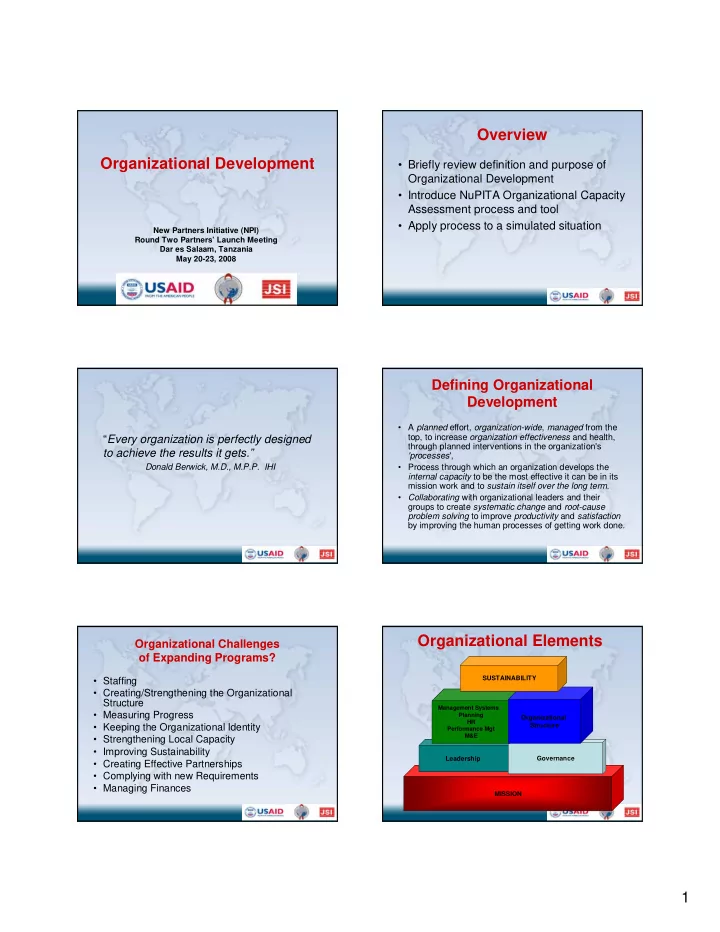
Organizational Challenges

  • f Expanding Programs?
  • Staffing
  • Creating/Strengthening the Organizational

Structure

  • Measuring Progress
  • Keeping the Organizational Identity
  • Strengthening Local Capacity
  • Improving Sustainability
  • Creating Effective Partnerships
  • Complying with new Requirements
  • Managing Finances

MISSION Leadership Governance Governance

Organizational Elements

Management Systems : : Planning HR Performance Mgt M&E Organizational Structure SUSTAINABILITY

slide-2
SLIDE 2

2 Organizational Development (OD) is a process

Assessing OD Needs

  • Identify Priority Areas
  • Assess where you are
  • Data
  • Information
  • Input from staff, partners, clients
  • Identify Standards of Excellence
  • Best Practices
  • Measure performance against standards
  • Address Gaps

– Develop and agree on an improvement plan – Set up team

  • Communicate & Implement
  • Measure progress at agreed upon intervals

Purpose of OCA

Organizational Capacity Assessment (OCA)

  • Is available in many forms/structures to meet

needs of target audience

  • Assists organizations to review status against
  • rganizational capacity standards to identify

both strengths and weaknesses

  • Enables development of organizational

improvement plans

  • Provides framework for continual review of

OC achievements and program achievements

  • Builds internal capacity

Example: NGO ORGANIZATIONAL ASSESSMENT TOOL (OCA) The NGO has an

  • rganizational structure

which is well designed and relevant to the mission/goals, roles and responsibilities are clearly defined and appropriate, and all positions are filled. The NGO has an organizational structure which is well designed and relevant to the NGO’s mission/goals; and roles and responsibilities are clearly defined and appropriate, but some positions are not filled. The organization has a basic organizational structure with clearly defined lines of authority and responsibilities. The organization has no formal structure and member roles and responsibilities are not clear. 4 3 2 1

  • 3. Structure,

Roles and Responsibilities The organization has well conceived constitution and bylaws and thoroughly developed operational policies to guide work, human resources management practices and financial management The organization has constitution, bylaws and some written policy but policies may be incomplete The organization has basic written constitution and bylaws but no written policies that guide work, human resource management practices or financial management The organization has no written constitution, bylaws or operational policies to guide work, human resources management practices,

  • r financial management

4 3 2 1

  • 2. Policies

The organization has clearly defined mission and goals that reflect the

  • rganization’s structure

and context, are written, and are clearly posted The organization has clearly defined mission and goals that reflect the organization’s structure and context, but they are not written and posted. The organization has clearly defined mission and goals but they do not reflect the organization’s current structure and context, they may or may not be written and posted The organization does not have clearly defined mission and goals. 4 3 2 1

  • 1. Mission/Goals

Stages of NGO Capacity Development and Characteristics GOVERNANCE The organisation has an annual wokplan and an associated budget which were developed with participation of

  • stakeholders. The plan

and budget are used to guide activities and resource allocation. Progress against the plan and expenditure is regularly reviewed (monitored) by the

  • rganization and

stakeholders and necessary adjustments made. The organization has an annual workplan & an associated budget was developed with participation of stakeholders. The plan and budget are used to guide implementation and resource allocation. However, progress against the plan is not reviewed with stakeholders. The organization has an annual workplan and an associated budget was developed with participation of stakeholders, but these are not consistently used to guide implementation and resource allocation. The organization has no annual work plan. 4 3 2 1

  • 5. Planning

The organization has complete and up to date information about all key stakeholders working in same geographic and technical area and stakeholders participate in at least yearly reviews of the HIV/AIDS activities and their impact on the

  • rganization’s area of
  • peration.

The organization has complete and up-to-date information about all key stakeholders working in the same geographic and technical area, has identified where they are, what they are doing and their expectations, but does not hold regular meetings with these stakeholders The organization has some information about stakeholders and service providers in the area (geographic and technical) in which it

  • perates, but this is

incomplete and out of date. The organization does not have complete information about key stakeholders and service providers in the area (geographic and technical) in which it

  • perates

4 3 2 1

  • 4. Stakeholder

Involvement Stages of NGO Capacity Development and Characteristics GOVERNANCE

Sample Assessment Tool (continued)

Audits Control over Assets Financial Controls Financial Management

Financial Management

Reporting Decision Making HRM Administrative Procedures

Management Systems
slide-3
SLIDE 3

3

Sample Assessment Tool (continued)

Service Delivery Service Delivery Action Planning M&E Indicators & Targets Standards & Supervision Performance Management Information Systems Information Systems Technical Linkages Community Leader Support IGA Sources of Funding Sustainability

Using the OCA Process

  • Participatory Process -includes relevant

members of organization including financial, administrative, technical, management and leaders, partners, volunteers

  • Self-directed or led by external expert/facilitator

to give objective perspective and provide OD knowledge

  • Periodically repeated to measure OD change

Preparation

  • Assemble a team
  • Amass relevant documents
  • Identify place and time

– (Process can take several hours to several days)

Prerequisites for success

All changes do not necessarily lead to improvement but all improvement requires

  • change. (IHI)
  • Board and leadership commitment
  • Openness to change
  • Management of Change

OCA Outcome

  • Improvement plan aimed at addressing identified

areas of weakness

  • Plan is linked to measurable outcomes
  • Plan includes objectives, actions,

responsibilities, a monitoring strategy, a timeline and required inputs, including TA

  • Plan is periodically reviewed to measure

effectiveness of strategies

  • OCA repeated annually to measure OD
  • Internal capacity development

Applying the Process

  • Break into 6 groups;
  • Imagine yourself as part of an OCA team;
  • Read the scenario; and
  • Answer the questions.
slide-4
SLIDE 4

4 Small Group Exercise

The Organization for Positive Change (OPC), based in Ohio, has a USAID contract to provide school fees and supportive services to 780 orphans in 5 communities of Lesotho over the next 3 years. The communities receive services from NGOs and MOH through the District Health Team. OPC has awarded a sub-grant to the New Hope Society to implement the local

  • program. New Hope has 3 full time staff, 100 volunteers and 10 years

experience in these communities. The consultant technical advisors have arrived in Lesotho to conduct an Organizational Capacity Assessment – a diagnostic review process that helps organizations determine their strengths and areas for improvement. OPC, New Hope staff and volunteers, DHT and the advisors reviewed, discussed and scored New Hope’s status on 15 organizational elements. M&E was slated for immediate action due to its importance to PEPFAR and its score, 2.

Reporting Indicators

  • Key reporting indicators for New Hope

include:

– # communities covered – # orphans receiving school fees – # orphans receiving monthly support services

Systems & trained individuals are in place to collect and analyze data. Data on program activities are available, up to date and the data are regularly used for follow-up monitoring, strategy adjustments and future planning. Systems & trained individuals are in place to collect and analyze data. Data on activities are available, current but data is not verified and inconsistent. Findings are not used for follow-up planning or strategy adjustment. Staff and volunteers are trained in data collection, have reporting formats but data is not regularly reported or collected and a system for analysis is lacking. The

  • rganization

has no system to collect, analyze and report on activities, program or

  • utputs.
  • 4. High level of

capacity in place

  • 3. Moderate

level of capacity in place

  • 2. Basic level
  • f

capacity in place

  • 1. Clear need

for increased capacity Monitoring and Evaluation

As members of the OCA Team:

  • What are the problems that need to be

addressed?

  • What inputs are needed to help New Hope

reach level 3?

  • What process should be put in place to

monitor progress?

Options for OD Technical Assistance

  • Short term Technical Assistance
  • NuPITA staff member seconded to provide

day to day support

  • Exchange visits with organizations which

have well established systems

  • Other

Next Steps

  • Adapt OCA for NPI partners

– Addressing critical functions

  • Discuss time table for conducting OCAs
  • Discuss TA for assisting improvement plan

implementation