Overview of todays presentation 1. Where did we begin and why? 2. - - PDF document

overview of today s presentation
SMART_READER_LITE
LIVE PREVIEW

Overview of todays presentation 1. Where did we begin and why? 2. - - PDF document

Presented at Building Community through Seasons for Growth Trainers & Companion Conference October 2011 __________________________________________________________________________________ Overview of todays presentation 1. Where did we begin


slide-1
SLIDE 1

Presented at Building Community through Seasons for Growth Trainers & Companion Conference October 2011 __________________________________________________________________________________

Overview of today’s presentation

  • 1. Where did we begin and why?
  • 2. What are the core successful elements of the program?
  • 3. What has the most recent evaluation indicated about the impact of the program?
  • 4. What else do we know from more recent research that points to the continuing

relevance of the program?

  • 5. Where/how might the program be further developed in the future?

Where did we begin and Why?

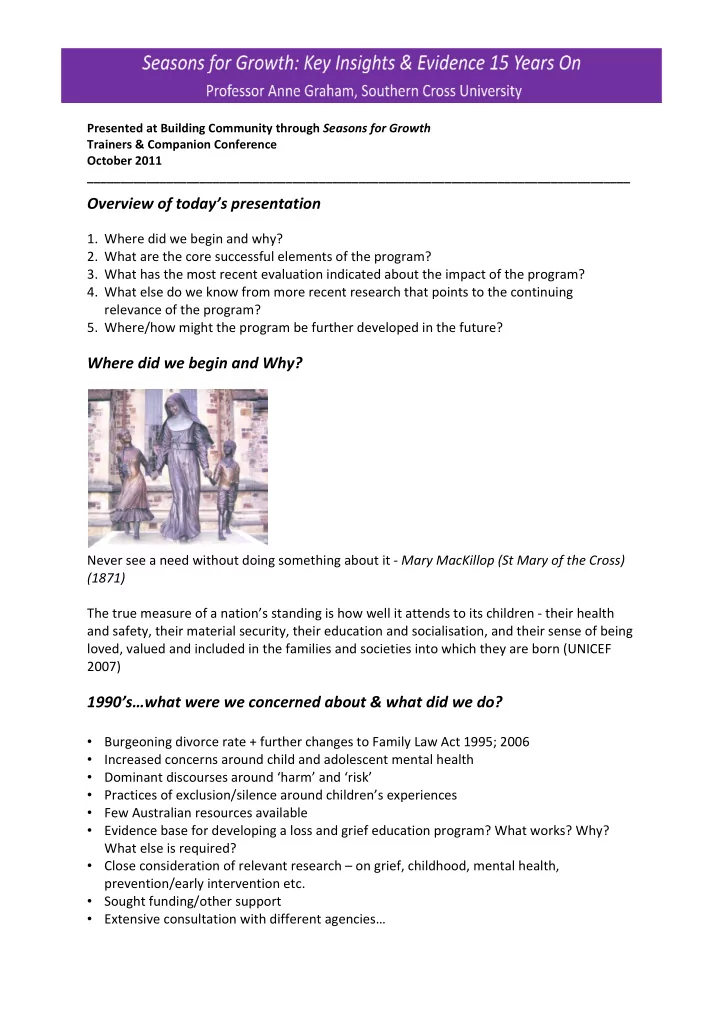
Never see a need without doing something about it ‐ Mary MacKillop (St Mary of the Cross) (1871) The true measure of a nation’s standing is how well it attends to its children ‐ their health and safety, their material security, their education and socialisation, and their sense of being loved, valued and included in the families and societies into which they are born (UNICEF 2007)

1990’s…what were we concerned about & what did we do?

  • Burgeoning divorce rate + further changes to Family Law Act 1995; 2006
  • Increased concerns around child and adolescent mental health
  • Dominant discourses around ‘harm’ and ‘risk’
  • Practices of exclusion/silence around children’s experiences
  • Few Australian resources available
  • Evidence base for developing a loss and grief education program? What works? Why?

What else is required?

  • Close consideration of relevant research – on grief, childhood, mental health,

prevention/early intervention etc.

  • Sought funding/other support
  • Extensive consultation with different agencies…
slide-2
SLIDE 2

So what emerged as important…

  • Use of metaphor (‘seasons’) as a key learning tool
  • Need for sound theory ‐ Worden’s ‘tasks’ of grief
  • Importance of psycho‐social ‘competence’ and development of skills
  • Acknowledging ‘difference’ ‐ providing a range of activities/options to facilitate learning
  • ‘Like‐to‐like’ peer learning ‐ giving children and young people a ‘voice’
  • Privileging the role of ‘conversation’
  • Adult facilitators as ‘Companions’
  • Structured and detailed manuals/resources for different levels
  • Mandatory training – ‘inside out’ approach
  • Implementation guidelines/support for schools/agencies
  • Navigating different disciplinary/sector interests…

In your experience…

  • What have you found to be the most positive/beneficial aspect(s) of the program for the

participants?

  • What have you found to be the most challenging aspect/s of the program for the

participants?

  • What has been most rewarding for you as a trainer and/or Companion?
  • What has been most challenging for you as a trainer and/or Companion?
  • What have you discovered about children and their capacity to adapt to change and loss?
slide-3
SLIDE 3

What did the most recent evaluation findings indicate?

  • Data collected from 57 groups with 334 participants
  • 6 regions in Australia, New Zealand and Scotland
  • 295 PRE participant surveys completed (93%)
  • 258 POST participant surveys completed (81%)
  • 47 Companion surveys completed (84%)
  • 30 parent surveys completed (9%)
  • [On‐line surveys utilising avatar technology]
  • 1. Children & young people enjoyed their Seasons for Growth (SfG) experience

and valued it highly

  • 95% completion rate – high
  • SfG participants reported very high levels of satisfaction with all aspects of program, with
  • nly a few expressing any concern (e.g. ‘shy’, ‘anxious’ or ‘nervous’) in the pre‐survey
  • SfG Companions felt children’s greatest ‘likes’ were:

camaraderie of being in a group

  • pportunity to express themselves

SfG Resources

slide-4
SLIDE 4
  • 2. Parents valued the SfG program

Parents say: SfG met their expectations (97% ‘very well’ or ‘quite well)

  • “I would just like to thank you for putting this program in place and allowing children

access to it. My son really enjoyed the sessions and I am very grateful and appreciative

  • f the opportunity, help and support that he has been given.”
  • “I hope it continues so other children can benefit as we have.”
  • “My daughter loved the program and looked forward to attending each week and the

workbook that she was very proud of.”

  • “I'm glad it was available for my children, and I think that a safe outlet for them to discuss

issues is imperative to a balanced person, so a great big heartfelt thank you to the Seasons group.”

  • “It is a fantastic program that I would recommend to any families that have experienced

a loss. Thank you for developing such a worthwhile program for children.”

  • “[Name of child] enjoyed sharing with others and relating 'change' to the 'seasons’.”
  • 3. Companions valued the SfG program

Companions say: SfG has changed them (84% ‘a great deal to ‘a little’) – particularly improving their understanding of children and strengthening their own personal qualities

  • “I can't praise the program enough. I have seen the weight lifted off many young people's

shoulders through doing this program.”

  • “This program has been a source of great joy for the children who have participated in

the program over the past ten years. It has been a source of satisfaction to me and I continue to be amazed at the results of this wonderful program.”

  • “It is very valuable and thoroughly enjoyable. We always have a lovely celebration and

the pupils usually ask if they can do the programme again!!! High praise indeed!!”

  • “Once again it was a privilege to share this journey with a very special group of children.”
  • “I think it is one of the best programs I have used in a group setting.”
  • 4. The SfG program addresses an increasingly common area of need

Companions & Parents identified the following 5 key issues represent a challenge for children experiencing family change:

  • Knowing there is someone to talk to
  • Understanding and managing their feelings
  • Recognising they can’t change what’s happened
  • Understanding they are not to blame
  • Recognising that sometimes change can be a good thing
slide-5
SLIDE 5

Impact on Participants

  • 6. The SfG program builds participants understanding and skills
  • 6. The SfG program improves participants’ emotional wellbeing

1 2 3 4 5

It's OK to cry when you're sad It's OK to feel angry I can choose how I want to act when I … My family is still special even though … Change happens in lots of families Some good things have come from … I worry the changes were my fault Sometimes I find it hard to say how I … I have some important things to say … I am OK talking about change in my … I am OK talking about my feelings I know who I can talk to when I feel … MEAN RATINGS (1= Strongly Disagree, 5= Strongly Agree)

STATISTICALLY SIGNIFICANT CHANGES IN PARTICIPANT RATINGS

PRE SURVEY… POST SURVEY…

slide-6
SLIDE 6
  • 8. The SfG program enables participants to express their views, thoughts and

feelings

  • 9. The SfG program strengthens participants’ social and support networks

So…looking back…what have we learned?

  • Children yearn recognition
  • Dialogue/conversation with children is critically important
  • Relationships (adult and peer) matter immensely
  • Children’s identities and experiences cannot be generalised or universalised
  • Children can be both capable/vulnerable, dependent/independent, passive/active,

uncomplicated/complex, happy/sad etc.

Recognition through Participation in SfG…

The Seasons for Growth program actively pursues principles of inclusion and participation ‐ children being recognised, respected and able to ‘have a say’ ‐ as central in understanding and adapting to change in their families. One of the ironies of this exclusion of children from open discussions about divorce and changes in family life is that they are a fount of knowledge and information themselves on what it is like, on how to cope, on how to intervene (even in limited ways) and what it all feels like. (Smart, Wade & Neale, 1999, p.366)

slide-7
SLIDE 7

Why is an emphasis on ‘participation’ important…?? and also… So…children’s participation in the Seasons for Growth program is ultimately about their recognition:

  • Of who they are (their identity)
  • Of their place in social/family life (their status)
  • Of what they have to say (their voice)

‘Learning by doing, learning by participation instead of exclusion, is to be considered as a powerful tool to promote self‐confidence, self‐respect and a sense of control over one’s

  • wn life’.

(De Winter et al, 1997, p.21)

slide-8
SLIDE 8

Recognition also links to…

Resilience research

  • self‐esteem (‘I am’),
  • security (‘I have’), and
  • self‐efficacy (‘I can’).
  • ‘Participation’ in Seasons for Growth is not just about a process of listening to children,

hearing their voices or accessing their views, experiences, fears, desires and uncertainties: it’s about scaffolding them to discover, negotiate and affirm who they are ‐ and their place in a world that’s changing…

The role of recognition in Seasons for Growth…

  • Recognition theory points to the importance of…

self confidence ‐ the child’s underlying capability to express needs and desires without fear of abandonment but instead with a high estimation of ability; self‐respect ‐ less to do with having a good opinion of oneself than with the possession of dignity and a sense of oneself as a person; and self‐esteem ‐ which is a sense of one’s uniqueness and difference, that which makes a child feel valuable. What are the tacit and explicit ways you recognise the children & young people you work with in SfG so as to foster these outcomes?

So…

  • A key challenge is ensuring the program rationale, structure, curriculum and learning

processes maximise opportunities for children and young people to ‘have a say’ in a safe, participative environment that doesn’t presume, prescribe, judge, take for granted or silence what it is that children know or find important to share.

  • 2. The potential of dialogue for facilitating recognition…

‘The crucial feature of human life is its fundamentally dialogical character……We define our identity always in dialogue with, and sometimes in struggle against, the things our significant others want to see in us’ (emphasis added) (Taylor, 1994, pp. 32 ‐33). ‘All change, reform or progress must start with conversation. The status quo can be changed when conversation occurs’ (Horn, 2000, p.70).

slide-9
SLIDE 9

“Conversation”

  • 3. Relationships matter immensely

What are the strategies you use to ‘keep company’ with the children you Companion? In what ways have you been ‘changed, altered or converted’ through your work with children (or adults) in the Seasons for Growth program?

As Companions…

  • We play an important role in listening to, interpreting and responding respectfully to

children and their experience. Being mindful about which agendas are being addressed in/through the program, whose needs are being met and what dynamics of power and authority are at work, is an important practical and ethical dimension of our role.

  • 4. Children’s identities and experiences cannot be generalised or

universalised

  • Who is the child you engage within your Seasons for Growth work?
  • What are the dominant images of children (or childhood) that shape our interactions

with them? good, bad, angel, devil, innocent, dangerous, delinquent, vulnerable, capable, ‘becoming’, a ‘project’ to be worked on …

  • How do our constructions of children and childhood influence or impact the way we work

with them in the SfG context?

slide-10
SLIDE 10

Newer theories about ‘childhood’ more explicitly informing our work…

What is ‘Childhood Studies’?

  • Acknowledges the importance of an interdisciplinary approach
  • Recognises ‘immaturity’ of children is a biological fact of life but the ways we understand

such immaturity is socially constructed

  • Challenges notions of children as natural, passive, dependent, vulnerable, incompetent

and incomplete i.e. as children being ‘seen and not heard’; ‘becomings’ rather than ‘beings’ etc.

Implications of approaching ‘childhood’ from such a perspective…

  • Childhood is socially constructed and culturally situated
  • The lives, identities and experiences of children cannot be generalised or universalised
  • Childhood cannot be separated from other factors and experiences such as class, gender,

ethnicity etc. that shape identity

  • Children and their relationships are important and worthy of our close attention
  • Children are active in shaping and determining their lives
  • Children are social agents
  • Conceptions of children as irrational, incompetent, vulnerable and unable to know their
  • wn best interests, now need to accommodate the ‘Other’ of their experience, that is,

their competence, autonomy, resilience and agency… and the movement between both!

Revisiting key elements of SfG in light of these insights…

  • Use of metaphor (‘seasons’) as a key learning tool…
  • Need for sound theory ‐ Worden’s ‘tasks’ of grief…
  • Importance of psycho‐social ‘competence’ and development of skills…
  • Acknowledging ‘difference’ ‐ providing a range of activities/options to facilitate learning…
  • ‘Like‐to‐like’ peer learning…
  • Privileging the role of ‘conversation’…
  • Adult facilitators as ‘Companions’…
  • Structured and detailed manuals/resources for different levels…
  • Mandatory training – ‘inside out’ approach…
  • Implementation guidelines/support for schools/agencies…
  • Navigating different disciplinary/sector interests…
  • Looking to the present and the future….

What does all this mean for progressing children’s ‘wellbeing’? What is ‘wellbeing’??

  • Term is poorly defined and under‐theorised.
  • Variously described in terms of ‘mental health’, ‘resilience’, ‘psychosocial competence’

etc. ‘Wellbeing lacks definition, both as a concept and in practice… there is little or no consensus about what it really means or looks like and therefore to produce and reproduce it, and to know that it is there, proves highly difficult except in the most general of terms’ (emphasis added). (Dinham, 2007, p.3)

slide-11
SLIDE 11

The origins of ‘wellbeing’?

Goes back to philosophers’ earliest attempts to define and understand states of ‘happiness’

  • Aristotelian notion of ‘living well’…

‘Well‐being is a complex construct that concerns optimal experience and functioning’ (Ryan and Deci, 2001, p.141) …which will, of course be somewhat relative to context. Broadly incorporates notions of a person’s good, benefit, advantage, interest, prudential value, welfare, happiness, flourishing, utility, quality of life, and thriving. (Camfield, Streuli and Woodhead, 2009)

‘Mental Health’ in relation to ‘Wellbeing’?

  • ‘Mental health is a state of emotional and social wellbeing in which the individual realises

his or her own abilities, can cope with the normal stresses of life, can work productively

  • r fruitfully, and is able to make a contribution to his or her community’ (emphasis

added). (World Health Organisation, 2001)

  • ‘Wellbeing’ emerging as preferable to ‘mental health’ – countering ‘deficit’ discourses.

So why keep thinking about how SfG might improve ‘wellbeing’?

  • The mental health of Australian children and young people is a continuing matter of

national concern…

  • 10% of young people have long‐term mental or behavioural problems and 16% report

high or very high levels of psychological distress (AIHW, 2007)

Many social and emotional difficulties linked with change and loss…

  • A study of 10,000 school students found ‘large percentages of students (from preschool

to Year 12) experience different social and emotional difficulties’, including reporting they: Were lonely (18%) Had recently felt hopeless and depressed for a week and have stopped regular activities (20%) Were very stressed (31%) Had difficulty controlling how depressed they got (32%) Lost their temper a lot (35%) Worried too much (42%) Had difficulty calming down when upset (48%) Are not doing as well in their school work as they could (65%) (Bernard et al, 2007)

slide-12
SLIDE 12

‘Paradigm shifts’ in research on wellbeing…

  • A well‐being perspective is prioritised over a ‘well‐becoming’ (or solely outcomes‐based

perspective)

  • New domains of children’s lives (such as children’s subcultures) are being explored

alongside traditional domains (like health and safety)

  • A focus on survival and the negative aspects of children’s lives is balanced by an emphasis
  • n wider dimensions of wellbeing and a more positive view of children’s capacities and

resilience

  • The views of experts and proxies (such as teachers and caregivers) are being

supplemented by the inclusion of children’s views (Ben‐Arieh, 2006)

In thinking about the wellbeing needs of children & YP we might consider questions such as…

  • What are children doing?
  • What do children need?
  • What do children have?
  • What do children think and feel?
  • To whom or what are children connected and related?
  • What do children contribute?
  • How do children adapt and problem solve?

Answering such questions ‘will enable a more complete picture of children as human beings in their present life, including the positive aspects of their lives, and in a way that values them as legitimate members of their community and broader society’ (Ben‐Arieh, 2005, p.577). In Australia, we’re still a little way off implementing such a vision….

But we can continue to learn a great deal through listening to what children tell us in Seasons for Growth…

slide-13
SLIDE 13

And for the final word…

“Children are not the people of tomorrow, but are people of today. They have a right to be taken seriously and to be treated with tenderness and respect”. (Janusz Korczak, 1929)