
SLIDE 1
Overview of the Soultz geothermal project
Dr Albert Genter genter@soultz.net GeoElec Visit Kutzenhausen, 09th November 2012
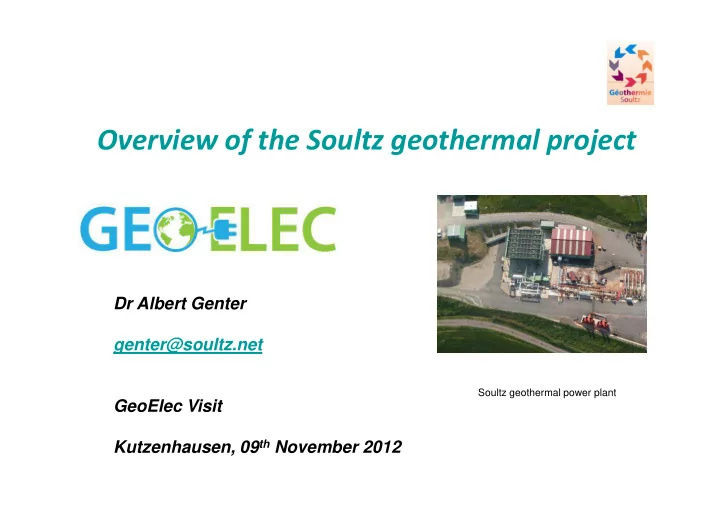
Soultz geothermal power plant
Overview of the Soultz geothermal project Dr Albert Genter - - PowerPoint PPT Presentation
Overview of the Soultz geothermal project Dr Albert Genter genter@soultz.net Soultz geothermal power plant GeoElec Visit Kutzenhausen, 09 th November 2012 OUTLINE Project organization Scientific achievements Technical
Dr Albert Genter genter@soultz.net GeoElec Visit Kutzenhausen, 09th November 2012
Soultz geothermal power plant
3
Soultz Drilling Rig
Hot Dry Rock
EGS
4
Large reservoir with similar fluid composition: open system
Geothermal fluid Artificial heat exchanger
5
Industrial Partners Public Funding Scientific Partners
European Economic Interest Grouping “Exploitation Minière de la Chaleur” GEIE EMC
6
Deep Drilling & Stimulation 29M€ 2001 Phase I 2005 2004 Phase II 2009 Power plant construction 25M€ 2010 Phase III 2012 Scientific and Technical monitoring 5M€
7
Site Selection Drilling Stimulation Testing Concept Build & test power plant Operate and circulation Site abandonment
Fracture on
Concessional scale Borehole Image Micro-seismic cloud structure Power plant exploitation Power plant dismantlement Geothermal Development
Location
Technology
Feed-in tariff
One of the highest geothermal anomaly in Western Europe
8
Sediments Granite
GPK2 GPK1 GPK4 GPK3 Pump
ORC plant Down-hole Pump
9
10
Soultz
Dèzes et al., 2004
11
Soultz Horst Transverse Seismic line Geothermal target is a deep crystalline rock
12
Sediments Granite
Renard & Courrioux, 1994; Valley, 2007
Major fault system in the sediments Need for imaging the deep fractured granite
13
1987 – 1991 Exploration phase 1991 – 1998 Creation of the 2 wells system GPK1/GPK2 at - 3600 m 1999 – 2007 Creation of the 3 wells system GPK2/GPK3/GPK4 at - 5000 m 2007 – 2009 Construction of the first production unit ORC - 1.5 MWe
the 2 wells (4 months)
the 3 wells (5 months)
stimulations (chemical)
equipment (turbine and generator, heat exchangers, cooling systems …)
in GPK2 at - 350 m
power plant 13.06.2008
in GPK4 at - 500m
2010-2012
14
50° C at 400 m depth
15
Core K21, GPK-1 (3510 m) Monzogranite Crystals of FK (1 to 4 cm) Granite matrix: plagioclase, quartz, biotite and hornblende Accessory minerals: magnetite, zircon, apatite, titanite, hematite, leucoxene,
7 cm
16
1mm 50mm
GPK1 well K5-20 GPK1 well K5-20 GPK1 well K19-12
17
1987 – 1991 Exploration phase 1991 – 1998 Creation of the 2 wells system GPK1/GPK2 at - 3600 m 1999 – 2007 Creation of the 3 wells system GPK2/GPK3/GPK4 at - 5000 m 2007 – 2009 Construction of the first production unit ORC - 1.5 MWe
the 2 wells (4 months)
the 3 wells (5 months)
stimulations (chemical)
equipment (turbine and generator, heat exchangers, cooling systems …)
in GPK2 at - 350 m
power plant 13.06.2008
in GPK4 at - 500m
2010-2012
18
19
Since 1987:
BHT=200° C
700m 700m
20
20 40 60 80 100 120 140 160 180 200 220 500 1000 1500 2000 2500 3000 3500 4000 4500 5000 5500 temperature [° C] true vertical depth [m] Temperature Logs Equilibrium GPK-2 GPK-3 GPK-4
Natural circulation within hydrothermally altered and fractured zones
Triassic sandstone Paleozoic granite
Fractured Sandstone Fractured Altered Granite
– Fracture network with borehole image logs – Petrography and hydrothermal alterations with cuttings, cores and geophysical logs analyses
– 2 granites (U/Pb dating) – Normal faults, graben – Fracture zones with low natural permeability
21
Dezayes et al., 2004
– Representative chemical composition: Na-Cl brine, pH ≈ 4.8-5.0 – TDS ≈ 97 g/l and density = 1.065 g/cm3 (20°C)
22
27,5 3,25 6,9 0,125 59,0 0,190 0,085 0,427 0,22 0,45 0,14
0,0 10,0 20,0 30,0 40,0 50,0 60,0
concentration (g/l)
Na K Ca Mg Cl SO4 HCO3 SiO2 Br Sr Li
species
Sanjuan et al., 2008
23
GPK2, 2000 µseismic events M>1 GPK3, 2003 µseismic events M>1 Presure
Time
Dorbath et al., 2009 Cuenot et al., 2008
24
25
Several thousands of microseismic events during each stimulation test Several felt earthquakes (M > 2) Maximum magnitudes
26
growing fear due to:
lots of phone calls (complain or ask for information) complaints to local authorities from individuals or associations articles in local newspapers around 70 complaints for presumed damages, which were evaluated by experts from insurance companies long-term risk of strong opposition to the project
27
100 200 300 400 500 600 700 800 900 1000
07/07/05 27/07/05 16/08/05 05/09/05 25/09/05 15/10/05 04/11/05 24/11/05 14/12/05 03/01/06
Time (days) SN fluorescein concentration (µg/l)
EGI data (Fluorimetry
injection of 150 kg of SN fluorescein dissolved in 950 l of fresh water BRGM data (HPLC)
Inflow of Inflow of geothermal brine geothermal brine
GPK3 GPK4 GPK2Sanjuan et al., 2006
Strong hydraulic dissymetry between GPK3/GPK2 & GPK3/GPK4 70% of external water: open system
28
1987 – 1991 Exploration phase 1991 – 1998 Creation of the 2 wells system GPK1/GPK2 at - 3600 m 1999 – 2007 Creation of the 3 wells system GPK2/GPK3/GPK4 at - 5000 m 2007 – 2009 Construction of the first production unit ORC - 1.5 MWe
the 2 wells (4 months)
the 3 wells (5 months)
stimulations (chemical)
equipment (turbine and generator, heat exchangers, cooling systems …)
in GPK2 at - 350 m
power plant 13.06.2008
in GPK4 at - 500m
2010-2012
29
30
www.geothermie-soultz.fr
31
32
34
35
36
37
Power plant
Max 1,5MWe Organic Rankine Cycle
Geothermal system
Production Well GPK2 26L/s @157°C 19bar
26L/s 13L/s 10L/s
Sediments Granite
GPK2 GPK1 GPK4 GPK3 Pump
38
Corrosion/scaling Down-hole pumps Noise Vibration Natural radioactivity Visual impact Micro-seismicity activity Low pressure re-injection Well production enhancement
39
Micro-seismicity activity Low pressure re-injection Well production enhancement
Physico-chemical monitoring Geothermal fluid Inter-well tracer Micro-seismicity monitoring Tracer modelling In fractured media 3D fault modelling
Longest hydraulic circulation test never done at Soultz: >10 months Low induced micro-seismicity activity Average rate is less than 2 µevents/day from January 2010 Maximum magnitude was 2.3, none felt
40
41
During recent circulation tests, micro-seismicity developed always in the same areas
In green, October events
Induced micro-seismicity activity at depth, December 2009 – August 2010:
43
Field data, Sanjuan, 2011 Tracer modelling Gentier et al., 2011
44
45 83.5% 11.6% 0.76% 0.4% 2.46%
CO2 N2 He H2 CH4
Gas sample collected on February 22, 2011 GLR (Gas Liquid Ratio) = 104% vol. = 0.18% mass δ13C value (-3.9‰) suggests a mixed sedimentary- magmatic CO2 signature Isotopic δD value: - 41.3‰ Isotopic δ18O value: -2.5‰
Closer from the Native Geothermal Brine it remains less than 1% of injected freshwater in February 2011
46
47
Corrosion by-pass Scaling: mineral deposits Heat exchanger Down-hole Pump
Low Temperature Skid : LTS On-going corrosion study at on-site reinjection conditions (70°C) and in laboratory (EIfER) Different steels are currently tested Casing: P110 & N80 Surface pipe: P265GH, P235GH, …
48
Longest on-site corrosion test in reinjection conditions (70° C) between May and October 2010 Corrosion rate ~0.2 mm/year
Designed, constructed & tested in 2008 by GEIE Operational conditions of the LTS: T = 50 - 70˚C P = 20 bar Flow = 0.9 m/s
49
High Temperature Skid (HTS) Designed in 2010 by GEIE In construction since July 2011 First experiments expected in 2012 Operational conditions of the HTS Height: 2.2m, width: 1.5m T = 155 - 165˚C P = 20 bar flow = 2 m/s
Coating experiments
50
N80 coupon Chemical maps
Sr As Pb Ga Ba
Barito-Celestine deposit (Ba,Sr)SO4: Ba, Sr Galena deposit PbS: Pb, As, Ga
51
– Mineralogical and geochemical studies with KIT/EnBW
minerals (other sulfides)
SEM - Microscopy Barite-Celestine dominated. Only traces of sulfides Scaling sample from GPK4 pipe
Geochemical characterization: Trace elements (metals) What are the mineral formation conditions (sulfides) ?
52
without inhibitor
red 5ml blue 5ml
Two products selected An injection system has been designed for doing a test in real operational conditions
53
Hydraulic part of the LSP Damaged impellers cutting samples
54
New screwing tool used for dismantling the production pump
Hydraulic part of the LSP showing a boronized diffusor Production well GPK-2 Technical sketch of the well-head showing the location of the vibration sensors
55
January to April 2011 @ Production well Frequency, Flow rate, Temperature and Pressure August to October 2011 @ Production well Frequency, Flow rate, Temperature and Pressure
56
Noise Vibration Natural radioactivity Visual impact
High speed turbine Air cooling system Geothermal equipment On-site radioprotection measurements
radiation dose values than the production part (high Temp, 160°C)
57
Research study on anti-scalant products Test in real conditions
58
59 GPK1 GPK1 GPK4 GPK4
White compact deposit at 80 m depth View downward of the casing at 194 m depth Very local white deposit at 327 m depth View downward of the casing at 369 m depth
Video tool Data acquisition system
60
61
62
ACCEPTABILITY OF DEEP GEOTHERMAL ENERGY: OPINION SURVEY
Kutzenhausen and Soultz villages Agreement from the 2 mayors Questionnaire with 80 questions 203 interviews
Radioactivity Visual Impact Noise Pollution Sismicity
Positive feed-back from local population
– Landau, Insheim – Bruchsal
63
June 2010
65
Neuchâtel Univ. 14 Sept 2011
66
67