
SLIDE 1
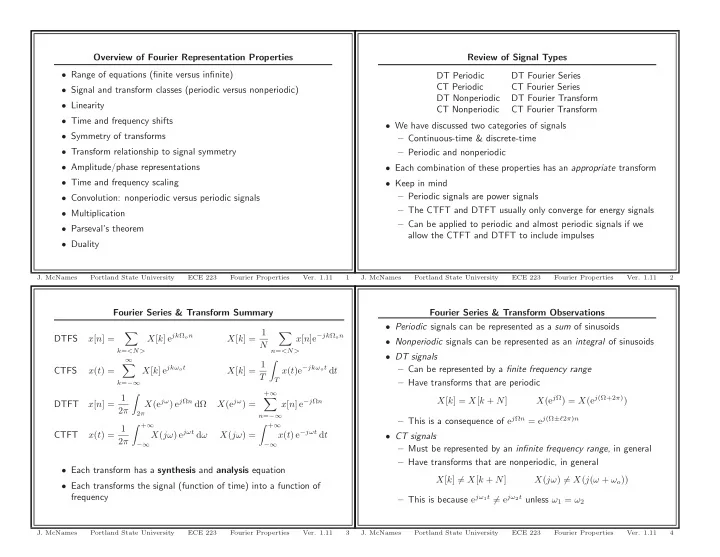
Fourier Series & Transform Summary DTFS x[n] =
- k=<N>
X[k] ejkΩon X[k] = 1 N
- n=<N>
x[n]e−jkΩon CTFS x(t) =
∞
- k=−∞
X[k] ejkωot X[k] = 1 T
- T
x(t)e−jkωot dt DTFT x[n] = 1 2π
- 2π
X(ejω) ejΩn dΩ X(ejω) =
+∞
- n=−∞
x[n] e−jΩn CTFT x(t) = 1 2π +∞
−∞
X(jω) ejωt dω X(jω) = +∞
−∞
x(t) e−jωt dt
- Each transform has a synthesis and analysis equation
- Each transforms the signal (function of time) into a function of
frequency
- J. McNames
Portland State University ECE 223 Fourier Properties
- Ver. 1.11
3
Overview of Fourier Representation Properties
- Range of equations (finite versus infinite)
- Signal and transform classes (periodic versus nonperiodic)
- Linearity
- Time and frequency shifts
- Symmetry of transforms
- Transform relationship to signal symmetry
- Amplitude/phase representations
- Time and frequency scaling
- Convolution: nonperiodic versus periodic signals
- Multiplication
- Parseval’s theorem
- Duality
- J. McNames
Portland State University ECE 223 Fourier Properties
- Ver. 1.11
1
Fourier Series & Transform Observations
- Periodic signals can be represented as a sum of sinusoids
- Nonperiodic signals can be represented as an integral of sinusoids
- DT signals
– Can be represented by a finite frequency range – Have transforms that are periodic X[k] = X[k + N] X(ejΩ) = X(ej(Ω+2π)) – This is a consequence of ejΩn = ej(Ω±ℓ2π)n
- CT signals
– Must be represented by an infinite frequency range, in general – Have transforms that are nonperiodic, in general X[k] = X[k + N] X(jω) = X(j(ω + ωo)) – This is because ejω1t = ejω2t unless ω1 = ω2
- J. McNames
Portland State University ECE 223 Fourier Properties
- Ver. 1.11
4
Review of Signal Types DT Periodic DT Fourier Series CT Periodic CT Fourier Series DT Nonperiodic DT Fourier Transform CT Nonperiodic CT Fourier Transform
- We have discussed two categories of signals
– Continuous-time & discrete-time – Periodic and nonperiodic
- Each combination of these properties has an appropriate transform
- Keep in mind
– Periodic signals are power signals – The CTFT and DTFT usually only converge for energy signals – Can be applied to periodic and almost periodic signals if we allow the CTFT and DTFT to include impulses
- J. McNames
Portland State University ECE 223 Fourier Properties
- Ver. 1.11