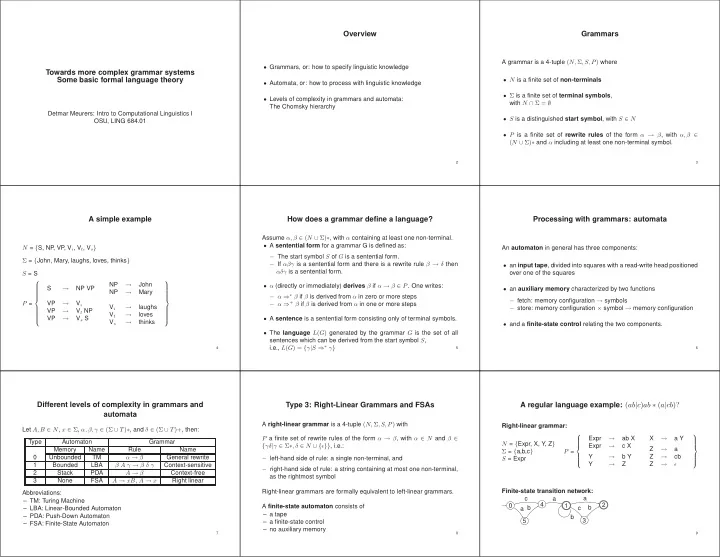

Towards more complex grammar systems Some basic formal language theory
Detmar Meurers: Intro to Computational Linguistics I OSU, LING 684.01
Overview
- Grammars, or: how to specify linguistic knowledge
- Automata, or: how to process with linguistic knowledge
- Levels of complexity in grammars and automata:
The Chomsky hierarchy
2Grammars
A grammar is a 4-tuple (N, Σ, S, P) where
- N is a finite set of non-terminals
- Σ is a finite set of terminal symbols,
with N ∩ Σ = ∅
- S is a distinguished start symbol, with S ∈ N
- P is a finite set of rewrite rules of the form α → β, with α, β ∈
(N ∪ Σ)∗ and α including at least one non-terminal symbol.
3A simple example
N = {S, NP , VP , Vi, Vt, Vs} Σ = {John, Mary, laughs, loves, thinks} S = S P = S → NP VP VP → Vi VP → Vt NP VP → Vs S NP → John NP → Mary Vi → laughs Vt → loves Vs → thinks
4How does a grammar define a language?
Assume α, β ∈ (N ∪ Σ)∗, with α containing at least one non-terminal.
- A sentential form for a grammar G is defined as:
− The start symbol S of G is a sentential form. − If αβγ is a sentential form and there is a rewrite rule β → δ then αδγ is a sentential form.
- α (directly or immediately) derives β if α → β ∈ P. One writes:
− α ⇒∗ β if β is derived from α in zero or more steps − α ⇒+ β if β is derived from α in one or more steps
- A sentence is a sentential form consisting only of terminal symbols.
- The language L(G) generated by the grammar G is the set of all
sentences which can be derived from the start symbol S, i.e., L(G) = {γ|S ⇒∗ γ}
5Processing with grammars: automata
An automaton in general has three components:
- an input tape, divided into squares with a read-write head positioned
- ver one of the squares
- an auxiliary memory characterized by two functions
− fetch: memory configuration → symbols − store: memory configuration × symbol → memory configuration
- and a finite-state control relating the two components.
Different levels of complexity in grammars and automata
Let A, B ∈ N, x ∈ Σ, α, β, γ ∈ (Σ ∪ T)∗, and δ ∈ (Σ ∪ T)+, then: Type Automaton Grammar Memory Name Rule Name Unbounded TM α → β General rewrite 1 Bounded LBA β A γ → β δ γ Context-sensitive 2 Stack PDA A → β Context-free 3 None FSA A → xB, A → x Right linear Abbreviations: – TM: Turing Machine – LBA: Linear-Bounded Automaton – PDA: Push-Down Automaton – FSA: Finite-State Automaton
7Type 3: Right-Linear Grammars and FSAs
A right-linear grammar is a 4-tuple (N, Σ, S, P) with P a finite set of rewrite rules of the form α → β, with α ∈ N and β ∈ {γδ|γ ∈ Σ∗, δ ∈ N ∪ {ǫ}}, i.e.: − left-hand side of rule: a single non-terminal, and − right-hand side of rule: a string containing at most one non-terminal, as the rightmost symbol Right-linear grammars are formally equivalent to left-linear grammars. A finite-state automaton consists of – a tape – a finite-state control – no auxiliary memory
8A regular language example: (ab|c)ab ∗ (a|cb)?
Right-linear grammar: N = {Expr, X, Y, Z} Σ = {a,b,c} S = Expr P = Expr → ab X Expr → c X Y → b Y Y → Z X → a Y Z → a Z → cb Z → ǫ Finite-state transition network: 1 2 3 4 5 b c a a c b a b
9