
SLIDE 1
Overflow Handling
- An overflow occurs when the home bucket for a
new pair (key, element) is full.
- We may handle overflows by:
Search the hash table in some systematic fashion for a bucket that is not full.
- Linear probing (linear open addressing).
- Quadratic probing.
- Random probing.
Eliminate overflows by permitting each bucket to keep a list of all pairs for which it is the home bucket.
- Array linear list.
- Chain.
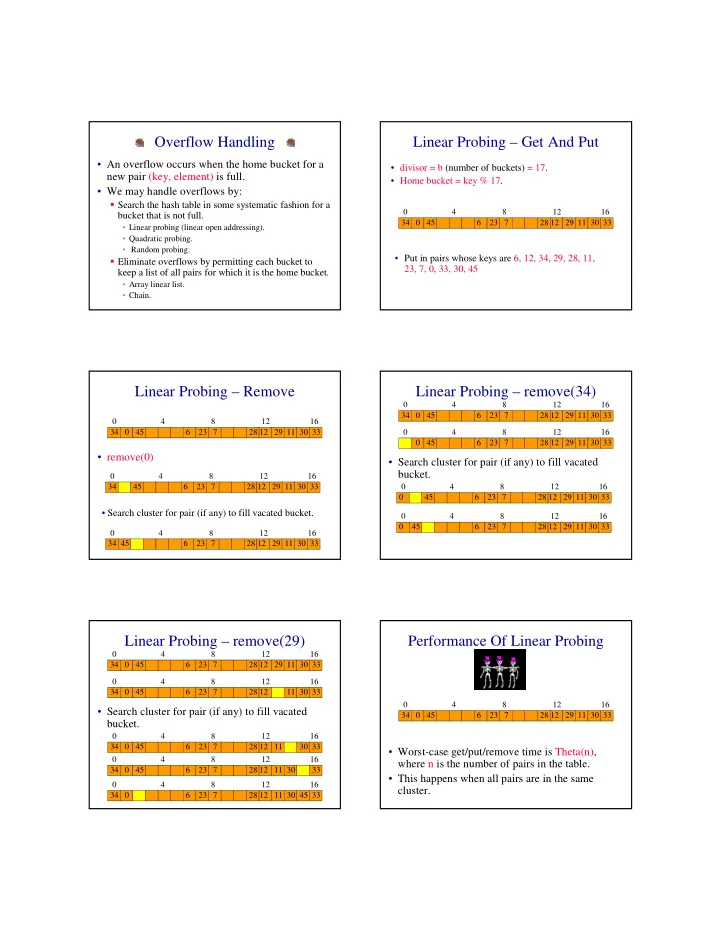
Linear Probing – Get And Put
- divisor = b (number of buckets) = 17.
- Home bucket = key % 17.
4 8 12 16
- Put in pairs whose keys are 6, 12, 34, 29, 28, 11,
23, 7, 0, 33, 30, 45
6 12 29 34 28 11 23 7 33 30 45
Linear Probing – Remove
- remove(0)
4 8 12 16 6 12 29 34 28 11 23 7 33 30 45 4 8 12 16 6 12 29 34 28 11 23 7 45 33 30
- Search cluster for pair (if any) to fill vacated bucket.
4 8 12 16 6 12 29 34 28 11 23 7 45 33 30
Linear Probing – remove(34)
- Search cluster for pair (if any) to fill vacated
bucket.
4 8 12 16 6 12 29 34 28 11 23 7 33 30 45 4 8 12 16 6 12 29 28 11 23 7 33 30 45 4 8 12 16 6 12 29 28 11 23 7 33 30 45 4 8 12 16 6 12 29 28 11 23 7 33 30 45
Linear Probing – remove(29)
- Search cluster for pair (if any) to fill vacated
bucket.
4 8 12 16 6 12 29 34 28 11 23 7 33 30 45 4 8 12 16 6 12 34 28 11 23 7 33 30 45 4 8 12 16 6 12 11 34 28 23 7 33 30 45 4 8 12 16 6 12 11 34 28 23 7 33 30 45 4 8 12 16 6 12 11 34 28 23 7 33 30 45
Performance Of Linear Probing
- Worst-case get/put/remove time is Theta(n),
where n is the number of pairs in the table.
- This happens when all pairs are in the same