
SLIDE 1
GGI workshop 2012 Filip Moortgat (ETH Zurich) 1
GGI workshop
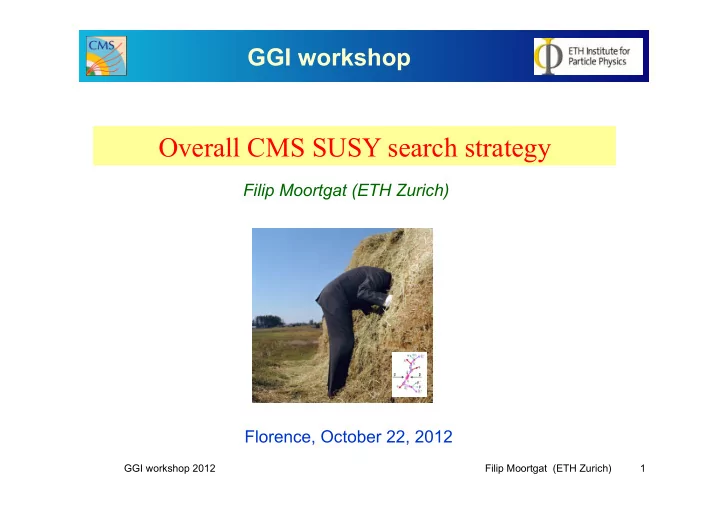
Overall CMS SUSY search strategy
Filip Moortgat (ETH Zurich) Florence, October 22, 2012
Overall CMS SUSY search strategy Filip Moortgat (ETH Zurich) - - PowerPoint PPT Presentation
GGI workshop Overall CMS SUSY search strategy Filip Moortgat (ETH Zurich) Florence, October 22, 2012 GGI workshop 2012 Filip Moortgat (ETH Zurich) 1 Outline Strategy for the first data Assume pair production of colored
GGI workshop 2012 Filip Moortgat (ETH Zurich) 1
Filip Moortgat (ETH Zurich) Florence, October 22, 2012
■ Strategy for the first data ◆ Assume pair production of colored sparticles (squark/gluino) ◆ Wide range of topological searches ◆ Develop data-driven background prediction methods ■ Current focus ◆ Focussed searches for 3rd generation ◆ Focussed searches for charginos/neutralinos/sleptons ■ Near Future ◆ Natural SUSY ◆ Compressed spectra GGI workshop 2012 Filip Moortgat (ETH Zurich) 2
GGI workshop 2012 Filip Moortgat (ETH Zurich) 3
backgrounds All hadronic 1-lepton OS 2-lepton SS 2-lepton ≥ 3-lepton Jets + MET Lepton veto Single lepton + jets + MET Opposite- sign di- lepton + MET Same sign di-lepton + jets + MET Multi-lepton + MET
j j all jets
GGI workshop 2012 Filip Moortgat (ETH Zurich) 4
All hadronic 1-lepton OS 2-lepton SS 2-lepton ≥ 3-lepton 4 separate analyses 5 different analyses 2 analysis inside Z. 3 analyses
4 analyses 2/3 analyses 1-photon 2-photon RPV Long-lived 1 analysis 1 analysis (previously exotica, now SUSY) (Exotica group)
GGI workshop 2012 Filip Moortgat (ETH Zurich) 5
All hadronic 1-lepton OS 2-lepton SS 2-lepton ≥ 3-lepton Jets + MET Lepton veto Single lepton + jets + MET Opposite- sign di- lepton + MET Same sign di-lepton + jets + MET Multi-lepton
GGI workshop 2012 Filip Moortgat (ETH Zurich) 6
j2 / MT ( j1j2)
j2 / ET j1
CMS hadronic searches make use of dedicated kinematic variables in order to suppress QCD
■ Pre-data: strong focus on data-driven background
◆ Not rely on whether the simulation (both MC generators and
detector simulation) would describe the data (cfr. Tevatron)
◆ So be ready with data-driven background prediction methods
prediction of the SM background is reliable
◆ Lead to the development of many, redundant data-driven
background prediction methods
complement each other
■ Currently: MC describes the SM processes well! ◆ Still beware of extreme tails and other delicate predictions
GGI workshop 2012 Filip Moortgat (ETH Zurich) 7
■ Examples of data-driven methods: ◆ Z neutrinos (irreducible bckg.):
use replacement techniques:
1)
Z l+l- + jets: clean (+) but low statistics (-)
2)
W l v + jets: larger stats (+) but selection is not pure (-)
3)
Gamma + jets: very high stats (+) but significant theoretical uncertainties (-)
◆ Top-antitop and W+jets: “lost lepton” method
replace µ by simulated tay decaying hadronically
GGI workshop 2012 Filip Moortgat (ETH Zurich) 8
GGI workshop 2012 Filip Moortgat (ETH Zurich) 9
Search using MHT at 7 TeV Search using MT2 at 7 TeV
GGI workshop 2012 Filip Moortgat (ETH Zurich) 10
All hadronic 1-lepton OS 2-lepton SS 2-lepton ≥ 3-lepton Jets + MET Single lepton + jets + MET Opposite- sign di- lepton + MET Same sign di-lepton + jets + MET Multi-lepton
background prediction method:
GGI workshop 2012 Filip Moortgat (ETH Zurich) 11
Lept. Spectr. method at 7 TeV Lept. Pol. method at 7 TeV
neutrino pT spectra are
polarization effects
fermions; little correlation in large part
GGI workshop 2012 Filip Moortgat (ETH Zurich) 12
GGI workshop 2012 Filip Moortgat (ETH Zurich) 13
All hadronic 1-lepton OS 2-lepton SS 2-lepton ≥ 3-lepton Jets + MET Single lepton + jets + MET Opposite- sign di- lepton + MET Same sign di-lepton + jets + MET Multi-lepton
gluino cascades
Main backgrounds:
■ Backgrounds prediction methods: ◆ Non-prompt leptons
extrapolation in isolation/identification
◆ Charge mis-identification
◆ Rare SM processes
backgrounds
GGI workshop 2012 Filip Moortgat (ETH Zurich) 14
GGI workshop 2012 Filip Moortgat (ETH Zurich) 15
2011 data at 7 TeV 2012 data at 8 TeV
https://twiki.cern.ch/twiki/bin/view/CMSPublic/PhysicsResultsSUS12017
GGI workshop 2012 Filip Moortgat (ETH Zurich) 16
All hadronic 1-lepton OS 2-lepton SS 2-lepton ≥ 3-lepton Jets + MET Single lepton + jets + MET Opposite- sign di- lepton + MET Same sign di-lepton + jets + MET Multi-lepton
background further. Top is now the main background.
endpoint measurements
■ Outside of Z-window: ◆ Use OS – SF subtraction to reject ttbar and all other backgrounds
containing W pairs
■ Inside the Z-window: ◆ Two background prediction methods for Z+jet background:
“JZB” and MET templates from photon+jets
GGI workshop 2012 Filip Moortgat (ETH Zurich) 17
GGI workshop 2012 Filip Moortgat (ETH Zurich) 18
All hadronic 1-lepton OS 2-lepton SS 2-lepton ≥ 3-lepton Jets + MET Single lepton + jets + MET Opposite- sign di- lepton + MET Same sign di-lepton + jets + MET Multi-lepton
GGI workshop 2012 Filip Moortgat (ETH Zurich) 19
GGI workshop 2012 Filip Moortgat (ETH Zurich) 20
GGI workshop 2012 Filip Moortgat (ETH Zurich) 21
LHC @ ~14 TeV
Current LHC limit
(CMS Physics TDR)
GGI workshop 2012 Filip Moortgat (ETH Zurich) 22
e.g.
◆ Branching ratio’s usually assumed to be 100%
quite a drastic assumption
◆ Note that these limits typically hold for low LSP
masses only and all limits disappear if the mass of the LSP is larger than ~450 GeV
◆ So be careful when drawing conclusions on
physics!
GGI workshop 2012 Filip Moortgat (ETH Zurich) 23
■ That was the classic topological strategy ◆ Search for generic jet+MET signatures, containing 0/1/2/3+ leptons ◆ Generic, but often optimized for specific models (CMSSM, SMS) ■ Recently: also more model-specific approach ◆ 3rd generation ◆ EWK production of charginos/neutralinos GGI workshop 2012 Filip Moortgat (ETH Zurich) 24
◆ Light stops/sbottoms ◆ Light higgsinos ◆ Not-too-heavy gluinos
are needed for a natural theory of EWSB
GGI workshop 2012 Filip Moortgat (ETH Zurich) 25
e.g. arXiv:1110.6926
◆ Existing searches are already sensitive
(esp. the ones requiring b-tags)
◆ Add dedicated searches
Two main directions: 1) Gluino production (+ decay into stop-top or sbottom-bottom)
➨ Focus on high jet multiplicity, high #b-jets, …
2) No gluino production, only direct stop/sbottom production
➨ Difficult. Needs customized search strategies.
GGI workshop 2012 Filip Moortgat (ETH Zurich) 26
GGI workshop 2012 Filip Moortgat (ETH Zurich) 27
◆ Hadronic with 0/1/2/3+ b-tags ◆ 2 SS leptons + b-tag
GGI workshop 2012 Filip Moortgat (ETH Zurich) 28
https://twiki.cern.ch/twiki/bin/view/CMSPublic/PhysicsResultsSUS11016
◆ So far have discussed strong production of colored particles ◆ But LHC is starting to also get sensitive to EWK production!
GGI workshop 2012 Filip Moortgat (ETH Zurich) 29
GGI workshop 2012 Filip Moortgat (ETH Zurich) 30
https://twiki.cern.ch/twiki/bin/view/CMSPublic/PhysicsResultsSUS12006
Sometimes maximal HT cut. Often using a b-jet veto.
GGI workshop 2012 Filip Moortgat (ETH Zurich) 31
◆ Depending on the nature of the LSP, single or double photon final
states may dominate:
GGI workshop 2012 Filip Moortgat (ETH Zurich) 32
https://twiki.cern.ch/twiki/bin/view/CMSPublic/PhysicsResultsSUS12018
γ+ MET γγ + MET
■ Many topological searches for new physics at the LHC have
◆ Limits on squarks/gluinos between 800-1200 GeV for light LSP
■ Also some focused search efforts: ◆ First limits on direct EWK chargino/neutralino production ◆ Dedicated 3rd generation searches ongoing ■ Challenges for the future: ◆ 3rd generation (direct stop/sbottom searches) ◆ Compressed spectra (trigger, analysis strategy, …) GGI workshop 2012 Filip Moortgat (ETH Zurich) 33
GGI workshop 2012 Filip Moortgat (ETH Zurich) 34
GGI workshop 2012 Filip Moortgat (ETH Zurich) 35
◆ Many possibilities ◆ Often can reinterpret Exotica analyses:
GGI workshop 2012 Filip Moortgat (ETH Zurich) 36
exclude gluino masses below 460 GeV
Example: gluino to 3 quarks:
◆ Dedicated analyses with 0/1/2 leptons for m(stop) < m(top) as well
as m(stop) > m(top)
GGI workshop 2012 Filip Moortgat (ETH Zurich) 37
GGI workshop 2012 Filip Moortgat (ETH Zurich) 38
GGI workshop 2012 Filip Moortgat (ETH Zurich) 39
GGI workshop 2012 Filip Moortgat (ETH Zurich) 40
ATLAS
GGI workshop 2012 Filip Moortgat (ETH Zurich) 41
GGI workshop 2012 Filip Moortgat (ETH Zurich) 42