1
OVERALL APPROACH Consultation demonstrated support for A clear - - PowerPoint PPT Presentation
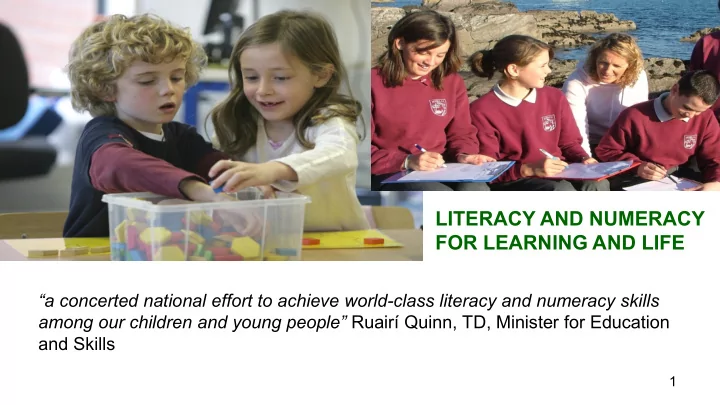
LITERACY AND NUMERACY FOR LEARNING AND LIFE a concerted national effort to achieve world -class literacy and numeracy skills among our children and young people Ruair Quinn, TD, Minister for Education and Skills 1 OVERALL APPROACH
2
OVERALL APPROACH Consultation demonstrated support for…
- A clear emphasis on literacy and numeracy in the educational system
- The importance of L&N for an individual’s personal development, life
chances and prosperity
- Good L&N skills – good for equity and Irish society
- Need to improve literacy and numeracy standards
- A comprehensive approach from early childhood education to end of
schooling
- Making improvements through a broad range of measures in an
integrated way
- Setting of clearly defined targets and identification of definitive actions
3
OVERALL APPROACH The Strategy encompasses…
- Actions relating to
– How we help families and communities to support children’s learning – Improving practice among teachers and early years staff – Enabling principals and deputy principals to lead change and improvement – Making sure curriculum is clear about what we want children and young people to learn – Continued support for students with additional learning needs (special education needs (SEN), high achievers, students for whom English is an additional language (EAL), disadvantaged) – Improving the way we monitor how students learn, using this to inform teaching and improvement
4
EARLY CHILDHOOD AND FAMILIES The Strategy includes:
- National public information campaign – role that
parents/communities can play
- Advice and information for parents
www.helpmykidlearn.ie
- Ensuring school improvement plans incorporate actions
to support effective working relationships with parents
- Better information for parents on children’s progress
5
EARLY CHILDHOOD AND FAMILIES The Strategy includes:
- Ensure teacher education programmes address role of
parents and how to establish and foster home-school relationships
- Encourage schools and libraries to cooperate to support
literacy in families
- D/CYA evaluations of existing initiatives
– Learn from existing initiatives and disseminate practice – Target funding over time
- Pilot joint inspections of Early Childhood Education and
Care provision
6
TEACHERS’ AND EARLY YEARS’ STAFF PROFESSIONAL PRACTICE
Strategy includes:
- Higher entry requirements
- Longer initial teacher education
– 4-year Bachelor of Education – 2-year diploma for primary and post-primary teachers
- Increased time in school-based experience – a
developmental experience
- Major changes to course content to develop student
teachers’ understanding and ability to apply skills in areas such as children’s language acquisition.
7
TEACHERS’ AND ECCE STAFF PROFESSIONAL PRACTICE
Strategy includes:
- Mandatory participation in induction programme
for beginning teachers
- Focussed continuing professional development
for teachers on teaching, learning and assessment of literacy and numeracy as part of
- ngoing professional development requirements
8
SCHOOL LEADERSHIP Strategy includes:
- Improve understanding and ability of principals
and deputy principals to lead improvements in literacy and numeracy
- Targetted professional development for
principals and deputy principals on
– leading improvements in teaching, learning, assessment of literacy and numeracy – Using assessment to inform improved teaching – Effective school self-evaluation
9
CURRICULUM + LEARNING EXPERIENCE Strategy includes
- Revision of English and Irish using learning outcomes
approach (primary and post-primary)
- Supported by examples of what students should be able to
do for English, Irish and Maths – to inform teaching
- Phased revision of curriculum with Irish as L2 to follow
- Principles of Aistear (early years curriculum) to be fully
integrated into early school curriculum
- Make sure reading material addresses range of interests
(including boys) and digital literacy
10
CURRICULUM + LEARNING EXPERIENCE Strategy includes
- Systematic attention to teaching and learning of key
literacy skills, for example…
– Oral and aural skills, phonological/phonemic awareness, word identification, reading fluency, vocabulary, comprehension, writing – Appropriate attention to lower order and higher order skills
- Ensure in all curricular revision that integration of
literacy and numeracy is addressed
- Increase time for literacy and numeracy
11
ADDITIONAL LEARNING NEEDS Strategy includes…
- Commitments to disadvantage supports, SEN and EAL
supports within available resources
- How to address these additional needs – modules in initial
teacher education and teachers’ professional development
- Target support services to designated disadvantage schools
- Disseminate good practice from designated disadvantage
schools that are succeeding
- Ensure schools prioritise assessing, tracking progress of these
students in school self-evaluation
12
ASSESSMENT + EVALUATION Strategy includes
- Learning outcomes + examples of children’s work to
guide teachers’ assessment and teaching – to support assessment for learning
- Standardised testing in reading and mathematics at 2nd ,
4th, 6th class and 2nd year (i.e. at ages 8,10,12 and 14)
- Individual student data to parents
- Better transfer of progress records between schools
- Schools will aggregate data and look at strengths and
areas for improvement
- School self-evaluation: school improvement
13
ASSESSMENT + EVALUATION Strategy includes
- Aggregated data reported to board of management and
to Department annually
- National trends reported from assessments
- Inspection complementing self-evaluation
- National assessments of reading and mathematics
continue at 5-year intervals and extended to post-primary
- International participation and benchmarking
– PISA (Reading, Maths and Science, 15-year olds) – TIMSS (Maths/Science, primary), PIRLS (Reading, Primary)
14
A Framework for Junior Cycle
- A Framework for Junior Cycle
was published by Minister Quinn on 4th October 2012
- Contains radical changes to
how students’ progress and learning are assessed
15
Why Change?
Evidence from Research:
- A significant number of first-year students do not make progress,
particularly in English and Mathematics
- A significant number of students in second year become disengaged from
the learning process and find it almost impossible to re-connect to learning subsequently
- Choices made as early as first year of Junior Cycle (for example to take
Ordinary level rather than Higher Level) are almost impossible to reverse and may limit the options open to young people for the Leaving Certificate and after leaving school. This is a particularly important issue for students in lower stream classes and those in schools serving areas of disadvantage
- In third year, the Junior Certificate examination dominates the experiences
- f students; the focus of learning narrows, the emphasis is on rote learning
and for many students, the examination does not lead to positive learning experiences and outcomes.
16
Components of the Framework
- 8 principles
- 24 statements of learning
– describe what students should know, understand, value and be
able to do
- Key skills
– literacy, numeracy and six other key skills embedded in all syllabuses and short courses
17
Principles
- Quality
- Wellbeing
- Creativity and innovation
- Choice and flexibility
- Engagement and participation
- Inclusive education
- Continuity and development
- Learning to learn
18
Key skills
- Literacy
- Numeracy
- Managing myself
- Staying well
- Communicating
- Being creative
- Working with others
- Managing information and thinking
19
A School Programme: What will it look like?
- A school’s junior cycle programme will
include:
– Range of subjects – Range of short courses – Other learning experiences – Priority Learning Units (PLUs) – for group of students with special educational needs
20
21
Assessment
- Ongoing classroom assessment for learning
providing feedback to students throughout the 3 years
- Standardised testing for all students at end of
second year
– English reading and Mathematics – Irish reading in Irish-medium schools – Science Current Junior Certificate examination phased out and replaced by a school-based assessment over an 8 year period
22
Reporting
- Learning achieved by students recorded and
reported by the school to students and parents in the autumn after 3rd year
A junior cycle achievement profile
- School certificate
– Grades awarded to student in between 8-10 subjects or equivalent
- Achievement profile
– report on other learning experiences and achievements
23
Quality assurance to support new junior cycle
- Subject specifications will contain clear outcomes and examples of
students’ work to illustrate standards for teachers, parents and students
- Comprehensive professional development for teachers
- Professional development for principals in curriculum leadership and
assessment
- New reporting system will encourage generation of evidence of learning
across subjects, short courses and other learning experiences
- Standardised tests – information re students’ learning relative to the
student cohort
- National Council for Curriculum and Assessment moderation and
assessment toolkit
24
Quality assurance at the end of junior cycle
- State examinations Commission (SEC) will provide examination
papers and marking schemes for subjects
- SEC will administer and mark Irish, English and Maths for initial
period
- Internal moderation in schools in accordance with guidance on
moderation – formally confirmed by principal
- Results awarded will be returned to Department of Education and
Skills (DES) – national monitoring of patterns
- DES will provide schools with Data Profile arising from its statistical
analysis – advise the schools of patterns in the school’s data relative to national trends
25
Comments on the Framework – by the Partners and
- thers?
- “Welcome focus on the individual pupil’s learning experience, and the clarity… but need to
develop confidence in new JC as early as possible… needs to be properly supported and resourced if its introduction is to succeed” JMB… and NAPD similar sentiment
- The new system will allow students to develop their creativity and thinking processes ( NPC)
- An overhaul of the current overcrowded, rigid and subject-based curriculum is long overdue
(IBEC)
- Changes “will put students at the centre of their own education …. Has capacity to revolutionise
the educational experience of future second-level students in Ireland …. Result in better learning experiences for students .. Rather than train them for exams” ISSU
- “Move away from content cramming, rote learning and the grind culture is very important”
Scouting Ireland
26
Comments on the Framework by Teacher Unions
- Changes driven by budgetary rather than educational rationale…
disappointed that teachers were not specifically consulted, concerned with move from high stakes exam to an internal school assessment process may reduce public confidence; concerned that schools in advantaged areas will have a distinct advantage over schools in disadvantaged areas; Time, external moderation, CPD and payment where appropriate must be provided; concern about increased workload for teachers … in context of existing cutbacks (TUI)
- Deeply regrettable; ….. Overwhelming consensus that need reform…. But;
J Certificate is “high status”; manner of announcement – without consultation is profoundly disappointing – how can a certificate awarded by a school hold the same status as one awarded by the State (ASTI)
27
What had the media to say on Friday 5th Oct.
- Bold step, a huge advance, change is long overdue,
move away from the grind culture is very positive (Irish
Indo)
- Teachers won’t get extra pay in exam overhaul (Irish Indo)
- Education faces a new test (editorial Irish Indo)
- Radical reform will end “teaching to the test” (Irish Examiner)
- Evidence points to holding low stakes exams, Quinn
says (Irish Times)
- Teachers Unions express concern at proposed reform
(Irish Times)
28
What else had the media to say?
- Dead Certs: Junior exams to be scrapped in 3 years and
replaced with student assessments (Irish Daily Mirror (p2))
- Teachers not told of Junior Cert change: Quinn blasted
- ver lack of consultation (Irish Daily Star (p.12))
- The Sun - nothing
- Teachers Balk at new exams (headline front page)
– Reforming Junior Cert will force us to work longer hours with fewer resources and no promise of a pay rise (sub- headline front
page) (Irish Daily Mail)