Outline: Vergence Eye Movements: Classification I. Describe with 3 - - PowerPoint PPT Presentation

outline vergence eye movements classification i describe
SMART_READER_LITE
LIVE PREVIEW

Outline: Vergence Eye Movements: Classification I. Describe with 3 - - PowerPoint PPT Presentation

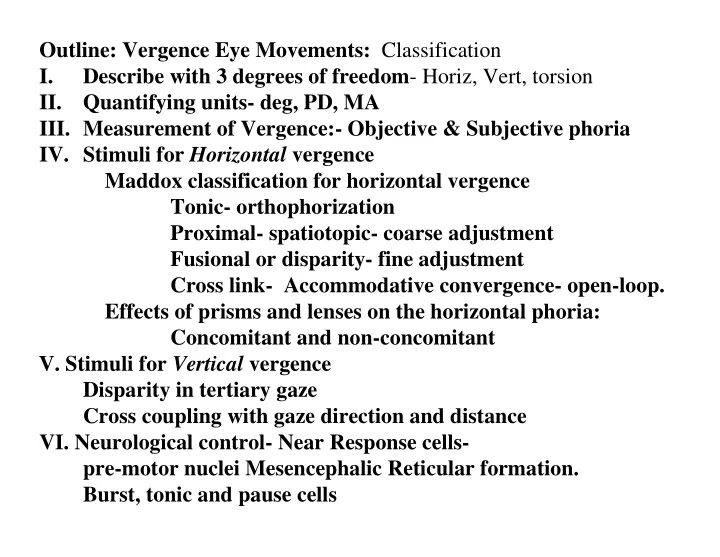
Outline: Vergence Eye Movements: Classification I. Describe with 3 degrees of freedom - Horiz, Vert, torsion II. Quantifying units- deg, PD, MA III. Measurement of Vergence:- Objective & Subjective phoria IV. Stimuli for Horizontal vergence


slide-1
SLIDE 1

Outline: Vergence Eye Movements: Classification I. Describe with 3 degrees of freedom- Horiz, Vert, torsion II. Quantifying units- deg, PD, MA

  • III. Measurement of Vergence:- Objective & Subjective phoria
  • IV. Stimuli for Horizontal vergence

Maddox classification for horizontal vergence Tonic- orthophorization Proximal- spatiotopic- coarse adjustment Fusional or disparity- fine adjustment Cross link- Accommodative convergence- open-loop. Effects of prisms and lenses on the horizontal phoria: Concomitant and non-concomitant

  • V. Stimuli for Vertical vergence

Disparity in tertiary gaze Cross coupling with gaze direction and distance

  • VI. Neurological control- Near Response cells-

pre-motor nuclei Mesencephalic Reticular formation. Burst, tonic and pause cells

slide-2
SLIDE 2

Outline: Vergence Eye Movements I. Describe with 3 degrees of freedom II. Quantifying units

  • III. Measurement

Objective Subjective

  • IV. Maddox classification for horizontal vergence
  • V. Neural control
slide-3
SLIDE 3

Version movement Vergence movement Same direction Opposite direction Conjugate rotation Disjunctive rotation Two classes of binocular eye movements:

slide-4
SLIDE 4

Vergence has three degrees of freedom

slide-5
SLIDE 5

Units for quantifying vergence: 1) Degrees 2) Prism Diopters ( ) = 100 x tan Degrees 3) Meter Angle (MA) = 1/VDm = MA x IPD cm e.g. 15 = 2.5 x 6.0 cm ∆ ∆ ∆ MA units are quantitatively similar to Diopter units of accommodation. MA are independent of the inter-pupillary distance. MA only apply to symmetrical convergence

slide-6
SLIDE 6

p IPD VD ? = 100 x tan p tan p = IPD / VD by substitution ? = 100 X IPD m / VD m ; IPD m X 100 = IPD cm ? = IPD cm / VD m ∆ ∆ ∆ α α α

slide-7
SLIDE 7

Iso-Vergence Circle Iso-Version Lines

Points A and B have the same Vergence angle. So do Points C and D. They lie on an iso- vergence circle Points A and C have the same Version angle. So do Points B and D. Iso-version lines This shows the Iso-Vergence Circle and Iso-Version lines in the visual plane.

A B C D

slide-8
SLIDE 8

Iso-Vergence & Iso-Accommodation Circles

A B C D

Stimuli to accommodation and convergence are not matched in eccentric gaze. Accommodation stimulus increases faster with azimuth than does the vergence stimulus The ideal AC/A decreases w/ azimuth

slide-9
SLIDE 9

Four Maddox Components of Horizontal Vergence

Maddox proposed that horizontal vergence was composed of a linear sum of these four components. 1) Tonic convergence- (Adaptable Resting level) 2) Proximal convergence- (Spatio-topic Gaze shifter) 3) Disparity (fusional) convergence- (Retino-topic Gaze refiner & maintainer) 4) Accommodative convergence (Coordinator of voluntary and involuntary)

slide-10
SLIDE 10

Anatomical Position of rest (APR) = 5 deg divergence

  • ccurs at birth, death, deep anesthesia or deep sleep

Physiological Position of rest (PPR) = approximately zero vergence with far fixation. Tonic vergence moves the eyes from APR to PPR tonic adapts to the PPR during the first 6 weeks of life Distance Phoria = PPR deviation from zero

slide-11
SLIDE 11

Tonic Vergence Estimates:

Anatomical Position of Rest (5 degrees divergence) Physiological Position of rest ( Approximately zero vergence with far fixation) Error of Physiological Position of Rest = Distance Phoria

A n a to m ica l p o sitio n o f re st P h ysio lo gica l p o sitio n of re st To n ic Ve rg e n ce E rro r = fa r ph o ria

slide-12
SLIDE 12

Tonic Vergence estimated from Phoria = Vergence error Phoria = [Vergence Response – Vergence Stimulus (Demand)] Convergence Response (CR) = [Phoria + Vergence Stimulus]

5 PD Eso Phoria 5 PD Exo Phoria Demand = 0 Demand = 15 PD CR = 5 PD CR = 10 PD

Eso + Exo -

slide-13
SLIDE 13

Orthophorization: Distribution of Phorias in the population is not normal, it is peaked near zero. Peaking (kurtosis) results from adaptation. TONIC VERGENCE ESTIMATE Far Phoria Near Phoria

slide-14
SLIDE 14

Phoria Adaptation: concomitant and non-concomitant

Prism adaptation produces concomitant change in phoria Anisometropic spectacle adaptation produces non-concomitant change in phoria. It also compensates for muscle paresis- Spread of Comitance

Solid lines show orthophoric alignment before adaptation Dashed lines show the phoria after adaptation, with right eye occluded

slide-15
SLIDE 15

Prism Adaptation after 5 sec and 60 sec

Vergence Angle Time --> Vergence Angle Time -->

Prism in Prism in Occluder in Occluder in

Horizontal disparity vergence and Prism Adaptation Adaptation occurs in about 60 seconds

slide-16
SLIDE 16

Slow Tonic Vergence Fast Phasic Vergence Model of temporal interactions between phasic and tonic components of vergence

slide-17
SLIDE 17

Subjective measures of vergence using diplopia Red Lens, Maddox Rod, neutralize with prism.

Normally, disparity produces diplopia which is nulled by fusional vergence. Disparity equals the unfused vergence error (phoria). Quantify the phoria by measuring diplopia. Disrupt fusion with a red lens or vertical prism over one eye to produce diplopia. Esophoria is produced by uncrossed disparity Exophoria is produced by crossed disparity Divergence corrects esophoria Convergence corrects exophoria

slide-18
SLIDE 18

Near crossed diplopia- Exo error Far uncrossed diplopia- Eso error Illustration of crossed and uncrossed diplopia

slide-19
SLIDE 19

Un-crossed disparity behind the fixation plane Crossed disparity in front of the fixation plane

slide-20
SLIDE 20
slide-21
SLIDE 21

Diplopia used for subjective measures of vergence error: Fixate the black spot and view the open spot in crossed

  • diplopia. Close left eye and right spot disappears.

Crossed diplopia Fixation point

slide-22
SLIDE 22

Proximal Vergence-Perceptual distance cues for gaze shifts Dynamic gaze-shifting response (analogous to a saccade) Proximal vergence is a voluntary gaze shift from one target distance to another in response to perceived distance. Horizontal proximal vergence is under voluntary control. Vertical and cyclo-vergence are not controlled

  • voluntarily. Instead they are cross-coupled with voluntary

horizontal proximal vergence. And all three vergence directions respond to disparity.

slide-23
SLIDE 23

Three components of disparity vergence stimulated by retinal (disparity) cues. Horizontal vergence – horizontal disparity Vertical vergence – vertical disparity Cyclo vergence- cyclo disparity

slide-24
SLIDE 24

Vertical disparities are produced by near tertiary points in space

slide-25
SLIDE 25

left eye right eye pupil visual target tertiary gaze position

Spatial geometry produces vertical disparity in tertiary directions. Vertical vergence responds even when one eye is occluded. It is cross-coupled with gaze direction and convergence and is part of the near response.

slide-26
SLIDE 26

Two Classes of Dynamic Vergence: 1) Gaze shifting responses to proximal stimuli (saccade like coarse adjustment to perceived distance, refined by disparity vergence) 2) Smooth tracking (pursuit like fine adjustment to perceived motion in depth. It is refined by disparity vergence).

slide-27
SLIDE 27

Disparity vergence response to small step disparity 150 ms latency (half the latency as for accommodation)

slide-28
SLIDE 28

Peak velocity increases proportionally with response size. Velocity is highest at the beginning of the vergence response and it decelerates to the end point.

Vergence step response

slide-29
SLIDE 29

Response velocity is proportional to step disparity stimulus Slope = 5 deg/sec/deg

slide-30
SLIDE 30

Disparity Vergence along the line of sight (Asymmetric vergence) Can we move one eye while the other eye remains still? A B

Hering’s law says we can not.

slide-31
SLIDE 31

Velocity interactions between saccades and vergence

A C D C->A D -> A A->C A->D

slide-32
SLIDE 32
  • !
  • "
  • # $%&%'
  • Saccades increase the velocity of accommodation and shorten latency
slide-33
SLIDE 33

Smooth vergence pursuit tracking with prediction

slide-34
SLIDE 34

Brainstem nuclei for the near response: Supra-oculomotor nucleus

Vergence-related Near-Response cells found here III Nucleus

slide-35
SLIDE 35

Types of vergence cells in Pre-motor nuclei: Superior Oculomotor Nucleus Tonic– Position cells Phasic– Velocity cells

slide-36
SLIDE 36

Phasic or burst (B) and Tonic (T) cells in superior

  • culomotor nucleus

Final common pathway

slide-37
SLIDE 37

Tonic cell coding vergence position activity

slide-38
SLIDE 38

Phasic Velocity Cell: Medial Rectus Motoneuron activity during Convergence

slide-39
SLIDE 39

Lunch time

slide-40
SLIDE 40

Dynamics of Accommodation: Latency (300 ms) & response time (1 sec)