Outline Introduction and Motivation 1 Analysis and Optimization - - PowerPoint PPT Presentation

outline
SMART_READER_LITE
LIVE PREVIEW

Outline Introduction and Motivation 1 Analysis and Optimization - - PowerPoint PPT Presentation

Introduction and Motivation Introduction and Motivation SOAP and XML Benchmarks SOAP and XML Benchmarks Parallel XML Parallel XML Related Work Related Work Conclusions and Future Work Conclusions and Future Work Outline Introduction and


slide-1
SLIDE 1

Introduction and Motivation SOAP and XML Benchmarks Parallel XML Related Work Conclusions and Future Work

Analysis and Optimization for Processing Grid-Scale XML Datasets

Michael R. Head Ph.D. Candidate

Grid Computing Research Laboratory Department of Computer Science Binghamton University

mike@cs.binghamton.edu

Tuesday, May 12, 2009

1 / 52 Introduction and Motivation SOAP and XML Benchmarks Parallel XML Related Work Conclusions and Future Work

Outline

1

Introduction and Motivation

XML and SOAP Ubiquity of Multi-processing Capabilities Contributions

2

SOAP and XML Benchmarks

SOAPBench XMLBench

3

Parallel XML

Investigating System Cache Effects Piximal: Parallel Approach for Processing XML

4

Related Work

5

Conclusions and Future Work

2 / 52 Introduction and Motivation SOAP and XML Benchmarks Parallel XML Related Work Conclusions and Future Work XML and SOAP Ubiquity of Multi-processing Capabilities Contributions Thesis statement

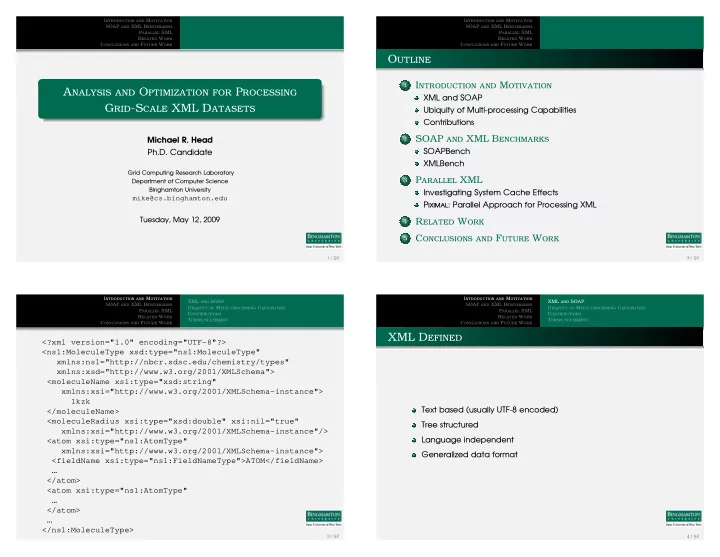
<?xml version="1.0" encoding="UTF-8"?> <ns1:MoleculeType xsd:type="ns1:MoleculeType" xmlns:ns1="http://nbcr.sdsc.edu/chemistry/types" xmlns:xsd="http://www.w3.org/2001/XMLSchema"> <moleculeName xsi:type="xsd:string" xmlns:xsi="http://www.w3.org/2001/XMLSchema-instance"> 1kzk </moleculeName> <moleculeRadius xsi:type="xsd:double" xsi:nil="true" xmlns:xsi="http://www.w3.org/2001/XMLSchema-instance"/> <atom xsi:type="ns1:AtomType" xmlns:xsi="http://www.w3.org/2001/XMLSchema-instance"> <fieldName xsi:type="ns1:FieldNameType">ATOM</fieldName>

...

</atom> <atom xsi:type="ns1:AtomType"

...

</atom>

...

</ns1:MoleculeType>

3 / 52 Introduction and Motivation SOAP and XML Benchmarks Parallel XML Related Work Conclusions and Future Work XML and SOAP Ubiquity of Multi-processing Capabilities Contributions Thesis statement

XML Defined

Text based (usually UTF-8 encoded) Tree structured Language independent Generalized data format

4 / 52

slide-2
SLIDE 2

Introduction and Motivation SOAP and XML Benchmarks Parallel XML Related Work Conclusions and Future Work XML and SOAP Ubiquity of Multi-processing Capabilities Contributions Thesis statement

Motivation from SOAP

Generalized RPC mechanism (supports other models, too) Broad industrial support Web Services on the Grid

OGSA: Open Grid Services Architecture WSRF: Web Services Resource Framework

At bottom, SOAP depends on XML

5 / 52 Introduction and Motivation SOAP and XML Benchmarks Parallel XML Related Work Conclusions and Future Work XML and SOAP Ubiquity of Multi-processing Capabilities Contributions Thesis statement

Importance of High Performance XML Processors

Becoming standard for many scientific datasets

HapMap - mapping genes Protein Sequencing NASA astronomical data Many more instances

6 / 52 Introduction and Motivation SOAP and XML Benchmarks Parallel XML Related Work Conclusions and Future Work XML and SOAP Ubiquity of Multi-processing Capabilities Contributions Thesis statement

Explosion of Data

Enormous increase in data from sensors, satellites, experiments, and simulations∗ Use of XML to store these data is also on the rise XML is in use in ways it was never really intended (GB and large size files)

7 / 52 Introduction and Motivation SOAP and XML Benchmarks Parallel XML Related Work Conclusions and Future Work XML and SOAP Ubiquity of Multi-processing Capabilities Contributions Thesis statement

Benchmark Motivation

Scientific applications place a wide range of requirements on the communication substrate and data formats. Simple and straightforward implementations can have a severe performance impact.

8 / 52

slide-3
SLIDE 3

Introduction and Motivation SOAP and XML Benchmarks Parallel XML Related Work Conclusions and Future Work XML and SOAP Ubiquity of Multi-processing Capabilities Contributions Thesis statement

Prevalence of Parallel Machines

All new high end and mid range CPUs for desktop- and laptop-class computers have at least two cores The future of AMD and Intel performance lies in increases in the number of cores Despite extant SMP machines, many classes of software applications remain single threaded

Multi-threaded programming considered ‘‘hard’’

9 / 52 Introduction and Motivation SOAP and XML Benchmarks Parallel XML Related Work Conclusions and Future Work XML and SOAP Ubiquity of Multi-processing Capabilities Contributions Thesis statement

XML and Multi-Core

Most string parsing techniques rely on a serial scanning process Challenge: Existing (singly-threaded) XML parsers are already very efficient [Zhang et al 2006]

10 / 52 Introduction and Motivation SOAP and XML Benchmarks Parallel XML Related Work Conclusions and Future Work XML and SOAP Ubiquity of Multi-processing Capabilities Contributions Thesis statement

Contributions

We present the design and implementation of a comprehensive benchmark suite for XML and SOAP implementations with standard mechanisms to quantify, compare, and evaluate the performance of each toolkit and study the strengths and weaknesses for a wide range of use case scenarios. We present an analysis of pre-fetching and piped implementation techniques that aim to offset disk I/O costs while processing large-scale XML datasets on multi-core CPU architectures.

11 / 52 Introduction and Motivation SOAP and XML Benchmarks Parallel XML Related Work Conclusions and Future Work XML and SOAP Ubiquity of Multi-processing Capabilities Contributions Thesis statement

Contributions Continued

We propose techniques to modify the lexical analysis phase for processing large-scale XML datasets to leverage opportunities for

  • parallelism. (Piximal)

We present an analysis of the scalability that can be achieved with our proposed parallelization approach as the number of processing threads and size of XML-data is increased. We present an analysis on the usage of various states in the processing automaton to provide insights on why the performance varies for differently shaped input data files.

12 / 52

slide-4
SLIDE 4

Introduction and Motivation SOAP and XML Benchmarks Parallel XML Related Work Conclusions and Future Work XML and SOAP Ubiquity of Multi-processing Capabilities Contributions Thesis statement

Publications

‘‘A Benchmark Suite for SOAP-based Communication in Grid Web Services,’’ in The Proceedings of Supercomputing 2005 ‘‘Benchmarking XML Processors for Applications in Grid Web Services,’’ in The Proceedings of Supercomputing 2006 ‘‘Approaching a Parallelized XML Parser Optimized for Multi-Core Processors,’’ in The Proceedings of SOCP 2007, workshop held in conjunction with HPDC 2007 ‘‘Parallel Processing of Large-Scale XML-Based Application Documents on Multi-core Architectures with PiXiMaL,’’ in The Proceedings e-Science 2008 ‘‘Performance Enhancement with Speculative Execution Based Parallelism for Processing Large-scale XML-based Application Data,’’ to appear in The Proceedings of HPDC 2009

13 / 52 Introduction and Motivation SOAP and XML Benchmarks Parallel XML Related Work Conclusions and Future Work XML and SOAP Ubiquity of Multi-processing Capabilities Contributions Thesis statement

Thesis Statement

In this thesis we present a comprehensive benchmark suite that facilitates the study of the strengths and weaknesses of XML and SOAP toolkits for a wide range of use case scenarios. We propose a parallel processing model for some application-based large-scale XML datasets that can effectively leverage opportunities for parallelism in emerging multi-core CPU architectures.

14 / 52 Introduction and Motivation SOAP and XML Benchmarks Parallel XML Related Work Conclusions and Future Work SOAPBench XMLBench

SOAP Benchmark Suite

Defines a set of operations to implement within a SOAP toolkit Tests both serialization and deserialization of a variety of data structures over a range of input sizes

Simple types: integers, strings, and floats Base64 encoded data Complex types: event streams, mesh interface objects

15 / 52 Introduction and Motivation SOAP and XML Benchmarks Parallel XML Related Work Conclusions and Future Work SOAPBench XMLBench

XML Benchmark Suite

1

A chosen set of XML documents

Low level probes Application-based benchmarks

2

A driver application for each XML processor

Runs the parser on the input, but does not act on the data

Eliminates application-level performance differences One for each interface style (SAX/DOM)

16 / 52

slide-5
SLIDE 5

Introduction and Motivation SOAP and XML Benchmarks Parallel XML Related Work Conclusions and Future Work Investigating System Cache Effects Piximal: Parallel Approach for Processing XML Memory Bandwidth Test State Scalability Test Serial NFA Tests

Readahead/Runahead

Explore OS level caching effects Offload disk input to another thread/core Improved the performance of an existing high performance parser by using a separate thread to read the input into cache

17 / 52 Introduction and Motivation SOAP and XML Benchmarks Parallel XML Related Work Conclusions and Future Work Investigating System Cache Effects Piximal: Parallel Approach for Processing XML Memory Bandwidth Test State Scalability Test Serial NFA Tests

Token-Scanning With a DFA

DFA-based table-driven scanning is both popular and fast

(or at least performance-competitive with other techniques)

Input is read sequentially from start to finish

Each character is used to transition over states in a DFA Transition may have associated actions

Supports languages that are not ‘‘regular’’

Commonly used in high performance XML parsers, such as TDX (C) and Piccolo (Java)

Amenable to SAX parsing Piximal-DFA uses this approach

18 / 52 Introduction and Motivation SOAP and XML Benchmarks Parallel XML Related Work Conclusions and Future Work Investigating System Cache Effects Piximal: Parallel Approach for Processing XML Memory Bandwidth Test State Scalability Test Serial NFA Tests

DFA Used in Piximal-DFA

1 2 3 4 5 6 7 8 9 10 whitespace ’<’ ’/’ name start ’>’ whitespace name char ’=’ name char ’"’ whitespace ’"’ not ’<’ or ’&’ whitespace name char ’>’ ’<’ char data name start name char space ’>’

19 / 52 Introduction and Motivation SOAP and XML Benchmarks Parallel XML Related Work Conclusions and Future Work Investigating System Cache Effects Piximal: Parallel Approach for Processing XML Memory Bandwidth Test State Scalability Test Serial NFA Tests

Parallel Scanning With a DFA?

DFA-based scanning =⇒ sequential operation Desire: run multiple, concurrent DFAs throughout the input

Generally not possible because the start state would be unknown

20 / 52

slide-6
SLIDE 6

Introduction and Motivation SOAP and XML Benchmarks Parallel XML Related Work Conclusions and Future Work Investigating System Cache Effects Piximal: Parallel Approach for Processing XML Memory Bandwidth Test State Scalability Test Serial NFA Tests

Overcoming Sequentiality With an NFA

Problem: start state is unknown Solution: assume every possible state is a start state

Construct an NFA from the DFA used in Piximal-DFA Such an NFA can be applied on any substring of the input

Piximal-NFA is the parser that does all of this:

Partition input into segments Run Piximal-DFA on the initial segment Run NFA-based parsers on subsequent partition elements Fix up transitions at partition boundaries and run queued actions

21 / 52 Introduction and Motivation SOAP and XML Benchmarks Parallel XML Related Work Conclusions and Future Work Investigating System Cache Effects Piximal: Parallel Approach for Processing XML Memory Bandwidth Test State Scalability Test Serial NFA Tests

Piximal-NFA’s Parameters

split_percent:

The portion of input to be dedicated to the first element of the partition, expressed as a percentage of the total input length

number_of_threads:

The number of threads to use on a run

22 / 52 Introduction and Motivation SOAP and XML Benchmarks Parallel XML Related Work Conclusions and Future Work Investigating System Cache Effects Piximal: Parallel Approach for Processing XML Memory Bandwidth Test State Scalability Test Serial NFA Tests

Preliminary Research Questions

Is there enough memory bandwidth to allow multiple automata to concurrently feed each thread its input? Processing each character along several paths through the NFA is costly: how does this work scale with the size of the initial DFA?

(E-science 2008)

Does the overhead of queuing the NFA actions cost an acceptable amount compared with the cost of DFA-parsing the first partition element?

(HPDC 2009)

23 / 52 Introduction and Motivation SOAP and XML Benchmarks Parallel XML Related Work Conclusions and Future Work Investigating System Cache Effects Piximal: Parallel Approach for Processing XML Memory Bandwidth Test State Scalability Test Serial NFA Tests

Memory Bandwidth Test

Models the work of partitioning the input the way Piximal-NFA does

File I/O is via mmap(2)

A thread is created for each partition element which accumulates each character A variety of split_percents and number_of_thread are chosen

Total time to read a large input a fixed number of times is measured Input file is SwissProt.xml, which is 109 MB in size

24 / 52

slide-7
SLIDE 7

Introduction and Motivation SOAP and XML Benchmarks Parallel XML Related Work Conclusions and Future Work Investigating System Cache Effects Piximal: Parallel Approach for Processing XML Memory Bandwidth Test State Scalability Test Serial NFA Tests

Memory Bandwidth Test – Experimental Setup

Run several machines, each from a homogeneous class running 64-bit versions of Linux 2× uniprocessor: 3.2 Ghz Intel Xeon (uniprocessor), 4 GB

RAM, Linux kernel 2.6.15, GNU Lib C 2.3.6, GCC 4.0.3

2× dual core: 2.66 Ghz Intel Xeon 5150 (dual core) CPUs, 8

GB RAM, Linux kernel 2.6.18, GNU Lib C 2.3.6, GCC 4.1.2

2× quad core: 2.33 Ghz Intel Xeon E5354 (quad-core) CPUs, 8

GB RAM, Linux kernel 2.6.18, GNU Lib C 2.3.6, GCC 4.1.2

4 nodes used from the 2× UP cluster, 10 from each of the other two Results for each class are averaged across all runs

25 / 52 Introduction and Motivation SOAP and XML Benchmarks Parallel XML Related Work Conclusions and Future Work Investigating System Cache Effects Piximal: Parallel Approach for Processing XML Memory Bandwidth Test State Scalability Test Serial NFA Tests

Bandwidth is Not a Bottleneck Up to 6 Cores

2 3 4 5 6 7 8 1.0 1.5 2.0 2.5 3.0 3.5 Number of threads Speedup

  • # cores (split %)

2 ( 52 % ) 4 ( 28 % ) 8 ( 12 % )

26 / 52 Introduction and Motivation SOAP and XML Benchmarks Parallel XML Related Work Conclusions and Future Work Investigating System Cache Effects Piximal: Parallel Approach for Processing XML Memory Bandwidth Test State Scalability Test Serial NFA Tests

Conclusions From Memory Bandwidth Tests

Even when doing very little per-character processing, performance gains possible by adding threads Returns do diminish rapidly More cores lead to smoother results

27 / 52 Introduction and Motivation SOAP and XML Benchmarks Parallel XML Related Work Conclusions and Future Work Investigating System Cache Effects Piximal: Parallel Approach for Processing XML Memory Bandwidth Test State Scalability Test Serial NFA Tests

State Scalability Test

Models the additional work done by the NFA threads by following multiple execution paths through the table Each NFA thread now must remember the state and calculate the next state for each character and for each start state

The DFA need only remember and calculate one state per input character

Does not model the memory used, actions stored, or garbage state elimination Goal: to find a balance point for DFA size + increased complexity of the recognized language − more work for the NFA to do, more space required for table

28 / 52

slide-8
SLIDE 8

Introduction and Motivation SOAP and XML Benchmarks Parallel XML Related Work Conclusions and Future Work Investigating System Cache Effects Piximal: Parallel Approach for Processing XML Memory Bandwidth Test State Scalability Test Serial NFA Tests

2× DC

2.0 2.5 3.0 3.5 4.0 0.5 1.0 1.5 2.0 2.5 3.0 Number of Threads Speedup

  • DFA state size (w/split %)

2 states, 28 % 4 states, 32 % 6 states, 36 % 8 states, 56 % 10 states, 60 % 12 states, 64 %

29 / 52 Introduction and Motivation SOAP and XML Benchmarks Parallel XML Related Work Conclusions and Future Work Investigating System Cache Effects Piximal: Parallel Approach for Processing XML Memory Bandwidth Test State Scalability Test Serial NFA Tests

2× QC – Best Speedup for DFA Sizes

2 3 4 5 6 7 8 1 2 3 4 5 Number of Threads Speedup

  • DFA state size (w/split %)

2 states, 12 % 4 states, 16 % 6 states, 20 % 8 states, 36 % 10 states, 40 % 12 states, 40 %

30 / 52 Introduction and Motivation SOAP and XML Benchmarks Parallel XML Related Work Conclusions and Future Work Investigating System Cache Effects Piximal: Parallel Approach for Processing XML Memory Bandwidth Test State Scalability Test Serial NFA Tests

Conclusions From State Scalability Test

The extra work of pushing characters through the multiple execution paths of the NFA is not in itself a limiting factor There is a ‘‘sweet spot’’ for DFA size: around 6-7 states which allows for the greatest language complexity and the best scalability

This is a crossover point where the O(N) extra NFA work overcomes the the O(1) work of simply reading the input

31 / 52 Introduction and Motivation SOAP and XML Benchmarks Parallel XML Related Work Conclusions and Future Work Investigating System Cache Effects Piximal: Parallel Approach for Processing XML Memory Bandwidth Test State Scalability Test Serial NFA Tests

Serial NFA Tests

Test hypothesis: the extra work required by using an NFA is offset by dividing processing work across multiple threads Run each automaton-parser sequentially and independently Divide the work as usual, with a range of split_percents and number_of_threads Time each component independently Completely parses the input, generating the correct sequence of SAX events The maximum time for all components to complete (plus fix up time) represents an upper bound on the time Piximal-NFA would take with components running concurrently

32 / 52

slide-9
SLIDE 9

Introduction and Motivation SOAP and XML Benchmarks Parallel XML Related Work Conclusions and Future Work Investigating System Cache Effects Piximal: Parallel Approach for Processing XML Memory Bandwidth Test State Scalability Test Serial NFA Tests

Differences From Previous Tests

Entirely sequential (no concurrency) Full XML parsing takes place Input file is different

‘‘Interop’’ test from SOAPBench and XMLBench SOAP-encoded arrays of various data types: integers, strings, and MIOs Array size is scaled between 10 and 50,000 elements for each type

33 / 52 Introduction and Motivation SOAP and XML Benchmarks Parallel XML Related Work Conclusions and Future Work Investigating System Cache Effects Piximal: Parallel Approach for Processing XML Memory Bandwidth Test State Scalability Test Serial NFA Tests

Modest Speedup Scalability for 10,000 Integers

2 3 4 5 6 7 8 0.0 0.5 1.0 1.5 2.0 2.5 Thread Count Potential Speedup Max Speedup Mean Speedup Min Speedup

34 / 52 Introduction and Motivation SOAP and XML Benchmarks Parallel XML Related Work Conclusions and Future Work Investigating System Cache Effects Piximal: Parallel Approach for Processing XML Memory Bandwidth Test State Scalability Test Serial NFA Tests

Split_Percent Critical for Speedup for 10,000 Integers

20 40 60 80 100 0.0 0.5 1.0 1.5 2.0 2.5 3.0 3.5 Split Percent Potential Speedup Max Speedup Mean Speedup Min Speedup

35 / 52 Introduction and Motivation SOAP and XML Benchmarks Parallel XML Related Work Conclusions and Future Work Investigating System Cache Effects Piximal: Parallel Approach for Processing XML Memory Bandwidth Test State Scalability Test Serial NFA Tests

Inconsistent Speedup Over a Range of Array Lengths

10000 20000 30000 40000 50000 0.0 0.5 1.0 1.5 2.0 2.5 Array Size Potential Speedup Max Speedup Mean Speedup Min Speedup

36 / 52

slide-10
SLIDE 10

Introduction and Motivation SOAP and XML Benchmarks Parallel XML Related Work Conclusions and Future Work Investigating System Cache Effects Piximal: Parallel Approach for Processing XML Memory Bandwidth Test State Scalability Test Serial NFA Tests

Characters in 10,000 Integers in a Range of States

1 2 3 4 5 6 7 8 9 10 DFA State Frequency 20000 40000 60000

37 / 52 Introduction and Motivation SOAP and XML Benchmarks Parallel XML Related Work Conclusions and Future Work Investigating System Cache Effects Piximal: Parallel Approach for Processing XML Memory Bandwidth Test State Scalability Test Serial NFA Tests

Conclusions From Integer Results

Speedup is possible in this case Choice of split point is critical for achieving any speedup at all Characters in content sections account for roughly 60% of the input characters Input is 117 KB in length Consists mainly of

...<i>1234</i><i>1235</i><i>1236</i>...

38 / 52 Introduction and Motivation SOAP and XML Benchmarks Parallel XML Related Work Conclusions and Future Work Investigating System Cache Effects Piximal: Parallel Approach for Processing XML Memory Bandwidth Test State Scalability Test Serial NFA Tests

Speedup Improves with Thread_Count for 10,000 Strings

2 3 4 5 6 7 8 0.0 0.5 1.0 1.5 2.0 2.5 3.0 3.5 Thread Count Potential Speedup Max Speedup Mean Speedup Min Speedup

39 / 52 Introduction and Motivation SOAP and XML Benchmarks Parallel XML Related Work Conclusions and Future Work Investigating System Cache Effects Piximal: Parallel Approach for Processing XML Memory Bandwidth Test State Scalability Test Serial NFA Tests

Split_Percent Less Critical for 10,000 Strings

20 40 60 80 100 0.0 0.5 1.0 1.5 2.0 2.5 3.0 3.5 Split Percent Potential Speedup Max Speedup Mean Speedup Min Speedup

40 / 52

slide-11
SLIDE 11

Introduction and Motivation SOAP and XML Benchmarks Parallel XML Related Work Conclusions and Future Work Investigating System Cache Effects Piximal: Parallel Approach for Processing XML Memory Bandwidth Test State Scalability Test Serial NFA Tests

Consistent Speedup Over a Range of Input Sizes

10000 20000 30000 40000 50000 0.0 0.5 1.0 1.5 2.0 2.5 3.0 3.5 Array Size Potential Speedup Max Speedup Mean Speedup Min Speedup

41 / 52 Introduction and Motivation SOAP and XML Benchmarks Parallel XML Related Work Conclusions and Future Work Investigating System Cache Effects Piximal: Parallel Approach for Processing XML Memory Bandwidth Test State Scalability Test Serial NFA Tests

Characters in 10,000 Strings are Mainly in Content

1 2 3 4 5 6 7 8 9 10 DFA State Frequency 400000 800000 1200000

42 / 52 Introduction and Motivation SOAP and XML Benchmarks Parallel XML Related Work Conclusions and Future Work Investigating System Cache Effects Piximal: Parallel Approach for Processing XML Memory Bandwidth Test State Scalability Test Serial NFA Tests

Conclusions from String Results

This sort of input is much more amenable to this approach

In maximum potential speedup achieved In number of cases where speedup is > 1

Split point is much less important here Characters in content sections account for roughly 99% of the input characters Input is 1.4 MB in size (though similar results are seen in inputs that are 117 KB) Consists mainly of ...<i>String content for the array

element number 0. This is long to test the hypothesis that longer content sections are better for the NFA.</i>...

43 / 52 Introduction and Motivation SOAP and XML Benchmarks Parallel XML Related Work Conclusions and Future Work Investigating System Cache Effects Piximal: Parallel Approach for Processing XML Memory Bandwidth Test State Scalability Test Serial NFA Tests

Conclusions from Serial NFA Test

Shape of the input strongly determines the efficacy of the Piximal approach

MIO has similar state usage and mix of content and tags as the integer and Piximal has a similar performance profile there Piximal works well on inputs with longer content sections punctuated by short tags

Starting in a content section helps because the ‘<’ character eliminates a large number of execution paths through the NFA

If ‘>’ could be treated similarly by the parser, starting in a tag would be less harmful

44 / 52

slide-12
SLIDE 12

Introduction and Motivation SOAP and XML Benchmarks Parallel XML Related Work Conclusions and Future Work Investigating System Cache Effects Piximal: Parallel Approach for Processing XML Memory Bandwidth Test State Scalability Test Serial NFA Tests

PXML: A Better Language for Piximal

Goal: Improve Piximal performance Reduce DFA size Increase the number of paths that lead to contradictions Restrict XML (as supported in Piximal) in the following ways: Disallow attributes: Transform into nested elements Disallow whitespace in tags: Without attributes, these are completely unnecessary Disallow ‘>’ in content sections: Unnecessary in any case Ignore distinction between characters that start a name and the rest

45 / 52 Introduction and Motivation SOAP and XML Benchmarks Parallel XML Related Work Conclusions and Future Work Investigating System Cache Effects Piximal: Parallel Approach for Processing XML Memory Bandwidth Test State Scalability Test Serial NFA Tests

DFA For Piximal-PXML

1 2 3 4 Whitespace ’<’ ’<’ ’/’ name character ’>’ ’>’ name character character data name character 46 / 52 Introduction and Motivation SOAP and XML Benchmarks Parallel XML Related Work Conclusions and Future Work Related Work

Related Work in High Performance XML Processing

Look-aside buffers/String caching [gsoap, XPP] Trie data structure with schema-specific parser [Chiu et al 02, Engelen

04]

One pass table-driven recursive descent parser [Zhang et al 2006] Pre-scan and schedule parser [Lu et al 2006] Parallelized scanner, scheduled post-parser [Pan et al 2007]

47 / 52 Introduction and Motivation SOAP and XML Benchmarks Parallel XML Related Work Conclusions and Future Work Final Conclusions

Conclusions

Existing XML and SOAP toolkits make limited use of multiple cores Scientific applications strain existing XML infrastructure Pre-caching mechanisms can improve performance of existing parsers A parallel parsing approach is necessary to achieve increased parser performance as document sizes grow 5-6 states is a good size for a Piximal DFA Restricting XML slightly should provide better performance at a low semantic cost Piximal’s applicability is dependent on the characteristics of the input file

48 / 52

slide-13
SLIDE 13

Introduction and Motivation SOAP and XML Benchmarks Parallel XML Related Work Conclusions and Future Work Final Conclusions

Limitations

PThread overhead during concurrent runs Restrictions on XML format

Namespaces CDATA Unicode Processing Instructions Validation

Optimal splitting algorithm unknown

49 / 52 Introduction and Motivation SOAP and XML Benchmarks Parallel XML Related Work Conclusions and Future Work Final Conclusions

Summary

1

Introduction and Motivation

XML and SOAP Ubiquity of Multi-processing Capabilities Contributions

2

SOAP and XML Benchmarks

SOAPBench XMLBench

3

Parallel XML

Investigating System Cache Effects Piximal: Parallel Approach for Processing XML

4

Related Work

5

Conclusions and Future Work

50 / 52 Introduction and Motivation SOAP and XML Benchmarks Parallel XML Related Work Conclusions and Future Work Final Conclusions

Thank you for your time.

51 / 52 Introduction and Motivation SOAP and XML Benchmarks Parallel XML Related Work Conclusions and Future Work Final Conclusions

Questions?

52 / 52

slide-14
SLIDE 14

Appendix Discussion of Proposed Work Other additional slides XMLBench Parallel XML Comparison with Expat and TCMalloc

Extra Slides

The following slides are additional and not part of the presentation.

53 / 52 Appendix Discussion of Proposed Work Other additional slides XMLBench Parallel XML Comparison with Expat and TCMalloc

Proposed Work

Re-run benchmarks, normalize analysis and plotting SOAPBench and XMLBench results should be re-run. Plots should be rebuilt to match the rest of the figures. XMLBench is available for researchers to download and use SOAPBench is available, but cannot support all the tested SOAP toolkits due to their proprietary nature Analyze a broader range of data from the serial NFA test The serial NFA tests show a small portion of the data collected in that

  • test. There is a wealth of information to uncover about the efficacy of

this approach in the data. Data and analysis is available in our repository and will be posted to a web site shortly

54 / 52 Appendix Discussion of Proposed Work Other additional slides XMLBench Parallel XML Comparison with Expat and TCMalloc

Proposed Work Continued

Investigate memory allocation issues Heap contention is a well known problem for applications with concurrent memory allocations. We plan to investigate the effect of a variety of allocators on Piximal. During Piximal development, we encountered some issues involving the the performance of malloc once a thread (even a thread with an empty start_routine) was created. We plan to investigate and report on this in detail. Have initial results (HPDC 2009), potential for broader investigation remains

55 / 52 Appendix Discussion of Proposed Work Other additional slides XMLBench Parallel XML Comparison with Expat and TCMalloc

Proposed Work Continued

Define characteristics of a restricted subset of XML documents: “PXML” Based on the above results, we can design a language which works best with Piximal-NFA. Potential targets include eliminating ‘>’ from content sections, removing CDATA sections, disallowing extra whitespace in tags, and perhaps eliminating attributes altogether. Briefly described in Chapter 5, Section 4 of the thesis document A formal grammar was not considered necessary for the scope of the thesis

56 / 52

slide-15
SLIDE 15

Appendix Discussion of Proposed Work Other additional slides XMLBench Parallel XML Comparison with Expat and TCMalloc

Overcoming Sequentiality With an NFA

Problem: start state is unknown Solution: assume every possible state is a start state

Construct an NFA from the DFA used in Piximal-DFA

1

Mark every state as a start state

2

Remove all the garbage state and all transitions to it

3

Create an queue for each start state to store actions that should be performed

Such an NFA can be applied on any substring of the input

Piximal-NFA is the parser that does all of this:

Partition input into segments Run Piximal-DFA on the initial segment Run NFA-based parsers on subsequent partition elements Fix up transitions at partition boundaries and run queued actions

57 / 52 Appendix Discussion of Proposed Work Other additional slides XMLBench Parallel XML Comparison with Expat and TCMalloc

Piximal-DFA Implementation Details

mmap(2)s input file to save memory

Uses {length, pointer} string representation

Strings (for tagnames, attribute values) point into the mapped memory All the way through the SAX-style event interface

DFA is encoded as two tables

Table of ‘‘next’’ state numbers indexed by state number and input character Table of boolean ‘‘action required’’ indicators indexed by ‘‘current’’ state and ‘‘next’’ state

Action required =⇒ a function is called to decode and execute the required action

DFA table is generated at compile time using a separate generator program

58 / 52 Appendix Discussion of Proposed Work Other additional slides XMLBench Parallel XML Comparison with Expat and TCMalloc

10 20 30 40 50 0.55 0.60 0.65 0.70 Run Number Relative Speedup

Speedup for the Readahead Parser Relative to Architecture

(Input Resides in Filesystem Cache)

  • ● ● ●
  • ● ● ● ●
  • ● ● ● ● ● ● ● ●
  • ● ● ● ● ● ● ● ● ●
  • ● ● ● ● ●
  • CMP

UP SMP

59 / 52 Appendix Discussion of Proposed Work Other additional slides XMLBench Parallel XML Comparison with Expat and TCMalloc

10 20 30 40 50 0.96 0.98 1.00 1.02 1.04 Run Number Relative Speedup

Speedup for the Runahead Parser Relative to Architecture

(Input Resides in Filesystem Cache)

  • ● ● ● ●
  • ● ●
  • ● ●
  • ● ●
  • CMP

SMP UP

60 / 52

slide-16
SLIDE 16

Appendix Discussion of Proposed Work Other additional slides XMLBench Parallel XML Comparison with Expat and TCMalloc

10 20 30 40 50 0.7 0.8 0.9 1.0 1.1 Run Number Relative Speedup

Speedup for the CMP Architecture Relative to Parser Type

(Input Flushed from Filesystem Cache)

  • ● ●
  • ● ●
  • ● ● ● ● ● ● ●
  • ● ● ● ● ●
  • ● ● ●
  • ● ● ● ● ●
  • ● ●
  • Runahead

Readahead

61 / 52 Appendix Discussion of Proposed Work Other additional slides XMLBench Parallel XML Comparison with Expat and TCMalloc

Benchmark Probes

Overhead test

Minimal XML document

(header plus one self-closing element)

Buffering

Repeated use of xsi:type attributes

Namespace management

Gratuitous use of xmlns attributes

SOAP payloads

‘‘Interop’’ test: arrays of integer, string, double, MIO, event objects

62 / 52 Appendix Discussion of Proposed Work Other additional slides XMLBench Parallel XML Comparison with Expat and TCMalloc

Benchmarks for Selected Applications

Ptolemy Workflow documents (which Kepler uses) Genetic data files

(Large) files from the International HapMap Project

Molecular data Mesh interface objects, event streams (WSMG) WS-Security documents

63 / 52 Appendix Discussion of Proposed Work Other additional slides XMLBench Parallel XML Comparison with Expat and TCMalloc

Overhead of Each Parser

1 2 3 4 5 6 7 8 xpp3 xerces−j−sax xerces−j−dom xerces−c−sax xerces−c−dom qt4−sax piccolo mono−reader mono−dom libxml2−sax libxml2−dom gsoap expat Parse time over 20 runs (ms) Parser All Parsers, Overhead Test

64 / 52

slide-17
SLIDE 17

Appendix Discussion of Proposed Work Other additional slides XMLBench Parallel XML Comparison with Expat and TCMalloc

Performance of C and C++-based Parsers

hapmap_1797SNPs.xml molecule_1kzk.pretty.xml workflow_Atype.xml workflow_PIW.xml

2,000 4,000 6,000 8,000 10,000 12,000 xerces−c−sax xerces−c−dom libxml2−sax libxml2−dom gsoap expat Parse time over 20 runs (ms) Parser C/C++ Parsers, Application−level Inputs

65 / 52 Appendix Discussion of Proposed Work Other additional slides XMLBench Parallel XML Comparison with Expat and TCMalloc

C Parser Performance Over SOAP Payloads

1000 2000 3000 4000 5000 6000 10000 20000 30000 40000 50000 60000 70000 80000 90000 100000 Parse Time for 20 runs (ms) Number of Elements in the Array Parsing Performance for SOAP Payloads of int Arrays expat gsoap libxml2-dom libxml2-sax qt4-sax xerces-c-dom xerces-c-sax

66 / 52 Appendix Discussion of Proposed Work Other additional slides XMLBench Parallel XML Comparison with Expat and TCMalloc

Performance of Java-based Parsers

hapmap_1797SNPs.xml molecule_1kzk.pretty.xml workflow_Atype.xml workflow_PIW.xml

1,000 2,000 3,000 4,000 5,000 6,000 7,000 8,000 9,000 xpp3 xerces−j−sax xerces−j−dom piccolo Parse time over 20 runs (ms) Parser Java Parsers, Application−level Inputs

67 / 52 Appendix Discussion of Proposed Work Other additional slides XMLBench Parallel XML Comparison with Expat and TCMalloc

XMLBench Conclusions

Low overhead =⇒ gSOAP and Expat, XPP3 gSOAP performs well with namespaces due to look-aside buffers Piccolo and XPP3 have comparable performance in Java

68 / 52

slide-18
SLIDE 18

Appendix Discussion of Proposed Work Other additional slides XMLBench Parallel XML Comparison with Expat and TCMalloc

2× UP Overall Results

Number of Threads 5 10 15 S p l i t P e r c e n t 20 40 60 80 T i m e ( s ) 12 14 16 18 20

69 / 52 Appendix Discussion of Proposed Work Other additional slides XMLBench Parallel XML Comparison with Expat and TCMalloc

2× DC Overall Results

Number of Threads 5 10 15 S p l i t P e r c e n t 20 40 60 80 T i m e ( s ) 6 8 10

70 / 52 Appendix Discussion of Proposed Work Other additional slides XMLBench Parallel XML Comparison with Expat and TCMalloc

2× QC Overall Results

Number of Threads 5 10 15 S p l i t P e r c e n t 20 40 60 80 T i m e ( s ) 4 6 8 10 12

71 / 52 Appendix Discussion of Proposed Work Other additional slides XMLBench Parallel XML Comparison with Expat and TCMalloc

2× DC Speedup For Best split_percents

2.0 2.5 3.0 3.5 4.0 1.4 1.6 1.8 2.0 2.2 2.4 Number of threads Speedup

  • Split Percent

52 % 36 % 28 %

72 / 52

slide-19
SLIDE 19

Appendix Discussion of Proposed Work Other additional slides XMLBench Parallel XML Comparison with Expat and TCMalloc

2× QC Speedup For Best split_percents

2 3 4 5 6 7 8 1.0 1.5 2.0 2.5 3.0 3.5 Number of threads Speedup

  • Split Percent

52 % 36 % 24 % 20 % 12 % 16 % 4 %

73 / 52 Appendix Discussion of Proposed Work Other additional slides XMLBench Parallel XML Comparison with Expat and TCMalloc

Conclusions From Speedup Cross Sections

Reaffirmation that speedup is possible Returns diminish for these machines at around 6 threads Overall, access to main memory is not an immediate bottleneck Putting the results from the best split_percents for each architecture...

74 / 52 Appendix Discussion of Proposed Work Other additional slides XMLBench Parallel XML Comparison with Expat and TCMalloc

2× UP Overall Raw Results

N u m b e r

  • f

D F A s t a t e s 5 10 15 Number of threads 5 10 15 Time (s) 20 25 30 35 40

75 / 52 Appendix Discussion of Proposed Work Other additional slides XMLBench Parallel XML Comparison with Expat and TCMalloc

2× DC Overall Results – Best Times

N u m b e r

  • f

D F A s t a t e s 5 10 15 N u m b e r

  • f

t h r e a d s 5 10 15 T i m e ( s ) 15 20 25 30 35

76 / 52

slide-20
SLIDE 20

Appendix Discussion of Proposed Work Other additional slides XMLBench Parallel XML Comparison with Expat and TCMalloc

2× QC Overall Results – Best Times

N u m b e r

  • f

D F A s t a t e s 5 10 15 N u m b e r

  • f

t h r e a d s 5 10 15 T i m e ( s ) 10 20 30 40

77 / 52 Appendix Discussion of Proposed Work Other additional slides XMLBench Parallel XML Comparison with Expat and TCMalloc

Conclusions From State Scalability Overall Results

Two major conclusions:

The speedup on the 2× quad-core machines appears stable as the number of threads increases There is a significant steepening when the DFA has 6-7 states

Performance reaches its max when the number of threads match the number of processing cores available

Each new thread adds substantial extra work compared with the memory bandwidth test

Plotting speedup for certain split_percents

78 / 52 Appendix Discussion of Proposed Work Other additional slides XMLBench Parallel XML Comparison with Expat and TCMalloc

XML Performance Limitations

Compared to ‘‘legacy’’ formats

Text-based

Lacks any ‘‘header blocks’’ (ex. TCP headers), so must scan every character to tokenize Numeric types take more space and conversion time

Lacks indexing

Unable to quickly skip over fixed-length records

79 / 52 Appendix Discussion of Proposed Work Other additional slides XMLBench Parallel XML Comparison with Expat and TCMalloc

Limitations of XML

Poor CPU and space efficiency when processing scientific data with mostly numeric data [Chiu et al 2002] Features such as nested namespace shortcuts don’t scale well with deep hierarchies

May be found in documents aggregating and nesting data from disparate sources

Character stream oriented (not record oriented): initial parse inherently serial Still ultimately useful for sharing data divorced of its application

80 / 52

slide-21
SLIDE 21

Appendix Discussion of Proposed Work Other additional slides XMLBench Parallel XML Comparison with Expat and TCMalloc

Reading ahead

Introduce two parsers which extend the existing, high performance Piccolo parser [Head et al 2006]

Runahead: opens two file descriptors for the input file

Start a thread that repeatedly calls read() on one of the file descriptors Pass the other file descriptor to the existing Piccolo parser in the main thread

Readahead: opens one file descriptor for the input file, and one pipe

Start a thread that reads from the file descriptor and writes to the pipe Pass the pipe to the existing Piccolo parser in the main thread

81 / 52 Appendix Discussion of Proposed Work Other additional slides XMLBench Parallel XML Comparison with Expat and TCMalloc

Test run

Run each parser (Piccolo, Runahead, and Readahead) on a large (GB-scale) XML file

Specifically, a protein sequence database file, psd7003.xml

No user code is run for any SAX event -- just the parser itself is tested File cache is cleared between each run running a separate process that reads multiple gigabyte files Each test is run 50 times for each parser Hotspot is warmed by running the parser on another input file with identical content before timing begins

82 / 52 Appendix Discussion of Proposed Work Other additional slides XMLBench Parallel XML Comparison with Expat and TCMalloc

Two Environmental Conditions Tested

Architectures

UP: Classic Uniprocessor P4-based machine (Dell workstation) SMP: Classic Symmetrical MultiProcessing P4-based machine (has server-class I/O system) (IBM e-server) CMP: Modern Chip MultiProcessing Core 2 Duo-based machine (Dell workstation)

System conditions

Cached: The input file is read (hence loaded into the system file cache) before timing begins Uncached: The input file is not read before timing begins (and flushed between each run)

83 / 52 Appendix Discussion of Proposed Work Other additional slides XMLBench Parallel XML Comparison with Expat and TCMalloc

Data Analysis

Speedup for both of the proposed parsers is computed to compare across architectures Baseline value is computing by averaging the times for each run of the unmodified Piccolo parser Speedup for each run is computed by dividing the baseline by the time at each test point

84 / 52

slide-22
SLIDE 22

Appendix Discussion of Proposed Work Other additional slides XMLBench Parallel XML Comparison with Expat and TCMalloc

10 20 30 40 50 0.6 0.8 1.0 1.2 1.4 Run Number Relative Speedup

Speedup for the Runahead Parser Relative to Architecture

(Input Flushed from Filesystem Cache)

  • ● ●
  • ● ●
  • ● ●
  • SMP

CMP UP

85 / 52 Appendix Discussion of Proposed Work Other additional slides XMLBench Parallel XML Comparison with Expat and TCMalloc

Readahead Conclusions

On systems with available memory and an available processing core with fresh inputs, this approach can provide some performance wins.

86 / 52 Appendix Discussion of Proposed Work Other additional slides XMLBench Parallel XML Comparison with Expat and TCMalloc

Comparison with Expat

Input file Expat Piximal-dfa Piximal-nfa

psd-7003 15.51 17.47 14.18

Table: Parse time, in seconds per parse, of high performance parsers

87 / 52 Appendix Discussion of Proposed Work Other additional slides XMLBench Parallel XML Comparison with Expat and TCMalloc

Comparison Between GLibC and TCMalloc

2 3 4 5 6 7 8 25 26 27 28 29 30 31 Number of threads Time (s) Selected allocator GNU libc 2.7 malloc Google TCMalloc

88 / 52