
SLIDE 1
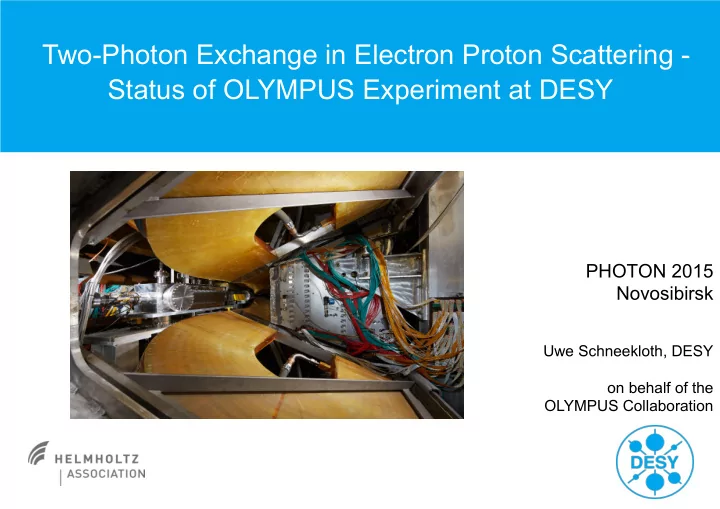
Two-Photon Exchange in Electron Proton Scattering -
Status of OLYMPUS Experiment at DESY
PHOTON 2015 Novosibirsk
Uwe Schneekloth, DESY
- n behalf of the
OLYMPUS Collaboration
Outline > Introduction and Motivation > Overview of the - - PowerPoint PPT Presentation
Two-Photon Exchange in Electron Proton Scattering - Status of OLYMPUS Experiment at DESY PHOTON 2015 Novosibirsk Uwe Schneekloth, DESY on behalf of the OLYMPUS Collaboration Outline > Introduction and Motivation > Overview of the
PHOTON 2015 Novosibirsk
Uwe Schneekloth, DESY
OLYMPUS Collaboration
Uwe Schneekloth | OLYMPUS Experiment, PHOTON| June 2015 | Page 2
> Introduction and Motivation > Overview of the Experiment > Schedule > Data Taking Periods > Performance > Radiative Corrections > Status of Analysis > Conclusions
Uwe Schneekloth | OLYMPUS Experiment, PHOTON| June 2015 | Page 3
Nucleon elastic form factors: electric GE and magnetic GM
> Fundamental observables describing distribution of charge and magnetism in proton and neutron > Described by quark structure of proton > Will be calculable in lattice QCD > For ~ 50 years unpolarized cross section measurements have determined Gp
E and Gp M using the Rosenbluth separation
dσ / dΩ (dσ / dΩ)Mott = σ σ 0 = A(Q2)+ B(Q2)tan2 θ 2 = GE
2(Q2)+τGM 2 (Q2)
1+τ + 2τGM
2 (Q2)tan2 θ
2
σ red = dσ dΩ ε(1+τ ) σ Mott = τGM
2 +εGE 2
ε = 1+ 2(1+τ )tan2θ / 2 ! " # $
−1
τ = Q2 / 4M p
2
(ε transverse virtual photon polarization)
Uwe Schneekloth | OLYMPUS Experiment, PHOTON| June 2015 | Page 4
2 + τGM 2
τGM
2
GE
2
θ=180o θ=0o
è Determine |GE|, |GM|,|GE/GM|
Uwe Schneekloth | OLYMPUS Experiment, PHOTON| June 2015 | Page 5
> All Rosenbluth data in agreement > Dramatic discrepancy between Rosenbluth and recoil polarization technique
§ Jefferson Lab data (>800 citations) polarized beam and target
> Interpreted as evidence for two photon contribution to elastic scattering
Proton Form Factor Ratio
0.5 1 1.5 2 1 2 3 4 5 6 7 µGE/GM Q2 [(GeV/c)2] Rosenbluth Litt ’70 Bartel ’73 Andivahis ’94 Walker ’94 Christy ’04 Qattan ’05 Polarization Gayou ’01 Punjabi ’05 Jones ’06 Puckett ’10 Paolone ’10 Puckett ’12 Fits Bernauer ’13 Fit Rosenbluth Fit all + phen. TPE
Uwe Schneekloth | OLYMPUS Experiment, PHOTON| June 2015 | Page 6
Two-Photon-Exchange
> Large theoretical model uncertainties
> Only experiment can definitively resolve the contributions beyond single photon exchange
> Determine TPE by measuring ratio of e+p/e-p, i.e. ratio of rates, no absolute cross section measurements
= σ( + ) σ( − ) = + ⇥(
† γ γ)
|
γ|
P.G. Blunden et al.
σ( − ) = |
γ| α
γ| | γ| α
+ . . .
σ( + ) = |
γ| α
+ |
γ| | γ| α
+ . . .
Uwe Schneekloth | OLYMPUS Experiment, PHOTON| June 2015 | Page 7
e+/e− - ratio
✏
Yount+Pine 1962 Browman 1965 Mar 1968 Bouquet 1968
Olympus projected
Yang phen. Guttmann phen. Bernauer phen. Afanasev Blunden (g.s.) Blunden (g.s. + ∆) Borisyuk (g.s.) Tomasi-Gustafsson 0.95 1 1.05 1.1 1.15 1.2 0.2 0.4 0.6 0.8 1
Elastic e+(e-) p scattering at 2 GeV beam energy
> Measure ratio of e+p/e-p rates with 1% precision > DORIS 100 mA e+(e-) beam > Unpolarized internal hydrogen target, density 3 x 10¹⁵ at/cm2 > Daily change of beam (e+ or e-) to minimize systematic error > Redundant luminosity measurements > Using former BLAST detector from MIT/
Comparison of data and theory
expected OLYMPUS sensitivity
Uwe Schneekloth | OLYMPUS Experiment, PHOTON| June 2015 | Page 8
> 2010: Blast detector shipped from MIT to DESY, assembled in parking position > 2011
§ February: Interaction region modified, test experiment § Summer: Detector moved in to beam position
> 2012 data taking
§ February: first data taking period § Fall: second data taking period 22.10.2012 – 2.01.2013 § Exceeded integrated luminosity: design 3.6 fb-1, achieved 4.45 fb-1
> 2013
§ Cosmic ray run § Complete survey § New magnetic field map § Beam position monitor calibration § Reconstruction/data analysis
> 2014/15: Reconstruction/data analysis
Uwe Schneekloth | OLYMPUS Experiment, PHOTON| June 2015 | Page 9
Uwe Schneekloth | OLYMPUS Experiment, PHOTON| June 2015 | Page 10
> Internal, windowless gas target > 60 cm long storage cell > Elliptical cross section (27 mm x 9 mm) > 100 µm thick aluminum wall > H2 flows up to 1 sccm > Cryo cooled ~45 K > O(1015) atoms/cm2 > Hydrogen produced by generator (electrolysis) INFN Ferrara, MIT
Uwe Schneekloth | OLYMPUS Experiment, PHOTON| June 2015 | Page 11
> 8 air coils from BLAST > Operating at reduced field > Positive and negative polarity > Maximum field 0.28 T
Uwe Schneekloth | OLYMPUS Experiment, PHOTON| June 2015 | Page 12
> Two chambers, trapezoidal shape > Jet-style drift cells > 5000 wires each > Tracks with 18 hits > 10o stereo angle
Uwe Schneekloth | OLYMPUS Experiment, PHOTON| June 2015 | Page 13
> Scintillation counters from BLAST > Trigger
§ Top/bottom coincidence § Kinematic constraint § + 2nd level wire chamber
> Time-of-flight for particle ID
Uwe Schneekloth | OLYMPUS Experiment, PHOTON| June 2015 | Page 14
Three independent measurements > Slow Control
§ Beam current and target density § 15 - 20% absolute uncertainty, relative <5%
> Tracking telescopes at 12o
§ Elastic ep scattering at small angles § Two independent sectors with independent tracking systems: MWPCs and GEMs § Use combined information or separately for cross checks
> Møller/Bhabha monitor at 1.3o
§ High statistics measurement, no dead time
Need e+p/e-p luminosity ratio, not precise absolute luminosity
Uwe Schneekloth | OLYMPUS Experiment, PHOTON| June 2015 | Page 15
Uwe Schneekloth | OLYMPUS Experiment, PHOTON| June 2015 | Page 16
Limited flow and luminosity in Feb. run Fall run
> Full hydrogen flow > DORIS top-up mode > Excellent performance > Exceeded integrated luminosity: § Design 3.6fb-1, achieved 4.45fb-1 > Daily switch of beam species, good balance > Mainly positive toroid polarity due to background > Negative field for systematics checks
Uwe Schneekloth | OLYMPUS Experiment, PHOTON| June 2015 | Page 17
> Independent luminosity measurement at 1.3o > In addition, can detect lepton from e p scattering > Cross check energy calibration and rate estimate > Rates are corrected for beam positions and slopes
Energy in right vs. left calorimeter
Uwe Schneekloth | OLYMPUS Experiment, PHOTON| June 2015 | Page 18
> Utilizing advanced Monte Carlo simulation to account for:
§ Beam position/slope § Detector acceptance/geometry § Detector resolution and response § Detector efficiencies § Radiative corrections (radiative e± p and Møller/Bhabha generators developed)
> Recent improvements:
§ Refinement of detector geometry model § Implementation of multiple generator weights for radiative generator systematic studies § Molecular flow Monte Carlo simulation of target gas flow to improve MC target distribution
Uwe Schneekloth | OLYMPUS Experiment, PHOTON| June 2015 | Page 19
> Molecular flow Monte Carlo simulaton of target more realistic than conductance-based calculation > Important to get shape of target distribution correct since e± acceptance can vary along target
Uwe Schneekloth | OLYMPUS Experiment, PHOTON| June 2015 | Page 20
One-photon exchange Lepton vertex correction Two-photon exchange Vacuum polarization Bremsstrahlung
Independent elastic e±p generators written at MIT (weighted) > Radiative corrections include:
§ Initial and finale state beamsstrahlung for lepton and proton, vertex corrections, vacuum polarization and soft two photo exchange § Hard two photon exchange not included
p, N, ∆, ?
soft TPE hard TPE
lepton momentum [MeV/c] lepton scattering angle 500 1000 1500 2000 20 30 40 50 60 70 80 90 100 0.8 0.9 1 1.1 1.2 σe+/σe
Møller/Bhabha generator with radiative corrections written at MIT
Uwe Schneekloth | OLYMPUS Experiment, PHOTON| June 2015 | Page 21
> Presently focusing on tracking of e±p events in 12o luminosity telescopes
§ Detailed simulation of target distribution has significantly improved data/MC comparison § Geometry description improved § MWPC digitization re-written, including handling of defective wire and multi-wire hits § Tracking code improved § TOF meantime used to identify recoil proton Very good agreement with “slow control” luminosity
Uwe Schneekloth | OLYMPUS Experiment, PHOTON| June 2015 | Page 22
> Recent tracking improvements
§ Geometry description § Minimization routine § Including TOF hits as additional track points (resolves ambiguities) § Expansion of elastic pattern library used by tracker § Advanced methods to recover difficult tracks § Time-to-distance fits expanded to include all runs (so far using 1000 runs) Status as of early May
Uwe Schneekloth | OLYMPUS Experiment, PHOTON| June 2015 | Page 23
Selection cuts on
> Coplanarity > Vertex correlation > θe, θp correlation > p, θ correlation > Event time correlation
Counts Energy [MeV] Reconstructed Beam Energy Before cuts After coplanarity cut After all cuts 500 1000 1500 2000 2500 3000 3500 4000
Uwe Schneekloth | OLYMPUS Experiment, PHOTON| June 2015 | Page 24
Selection cuts on
> Coplanarity > Vertex correlation > θe, θp correlation > p, θ correlation > Event time correlation
Proton angle Lepton angle Elastic lepton-proton pairs 10 20 30 40 50 60 70 80 90 10 20 30 40 50 60 70 80 90 10000 20000 30000 40000 50000 Counts
Systematic studies in progress
> In early May observed few percent left/right asymmetry > Found and fixed a few problems with reconstruction > Newly reconstructed data sample almost ready > Aiming at < 1% systematic uncertainty on e+/e- ratio
Uwe Schneekloth | OLYMPUS Experiment, PHOTON| June 2015 | Page 25
> Study of two photon exchange important for understanding proton form factor ratio disagreement
§ Two other experiments at Novosibirsk and JLab
> Former BLAST detector moved from MIT/Bates to DORIS accelerator at DESY and reassembled > Very successful data taking in 2012 > Data reconstruction and analysis well advanced > Large effort to understand systematic uncertainties to achieve ratio measurement at 1% level > Preliminary results on the full data set available fall this year
Uwe Schneekloth | OLYMPUS Experiment, PHOTON| June 2015 | Page 26
Institutes
> Arizona State University, USA > DESY > Hampton University, USA > INFN, Bari, Italy > INFN, Ferrara, Italy > INFN, Rome, Italy > MIT, USA > Petersburg Nucl. Phys. Inst. > Universität Bonn, Germany > University of Glasgow > Universität Mainz, Germany > Univ. of New Hampshire, USA > Yerevan Physics Inst., Armenia
45 physicists