Outline Introduction Paper: Paper: Antenna Designs Antenna - - PowerPoint PPT Presentation

outline
SMART_READER_LITE
LIVE PREVIEW

Outline Introduction Paper: Paper: Antenna Designs Antenna - - PowerPoint PPT Presentation

Paper presentation Ultra-Portable Devices Outline Introduction Paper: Paper: Antenna Designs Antenna Performance Analysis: Free Space vs Wearable Akram Alomainy,Yang Hao and David M Davenport Parametric St d Study of


slide-1
SLIDE 1

Paper presentation – Ultra-Portable Devices

Paper: Paper:

Akram Alomainy,Yang Hao and David M Davenport ”Parametric St d f W bl A t ith V i Di t f th Study of Wearable Antennas with Varying Distances from the Body and Different On-Body Positions” IET Seminar on Antennas and Propagation for Body-Centric Wireless Communications, London, UK, pp. 84-89, 2007

Presented by:

Rohit Chandra

2010-01-26 1 Paper Presentation - Ultra Portable Devices

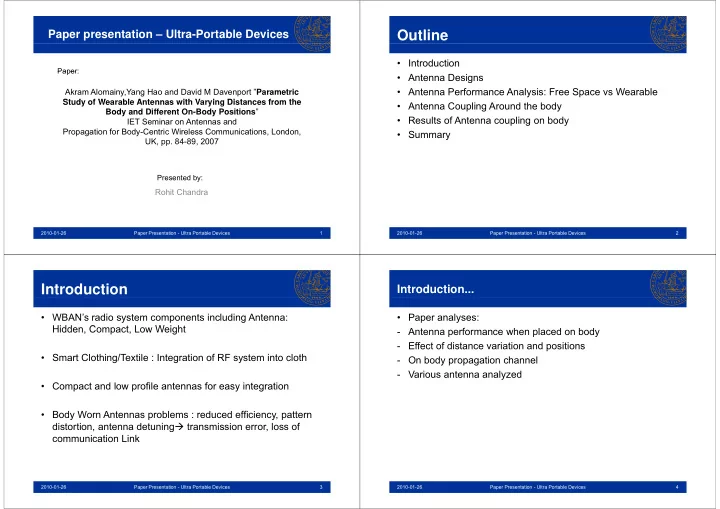
Outline

  • Introduction
  • Antenna Designs
  • Antenna Performance Analysis: Free Space vs Wearable
  • Antenna Coupling Around the body
  • Results of Antenna coupling on body
  • Summary

2010-01-26 2 Paper Presentation - Ultra Portable Devices

Introduction

  • WBAN’s radio system components including Antenna:

Hidd C t L W i ht Hidden, Compact, Low Weight

  • Smart Clothing/Textile : Integration of RF system into cloth
  • Compact and low profile antennas for easy integration
  • Body Worn Antennas problems : reduced efficiency, pattern

distortion, antenna detuning transmission error, loss of communication Link communication Link

2010-01-26 3 Paper Presentation - Ultra Portable Devices

Introduction...

  • Paper analyses:
  • Antenna performance when placed on body
  • Effect of distance variation and positions
  • On body propagation channel
  • Various antenna analyzed

2010-01-26 4 Paper Presentation - Ultra Portable Devices

slide-2
SLIDE 2

Antenna Types Antenna Types

  • Planar Antennas
  • Printed on FR4 substrate, εr = 4.6, σ = .002 S/m
  • Thickness = 1.6mm ( for Wiggle = 0.7mm)
  • Analysis : finite Integral Technique in 2.4 GHz ISM band

Analysis: Free Space Analysis

  • Excellent performance by conventional Antennas
  • Size reduction reduces antenna bandwidth and efficiency due to

Size reduction reduces antenna bandwidth and efficiency due to coupling between elements and vias.

slide-3
SLIDE 3

Wearable Antenna Analysis

  • Frequencies : 2.4, 2.44,2.48 GHz
  • Distance : 1 4 8 mm
  • Distance : 1,4,8 mm
  • Electric Properties of human body at 2.4 GHz

Wearable Antennas

  • Detuning from Free Space: change in effective length due to lossy body
  • Printed Monopole and Parasitic L less detuning due to ground plane
  • Narrow band of Parasitic L: distance variation is less

Narrow band of Parasitic L: distance variation is less

Radiation Pattern

  • Loss in backward radiation
  • Increased directivity because of

curvature of human body

Varying Distance Results

  • Difference in Left and right chest because of difference in human

physiological and electrical properties of tissues

  • Farther antenna more gain: reduction in absorbed power
slide-4
SLIDE 4

Results

  • Antennas with ground plane least affected by varying distance
  • Inverted L parasitic L and wiggle antenna: narrowband performance from return
  • Inverted L, parasitic L and wiggle antenna: narrowband performance from return

loss and transmission loss analysis.

  • Narrow band antennas: unreliable even if slight detuning
  • Narrow band antennas: unreliable even if slight detuning
  • Creeping wave: diffraction of space wave because of body curvature

Antenna coupling around body

  • Transmitter at left waist and receiver at right chest and right thigh.

g g g

  • Path Loss dependent on on-body link and type of antenna.

Reflection from ground

  • Ground Modeled as PEC plane near the feet of the human model
  • Ground affects the link closer to ground like left waist – left ankle

Ground affects the link closer to ground like left waist left ankle

  • Introduction of nulls in radiation pattern and Transmission coefficient due to

MPC

Measurements Results

  • Parasitic L at 4mm from

body

slide-5
SLIDE 5

On Body Communication Link Loss Loss

  • Monopole Antenna
  • Tx at left waist
  • Rx on right chest
  • 18 different body

postures changing 20 seconds

Summary

  • Antenna performance is different at different body positions

b f i ti i l t i l ti d t f because of variation in electrical properties and curvature of body.

  • Planar antenna with ground planes are more suitable.
  • Transmission loss depends on antenna type and property of

surrounding lossy material surrounding lossy material.

2010-01-26 18 Paper Presentation - Ultra Portable Devices