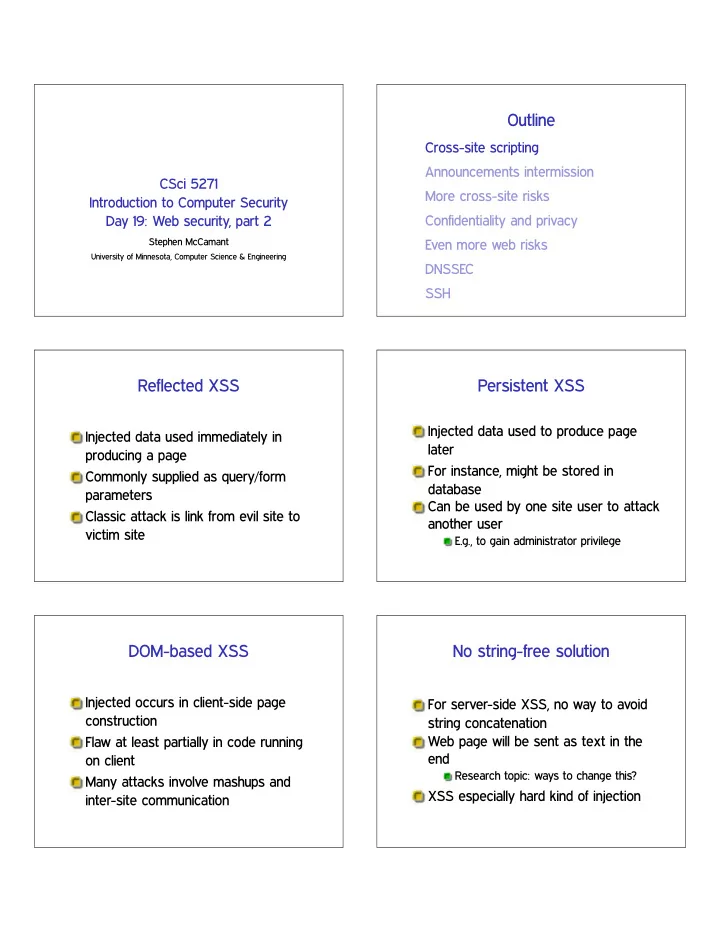
SLIDE 1 CSci 5271 Introduction to Computer Security Day 19: Web security, part 2
Stephen McCamant
University of Minnesota, Computer Science & Engineering
Outline
Cross-site scripting Announcements intermission More cross-site risks Confidentiality and privacy Even more web risks DNSSEC SSH
Reflected XSS
Injected data used immediately in producing a page Commonly supplied as query/form parameters Classic attack is link from evil site to victim site
Persistent XSS
Injected data used to produce page later For instance, might be stored in database Can be used by one site user to attack another user
E.g., to gain administrator privilege
DOM-based XSS
Injected occurs in client-side page construction Flaw at least partially in code running
Many attacks involve mashups and inter-site communication
No string-free solution
For server-side XSS, no way to avoid string concatenation Web page will be sent as text in the end
Research topic: ways to change this?
XSS especially hard kind of injection
SLIDE 2
Danger: complex language embedding
JS and CSS are complex languages in their own Can appear in various places with HTML
But totally different parsing rules
Example: ✧✳✳✳✧ used for HTML attributes and JS strings
What happens when attribute contains JS?
Danger: forgiving parsers
History: handwritten HTML, browser competition Many syntax mistakes given “likely” interpretations Handling of incorrect syntax was not standardized
Sanitization: plain text only
Easiest case: no tags intended, insert at document text level Escape HTML special characters with entities like ✫❧t❀ for ❁ OWASP recommendation: ✫ ❁ ❃ ✧ ✬ ✴
Sanitization: context matters
An OWASP document lists 5 places in a web page you might insert text
For the rest, “don’t do that”
Each one needs a very different kind of escaping
Sanitization: tag whitelisting
In some applications, want to allow benign markup like ❁❜❃ But, even benign tags can have JS attributes Handling well essentially requires an HTML parser
But with an adversarial-oriented design
Don’t blacklist
Browser capabilities continue to evolve Attempts to list all bad constructs inevitably incomplete Even worse for XSS than other injection attacks
SLIDE 3
Filter failure: one-pass delete
Simple idea: remove all occurrences of ❁s❝r✐♣t❃ What happens to ❁s❝r❁s❝r✐♣t❃✐♣t❃?
Filter failure: UTF-7
You may have heard of UTF-8
Encode Unicode as 8-bit bytes
UTF-7 is similar but uses only ASCII Encoding can be specified in a ❁♠❡t❛❃ tag, or some browsers will guess ✰❆❉✇✲s❝r✐♣t✰❆❉✹✲
Filter failure: event handlers
❁■▼● ♦♥♠♦✉s❡♦✈❡r❂✧❛❧❡rt✭✬①ss✬✮✧❃ Put this on something the user will be tempted to click on There are more than 100 handlers like this recognized by various browsers
Use good libraries
Coding your own defenses will never work Take advantage of known good implementations Best case: already built into your framework
Disappointingly rare
Content Security Policy
New HTTP header, W3C candidate recommendation Lets site opt-in to stricter treatment of embedded content, such as:
No inline JS, only loaded from separate URLs Disable JS ❡✈❛❧ et al.
Has an interesting violation-reporting mode
Outline
Cross-site scripting Announcements intermission More cross-site risks Confidentiality and privacy Even more web risks DNSSEC SSH
SLIDE 4 HA 2 questions
- 1. Network sniffing
- 2. Offline dictionary attack
- 3. Forging predictable cookies
- 4. SQL injection
- 5. Cross-site scripting
- 6. Crypto. attack against a poor MAC
Upcoming assignments
Progress reports due tonight by 11:55pm Exercise set 3 due Thursday at 11:55pm
Outline
Cross-site scripting Announcements intermission More cross-site risks Confidentiality and privacy Even more web risks DNSSEC SSH
HTTP header injection
Untrusted data included in response headers Can include CRLF and new headers, or premature end to headers AKA “response splitting”
Content sniffing
Browsers determine file type from headers, extension, and content-based guessing
Latter two for ✘ ✶% server errors
Many sites host “untrusted” images and media Inconsistencies in guessing lead to a kind of XSS
E.g., “chimera” PNG-HTML document
Cross-site request forgery
Certain web form on ❜❛♥❦✳❝♦♠ used to wire money Link or script on ❡✈✐❧✳❝♦♠ loads it with certain parameters
Linking is exception to same-origin
If I’m logged in, money sent automatically Confused deputy, cookies are ambient authority
SLIDE 5
CSRF prevention
Give site’s forms random-nonce tokens
E.g., in POST hidden fields Not in a cookie, that’s the whole point
Reject requests without proper token
Or, ask user to re-authenticate
XSS can be used to steal CSRF tokens
Open redirects
Common for one page to redirect clients to another Target should be validated
With authentication check if appropriate
Open redirect: target supplied in parameter with no checks
Doesn’t directly hurt the hosting site But reputation risk, say if used in phishing We teach users to trust by site
Outline
Cross-site scripting Announcements intermission More cross-site risks Confidentiality and privacy Even more web risks DNSSEC SSH
Site perspective
Protect confidentiality of authenticators
Passwords, session cookies, CSRF tokens
Duty to protect some customer info
Personally identifying info (“identity theft”) Credit-card info (Payment Card Industry Data Security Standards) Health care (HIPAA), education (FERPA) Whatever customers reasonably expect
You need to use SSL
Finally coming around to view that more sites need to support HTTPS
Special thanks to WiFi, NSA
If you take credit cards (of course) If you ask users to log in
Must be protecting something, right? Also important for users of Tor et al.
Server-side encryption
Also consider encrypting data “at rest” (Or, avoid storing it at all) Provides defense in depth
Reduce damage after another attack
May be hard to truly separate keys
OWASP example: public key for website ✦ backend credit card info
SLIDE 6 Adjusting client behavior
HTTPS and ♣❛ss✇♦r❞ fields are basic hints Consider disabling autocomplete
Usability tradeoff, save users from themselves Finally standardized in HTML5
Consider disabling caching
Performance tradeoff Better not to have this on user’s disk Or proxy? You need SSL
User vs. site perspective
User privacy goals can be opposed to site goals Such as in tracking for advertisements Browser makers can find themselves in the middle
Of course, differ in institutional pressures
Third party content / web bugs
Much tracking involves sites other than the one in the URL bar
For fun, check where your cookies are coming from
Various levels of cooperation Web bugs are typically 1x1 images used
Cookies arms race
Privacy-sensitive users like to block and/or delete cookies Sites have various reasons to retain identification Various workarounds:
Similar features in Flash and HTML5 Various channels related to the cache Evercookie: store in ♥ places, regenerate if subset are deleted
Browser fingerprinting
Combine various server or JS-visible attributes passively
User agent string (10 bits) Window/screen size (4.83 bits) Available fonts (13.9 bits) Plugin verions (15.4 bits) (Data from ♣❛♥♦♣t✐❝❧✐❝❦✳❡❢❢✳♦r❣, far from exhaustive)
History stealing
History of what sites you’ve visited is not supposed to be JS-visible But, many side-channel attacks have been possible
Query link color CSS style with external image for visited links Slow-rendering timing channel Harvesting bitmaps User perception (e.g. fake CAPTCHA)
SLIDE 7 Browser and extension choices
More aggressive privacy behavior lives in extensions
Disabling most JavaScript (NoScript) HTTPS Everywhere (whitelist) Tor Browser Bundle
Default behavior is much more controversial
Concern not to kill advertising support as an economic model
Outline
Cross-site scripting Announcements intermission More cross-site risks Confidentiality and privacy Even more web risks DNSSEC SSH
Misconfiguration problems
Default accounts Unneeded features Framework behaviors
Don’t automatically create variables from query fields
Openness tradeoffs
Error reporting
Few benign users want to see a stack backtrace
Directory listings
Hallmark of the old days
Readable source code of scripts
Doesn’t have your DB password in it, does it?
Using vulnerable components
Large web apps can use a lot of third-party code Convenient for attackers too
OWASP: two popular vulnerable components downloaded 22m times
Hiding doesn’t work if it’s popular Stay up to date on security announcements
Clickjacking
Fool users about what they’re clicking
Circumvent security confirmations Fabricate ad interest
Example techniques:
Frame embedding Transparency Spoof cursor Temporal “bait and switch”
SLIDE 8
Crawling and scraping
A lot of web content is free-of-charge, but proprietary
Yours in a certain context, if you view ads, etc.
Sites don’t want it downloaded automatically (web crawling) Or parsed and user for another purpose (screen scraping) High-rate or honest access detectable
Outline
Cross-site scripting Announcements intermission More cross-site risks Confidentiality and privacy Even more web risks DNSSEC SSH
DNS: trusted but vulnerable
Almost every higher-level service interacts with DNS UDP protocol with no authentication or crypto
Lots of attacks possible
Problems known for a long time, but challenge to fix compatibly
DNSSEC goals and non-goals
✰ Authenticity of positive replies ✰ Authenticity of negative replies ✰ Integrity ✲ Confidentiality ✲ Availability
First cut: signatures and certificates
Each resource record gets an ❘❘❙■● signature
E.g., ❆ record for one name✦address mapping Observe: signature often larger than data
Signature validation keys in ❉◆❙❑❊❨ RRs Recursive chain up to the root (or other “anchor”)
Add more indirection
DNS needs to scale to very large flat domains like ✳❝♦♠ Facilitated by having single ❉❙ RR in parent indicating delegation Chain to root now includes ❉❙es as well
SLIDE 9
Negative answers
Also don’t want attackers to spoof non-existence
Gratuitous denial of service, force fallback, etc.
But don’t want to sign “① does not exist” for all ① Solution 1, ◆❙❊❈: “there is no name between ❛❝❛❝✐❛ and ❜❛♦❜❛❜”
Preventing zone enumeration
Many domains would not like people enumerating all their entries DNS is public, but “not that public” Unfortunately ◆❙❊❈ makes this trivial Compromise: ◆❙❊❈✸ uses password-like salt and repeated hash, allows opt-out
DANE: linking TLS to DNSSEC
“DNS-based Authentication of Named Entities” DNS contains hash of TLS cert, don’t need CAs How is DNSSEC’s tree of certs better than TLS’s?
Signing the root
Political problem: many already distrust US-centered nature of DNS infrastructure Practical problem: must be very secure with no single point of failure Finally accomplished in 2010
Solution involves ‘key ceremonies’, international committees, smart cards, safe deposit boxes, etc.
Deployment
Standard deployment problem: all cost and no benefit to being first mover Servers working on it, mostly top-down Clients: still less than 20% Will be probably common: insecure connection to secure resolver
Outline
Cross-site scripting Announcements intermission More cross-site risks Confidentiality and privacy Even more web risks DNSSEC SSH
SLIDE 10 Short history of SSH
Started out as freeware by Tatu Yl¨
in 1995 Original version commercialized Fully open-source OpenSSH from OpenBSD Protocol redesigned and standardized for “SSH 2”
OpenSSH t-shirt SSH host keys
Every SSH server has a public/private keypair Ideally, never changes once SSH is installed Early generation a classic entropy problem
Especially embedded systems, VMs
Authentication methods
Password, encrypted over channel ✳s❤♦sts: like ✳r❤♦sts, but using client host key User-specific keypair
Public half on server, private on client
Plugins for Kerberos, PAM modules, etc.
Old crypto vulnerabilities
1.x had only CRC for integrity
Worst case: when used with RC4
Injection attacks still possible with CBC
CRC compensation attack
For least-insecure 1.x-compatibility, attack detector Alas, detector had integer overflow worse than original attack
Newer crypto vulnerabilities
IV chaining: IV based on last message ciphertext
Allows chosen plaintext attacks Better proposal: separate, random IVs
Some tricky attacks still left
Send byte-by-byte, watch for errors Of arguable exploitability due to abort
Now migrating to CTR mode
SLIDE 11 SSH over SSH
SSH to machine 1, from there to machine 2
Common in these days of NATs
Better: have machine 1 forward an encrypted connection (cf. HW1)
- 1. No need to trust 1 for secrecy
- 2. Timing attacks against password typing
SSH (non-)PKI
When you connect to a host freshly, a mild note When the host key has changed, a large warning
❅❅❅❅❅❅❅❅❅❅❅❅❅❅❅❅❅❅❅❅❅❅❅❅❅❅❅❅❅❅❅❅❅❅❅❅❅❅❅❅❅❅❅❅❅❅❅❅❅❅❅❅❅❅❅❅❅ ❅ ❲❆❘◆■◆●✿ ❘❊▼❖❚❊ ❍❖❙❚ ■❉❊◆❚■❋■❈❆❚■❖◆ ❍❆❙ ❈❍❆◆●❊❉✦ ❅ ❅❅❅❅❅❅❅❅❅❅❅❅❅❅❅❅❅❅❅❅❅❅❅❅❅❅❅❅❅❅❅❅❅❅❅❅❅❅❅❅❅❅❅❅❅❅❅❅❅❅❅❅❅❅❅❅❅ ■❚ ■❙ P❖❙❙■❇▲❊ ❚❍❆❚ ❙❖▼❊❖◆❊ ■❙ ❉❖■◆● ❙❖▼❊❚❍■◆● ◆❆❙❚❨✦ ❙♦♠❡♦♥❡ ❝♦✉❧❞ ❜❡ ❡❛✈❡s❞r♦♣♣✐♥❣ ♦♥ ②♦✉ r✐❣❤t ♥♦✇ ✭♠❛♥✲✐♥✲t❤❡✲♠✐❞❞❧❡ ❛tt❛❝❦✮✦ ■t ✐s ❛❧s♦ ♣♦ss✐❜❧❡ t❤❛t ❛ ❤♦st ❦❡② ❤❛s ❥✉st ❜❡❡♥ ❝❤❛♥❣❡❞✳