Outline Bitcoin background 8271 discussion of: Double Spending Fast - - PDF document

outline
SMART_READER_LITE
LIVE PREVIEW

Outline Bitcoin background 8271 discussion of: Double Spending Fast - - PDF document

Outline Bitcoin background 8271 discussion of: Double Spending Fast Payments in Bitcoin Double spends and fast payments Stephen McCamant (Original paper: Ghassan O. Karame, Elli Androulaki, and Srdjan Capkun) University of Minnesota


slide-1
SLIDE 1

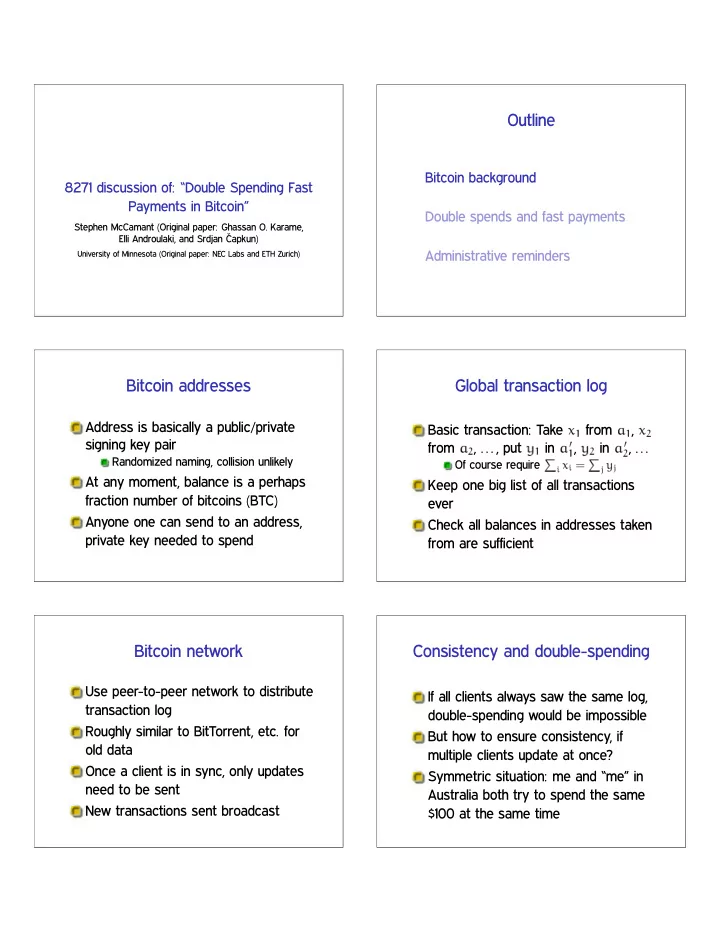
8271 discussion of: “Double Spending Fast Payments in Bitcoin”

Stephen McCamant (Original paper: Ghassan O. Karame, Elli Androulaki, and Srdjan ˇ Capkun)

University of Minnesota (Original paper: NEC Labs and ETH Zurich)

Outline

Bitcoin background Double spends and fast payments Administrative reminders

Bitcoin addresses

Address is basically a public/private signing key pair

Randomized naming, collision unlikely

At any moment, balance is a perhaps fraction number of bitcoins (BTC) Anyone one can send to an address, private key needed to spend

Global transaction log

Basic transaction: Take ①✶ from ❛✶, ①✷ from ❛✷, . . . , put ②✶ in ❛✵

✶, ②✷ in ❛✵ ✷, . . .

Of course require P

✐ ①✐ ❂ P ❥ ②❥

Keep one big list of all transactions ever Check all balances in addresses taken from are sufficient

Bitcoin network

Use peer-to-peer network to distribute transaction log Roughly similar to BitTorrent, etc. for

  • ld data

Once a client is in sync, only updates need to be sent New transactions sent broadcast

Consistency and double-spending

If all clients always saw the same log, double-spending would be impossible But how to ensure consistency, if multiple clients update at once? Symmetric situation: me and “me” in Australia both try to spend the same $100 at the same time

slide-2
SLIDE 2

Bitcoin blocks

Group ✘10 minutes of latest transactions into one “block” Use a proof of work so creating a block is very hard All clients race, winning block propagates

Bitcoin blockchains

Each block contains a pointer to the previous one Clients prefer the longest chain they know E.g., inconsistency usually resolved by next block

Regulating difficulty

Difficulty of the proof-of-work is adjusted to target the 10 minute block frequency Recomputed over two-week (2016 block) average Network adjusts to amount of computing power available

Bitcoin mining

Where do bitcoins come from

  • riginally?

Fixed number created per block, assigned by the client that made it Incentive to compete in the block generation race Called mining by analogy with gold

Enforcing consistency

Structure of network very resistant to protocol change

Inertia of everybody else’s code

Changes unpopular among miners will not stick Minor crisis in March 2013: details of database lock allocation cause half of network to reject large block

Outline

Bitcoin background Double spends and fast payments Administrative reminders

slide-3
SLIDE 3

Fast payments

You’d like to use Bitcoin for instantaneous transactions:

In-person snack machine, grocery store, etc. Pure digital goods like MP3s, e-books, etc. ATM withdrawal, currency conversion

But no possibility of reversing transactions later

So need strong protection against fraud

Reception vs. confirmation

Reception: transaction propagated through P2P network

Average about 3 seconds

Confirmation: transaction incorporated in block chain

Average 10 minutes per block

Conservative 6 confirmations: 1 hour, mail-order speed

Block generation time distribution

Expected: exponential with ✕ ❂ ✶✵ min Paper’s analysis basically confirms this with extra complexities

Good fit between 2-minute binned results and shifted geometric distribution with ♣ ❂ ✵✿✶✾ (vs. expected ✷❂✶✵)

Basic double-spend attack

Attacker ❆, victim (e.g., vendor) ❱ Two transactions ❚❘❱ and ❚❘❆ spend the same coins Attacker wins if ❚❘❱ accepted by vendor, but ❚❘❆ ends up in block chain Send ❚❘❱ to vendor, “helpers” introduce ❚❘❆ elsewhere

Analyzing difficulty

Nodes store whichever transaction they see first, ignore other Easy to ensure vendor sees ❚❘❱ first Which ❚❘ appears in the next block proportional to how many nodes keep it

Experimental difficulty

Ten geographically-distributed test nodes

Vary vendor location, randomly choose 1-2 helpers

Vary relative time of two introductions Many configurations had 100% success rate

slide-4
SLIDE 4

Countermeasure: listening period

Idea: after receiving transaction, wait 15 s to see a double spend

Proposed in a Bitcoin FAQ

Attacker has tradeoff between probabilities of detection and success Attractive attacks (5-30% success) possible

Especially when vendor has few connections

CM: network observers

Recruit extra nodes to listen for double spends In experiments with 5 observers, all double-spends were seen within a few seconds Authors recommend at least 3

  • bservers, arguably expensive

CM: forwarding double-spends

Authors propose: always forward transactions that appear to be double spends

But do not use for block generation

Affects only detection, not attack success Possible problems: load, DoS Not deployed as far as I know

Outline

Bitcoin background Double spends and fast payments Administrative reminders

Last call for Zerocoin

If anyone besides me wants to present the “Zerocoin” paper for Wednesday, now is your last chance to volunteer

More papers posted

New potential papers posted for:

Infrastructure paranoia Smartphone security Tor (Anti-)censorship

slide-5
SLIDE 5

Topic popularity survey

By Tuesday night, email me your list of the topic areas from the web page, sorted by order of your interest Mentioning specific papers is optional