Outline Explain why clinician burnout is a patient care and - - PDF document

outline
SMART_READER_LITE
LIVE PREVIEW

Outline Explain why clinician burnout is a patient care and - - PDF document

4/18/2018 Disclosure Journey to a Resilient and Thriving All planners, presenters, and reviewers of this Pharmacy Workforce content report no financial relationships relevant to this activity. Jennifer M. Schultz, Pharm.D., FASHP ASHP


slide-1
SLIDE 1

4/18/2018 1

Journey to a Resilient and Thriving Pharmacy Workforce

Jennifer M. Schultz, Pharm.D., FASHP ASHP Board of Directors

Clinical Pharmacy Supervisor/ Residency Program Director Bozeman Health, Bozeman, MT April 20, 2018

Disclosure

  • All planners, presenters, and reviewers of this

content report no financial relationships relevant to this activity.

Poll Everywhere Instructions

  • Text RXRESILIENCE to 22333 to join the conversation
  • All responses will appear to the audience in a “word cloud”

after submissions are gathered

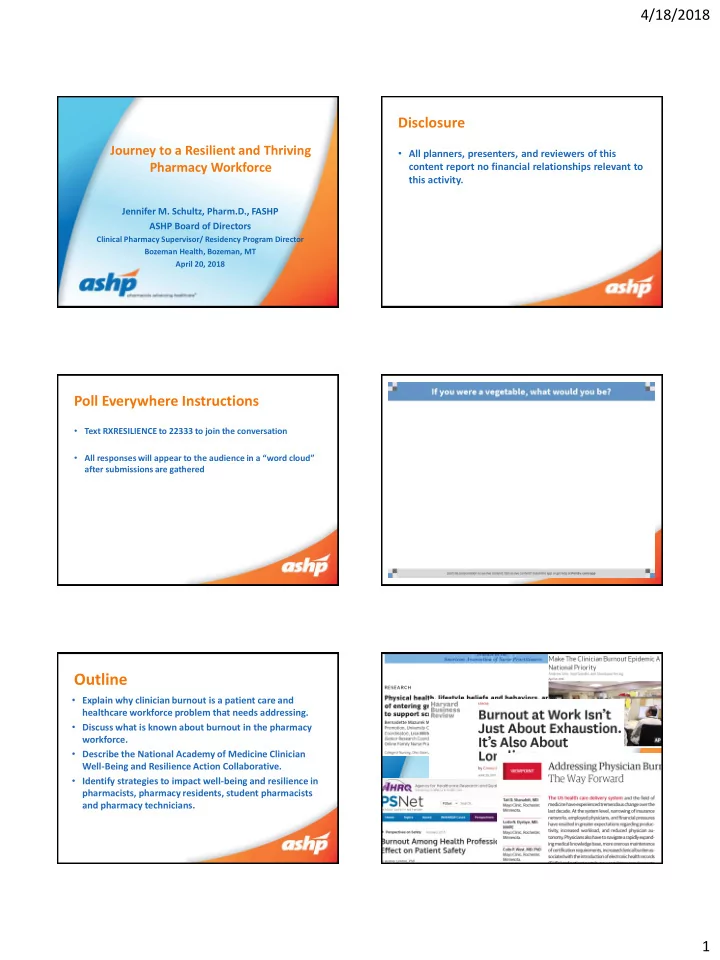
Outline

  • Explain why clinician burnout is a patient care and

healthcare workforce problem that needs addressing.

  • Discuss what is known about burnout in the pharmacy

workforce.

  • Describe the National Academy of Medicine Clinician

Well-Being and Resilience Action Collaborative.

  • Identify strategies to impact well-being and resilience in

pharmacists, pharmacy residents, student pharmacists and pharmacy technicians.

slide-2
SLIDE 2

4/18/2018 2 Burnout is a Patient Care Problem

Bodenheimer T, Sinsky C. From triple aim to quadruple aim: care of the patient requires care

  • f the provider. Ann Fam Med. 2014;12(6):573-6.

Swensen S, Shanafelt, Mohta NS. Leadership survey: Why physician burnout is endemic, and how health care must respond. NEJM Catalyst. December 8, 2016. Available at: https://catalyst.nejm.org/physician-burnout-endemic-healthcare-respond/

American Society of Health-System Pharmacists

  • Vision
  • Medication use will be
  • ptimal, safe, and

effective for all people all of the time

  • Membership

Organization

  • Established 1942
  • 45,000 members

ASHP Vision & Strategic Plan

  • Strategic Priorities and Goals

– Our Patients and Their Care

  • Goal 4: Improve Patient Care by Enhancing the Well-

Being and Resilience of Pharmacists, Student Pharmacists, and Pharmacy Technicians

– Our Members and Partners – Our People and Performance

Our Patients and Their Care: Goal 4

  • Key Objectives

– Engage in major national initiatives on clinician well-being and resilience – Facilitate the development of education aimed at helping pharmacists, student pharmacists, and pharmacy technicians address and effectively cope with the stress and burnout associated with demanding patient care environments – Seek opportunities to improve the well-being and resilience

  • f pharmacists participating in postgraduate residency

training. – Foster research that addresses well-being and resilience issues of pharmacists, student pharmacists, and pharmacy technicians

Quality and Safety

  • Medical Error

– ~8000 surgeons

  • Medical Malpractice

Litigation

– ~7000 surgeons

  • Health-care associated

infections

– Mean burnout hospital nurses independent predictor

  • Patient mortality ratios
  • Teamwork scores

– Mean EE physicians & nurses ICU

Burnout Medical Error

Bi-directional relationship Higher levels of burnout associated with increased odds of reporting a medical error in subsequent 3 months Self-perceived medical error associated with worsening burnout & depressive symptoms

Shanafelt Ann Surg 2009; Balch J Am Coll Surg 213; West JAMA 2006, 2009; Jones J Appl Psychol 1988; Cimiotti Am J Infect Control 2012; Welp Front Psychol 2015; Welp Crit Care 2016

slide-3
SLIDE 3

4/18/2018 3

Health Care Costs

↑Medical Errors ↑Malpractice claims ↑Turnover

– 1.2-1.3 x salary ($82-$88,000 per RN in 2007) – $500,000 to >$1 million

↑Absenteeism ↓Job productivity ↑Referrals ↑Ordering

Jones J Nurs Am 2008; Fibuch Physician Leadersh J 2015; Buchbinder Am J Manag Care 1999; Kushnir, Fam Pract 2014; Bachman Soc Sci Med 1999; Parker J Behav Med 1995, Toppinen-Tanner Behav Med 2005, Hilton J Occup Environ Med 2009

What is Stress?

  • Stress is a physical,

mental, or emotional factor that causes bodily or mental tension.

  • Stress can be

external or internal

https://www.medicinenet.com/script/main/art.asp?articlekey=20104

What is Burnout?

  • Syndrome of:
  • depersonalization
  • emotional exhaustion
  • low personal

accomplishment

  • Leads to decreased

effectiveness at work

  • Attributed to work-related

stress

Maslach, C., S. E. Jackson, et al. (1996). Maslach Burnout Inventory Manual. Palo Alto, CA, Consulting Psychologists Press.

Burnout is Not..

  • Having a bad day at work
  • Feeling overwhelmed for a day or two
  • Experiencing a bad mood
  • Wanting time-off from work
  • Needing a beverage at the end of the day

Maslach Burnout Inventory – Human Services Survey Tool

  • Medical Personnel

– Emotional exhaustion

  • Measures feelings of being emotionally overextended and exhausted by
  • ne’s work

– I feel emotionally drained from my work

– Depersonalization

  • Measures an unfeeling and impersonal response toward patients

– I don’t really care what happens to some patients

– Personal Accomplishment

  • Measures feelings of competence and successful achievement in one’s

work

– I have accomplished many worthwhile things in this job

– Response options (frequency): never, a few times a year or less, once a month or less, a few times a month, once a week, a few times a week, every day

slide-4
SLIDE 4

4/18/2018 4

High Prevalence of Burnout

Medicine

  • 2014, 6880 physicians, all

specialties, all practice types

  • 2012, 5521 medical students &

residents Nursing

  • 1999, >10,000 inpatient RN
  • 2007, 68,000 nurses

Aiken JAMA 2002;288; McHugh Health Aff 2011;30; Dyrbye Acad Med 89(3): 443-451; Shanafelt MCP 2015:90:1600

Burnout: Pharmacy Residents

Study Overview

  • Stress and negative affect

levels surveyed in PGY1 & PGY2s (n=524, 27.7% response)

  • Those working > 60

hours/week reported higher levels of perceived stress and elevated depression, hostility, and dysphoria

  • Perceived stress for pharmacy

residents was 19.06+5.9

– 14.2+6.2 in 18-29 year old health adults – 20.3+7.4 in cardiology medical residents

Takeaways

  • 10-item Perceived Stress

Scale is a free, validated tool to assess stress among pharmacy residents

  • Hostility was highest in

PGY2

  • When pressures of being
  • verworked > resident’s

ability to cope, well-being is in danger

Le HM, Young SD. Evaluation of stress experienced by pharmacy residents. AJHP.2017;74:599-604

Burnout: Clinical Pharmacists

  • Jones and colleagues measured clinical pharmacist

burnout (n=974)

– Nearly ¾ included respondents are certified by BPS – More than half completed residency training – 61.2% overall burnout rate; 52.9% high emotional exhaustion – Characteristics of burned out clinical pharmacists:

  • Less likely to have children (p=0.002)
  • More likely to work more median hours (p<0.001)
  • More likely to have attained BPS certification (p=0.005)

– No difference observed in practice area, hospital setting

Burnout: Clinical Pharmacists, cont.

  • Jones and colleagues measured clinical pharmacist

burnout (n=974)

– Many objective factors noted as increased in burned out individuals; however, no factors independently predict burnout – Strong predictors:

  • 1. Too many nonclinical duties
  • 2. Inadequate teaching time
  • 3. Inadequate administration time
  • 4. Difficult pharmacist colleagues
  • 5. Contributions unappreciated

Burnout: COP Faculty

  • El-Ibiary and colleagues measured faculty burnout

in US College of Pharmacy (n=758)

– 41.3% exhibited high emotional exhaustion scores – Women had significantly higher emotion exhaustion and lower personal accomplishment scores than men – Faculty who had a hobby had significantly lower emotional exhaustion scores, lower depersonalization score, and higher personal accomplishment scores – Faculty working in newer Colleges of Pharmacy (est. < 5 years) were associated with lower depersonalization and lower personal accomplishment scores.

Am J Pharm Educ. 2017;81(4):75

Drivers of Burnout in Healthcare Professionals

  • Excessive workload
  • Inefficient work

environment

  • Problems with work-life

integration

  • Loss of autonomy,

flexibility and control

  • Organizational culture and

values

  • Reduction of meaning in

work

  • Lack of social support at

work

  • Leadership behaviors
  • Nurses: Moral distress
  • Trainees: Learning

environment, Educational debt

  • Shanafelt. MCP 2016(7):836; Dyrbye et al. Arch Surg 2011; 146(2):211; Dyrbye et al. Arch Surg

147(10): 933-939; Shanafelt Arch Intern Med 2009; Dyrbye Med Educ 2016;50:132-149; Shanafelt MCP 2016; Williams Health Care Manag Rev 2007; Aiken JAMA 2002; Hamric Crit Care Med 2007

slide-5
SLIDE 5

4/18/2018 5

Drivers of Burnout in Healthcare Professionals

Risk Factors Associated With Burnout

Am J Health-Syst Pharm. 2017; 74:e576-81

Risk Factor Example Workload Job demands exceeding human limits; limited time to rest, recover, and restore. Control Role conflict; absence of direction in the workplace Reward Inadequate financial, institutional, or social reward in the workplace; lack of recognition Community Inadequate opportunity for quality social interaction at work; inadequate development of teams Fairness Perception of equity from an organization or leadership Values Organizational values are incongruous with an individual’s personal values or beliefs Job-person incongruity Personality does not fit or is misaligned with job expectations and coping abilities

National Academy of Sciences

▪ Founded in March, 1863 ▪ Private, nonprofit organization

  • f the country’s leading

researchers ▪ National Academy of Medicine

▪ Formed in 1970 to advise the nation on medical & health issues ▪ Dr. Victor Dzau is President Dzau VJ, Kirch DG, Nasca TJ. To care is human – collectively confronting the clinician-burnout crisis. NEJM.2018;378(4):312-314.

“Through collective action and targeted investment, we can not only reduce burnout and promote well-being, but also help clinicians carry out the sacred mission that drew them to the healing professions – providing the very best care to patients”

Action Collaborative Timeline

July 2016 July 2017 Jan 2017 Sept 2016 June 2017 May 2018 Sept 2017

slide-6
SLIDE 6

4/18/2018 6 Action Collaborative Goals

NAM

  • Improve baseline understanding

across organizations of challenges to clinician well-being

  • Raise visibility of clinician stress

and burnout

  • Advance evidence-based,

multidisciplinary solutions to reverse these trends, leading to improvements in patient care by caring for the caregiver

ASHP

  • Improve patient outcomes

through optimal medication use

  • Identify mechanisms to improve

and sustain pharmacy workforce well-being and resilience

  • Deploy pharmacy workforce to

support multidisciplinary solutions for improving healthcare workforce well-being and resilience

Collaborative Composition & Commitments

  • 36 sponsoring organizations, 100 network
  • rganizations:

– Professional organizations – Government – Technology and EHR vendors – Large health care centers – Payors

  • 130 commitment statements

– To provide an opportunity for organizations across the country discuss and share plans of action to reverse clinician burnout and promote clinician well-being. – https://nam.edu/initiatives/clinician-resilience-and-well- being/commitment-statements-clinician-well-being/

Creating An All-Encompassing Model

  • Broad enough to define the issue across all healthcare professions
  • Satisfactorily encompasses multiple environments (education,

practice)

  • Satisfactorily encompasses multiple stages of development of the

health professional

  • Satisfactorily encompasses system and individual issues in ways

that are helpful toward developing a solution (e.g. defining without stigmatizing)

  • Lends itself to being a tool for diagnosis, explanation, treatment
  • Serves as a taxonomy for organizing other elements/tools

developed as part of this NAM Collaborative

Brigham T, Barden C, Legreid Dopp, A, Hengerer A. et al. A journey to Construct an all-encompassing conceptual model of factors affecting clinician well-being and resilience. National Academy of Medicine, 2018.

slide-7
SLIDE 7

4/18/2018 7 STRATEGIES Identify Burnout

https://nam.edu/valid-reliable-survey-instruments- measure-burnout-well-work-related-dimensions/

Strategies to Alleviate Burnout in Healthcare Professionals

Risk Factors Associated With Burnout

Am J Health-Syst Pharm. 2017; 74:e576-81

Risk Factor Strategy to Alleviate Risk Workload Permitting time at the workplace to recover from a stressful event Control Clearly defined roles and expectations from organizational leadership Reward Identify suitable rewards to recognize achievements, provide

  • pportunities to teach or mentor trainees

Community Promote participation in professional organizations Fairness Transparency in decision-making Values Align personal expectations with organizational goals Job-person incongruity Evaluate and align job responsibilities with personal and professional expectations

AJHP

  • AJHP Article Types

Research Reports Special Features Clinical Reviews Therapy Updates Clinical Frontiers Clinical Consultation Case Reports Primers Notes Case Studies Columns Letters to the Editor

slide-8
SLIDE 8

4/18/2018 8 Engage in a hobby

  • Hob∙by (noun) – a pursuit outside one's regular
  • ccupation engaged in especially for relaxation

– Family – Faith – Fitness – Food – Fun

https://www.merriam-webster.com/dictionary/hobby; accessed 18 Jan 2018 https://www.wikihow.com/Encourage-a-Teenager-to-Take-Up-a-Hobby

Engage in a hobby Precepting

  • “Those involved with the education and training of

healthcare professionals [preceptors] need to be aware of an upcoming generation of professionals [students and residents] who may be more vulnerable than previous generations when facing criticism and challenges.”

Am J Health-Syst Pharm. 2017; 74:e576-81

Precepting Strategies

  • Keep your workload organized
  • Schedule time with learners and time for them to work

independently

  • Delegate patient care activities to learners
  • Don’t let a difficult situation get away from you
  • Share precepting responsibilities with a colleague
  • If possible, request a couple months off from precepting
  • Schedule exercise and personal time into your calendar

(and protect it)

  • Eat right
  • Sleep

LOOKING AHEAD

slide-9
SLIDE 9

4/18/2018 9

Follow the conversation: nam.edu/ClinicianWellBeing #ClinicianWellBeing

NAM Knowledge Hub Join the conversation:

Questions? Ideas? Considerations?

Christina Martin Anna Legreid Dopp cmartin@ashp.org adopp@ashp.org