Outline Evaluating Models of Natural Image Patches Evaluating - - PowerPoint PPT Presentation

outline evaluating models of natural image patches
SMART_READER_LITE
LIVE PREVIEW

Outline Evaluating Models of Natural Image Patches Evaluating - - PowerPoint PPT Presentation

Outline Evaluating Models of Natural Image Patches Evaluating Models Comparing Whitening and ICA Models Chris Williams Spherically Symmetric Distribution Neural Information Processing Lp-spherical Distributions School of


slide-1
SLIDE 1

Evaluating Models of Natural Image Patches

Chris Williams

Neural Information Processing School of Informatics, University of Edinburgh

January 15, 2018

1 / 16

Outline

◮ Evaluating Models ◮ Comparing Whitening and ICA Models ◮ Spherically Symmetric Distribution ◮ Lp-spherical Distributions

2 / 16

Evaluating Models

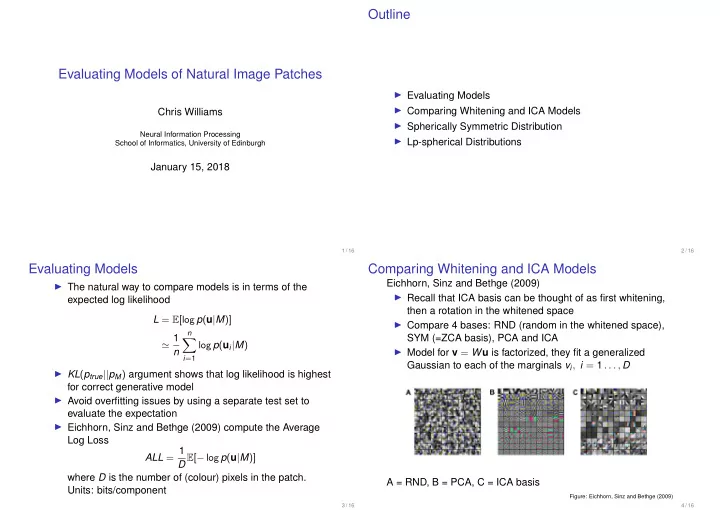
◮ The natural way to compare models is in terms of the expected log likelihood L = E[log p(u|M)] ≃ 1 n

n

  • i=1

log p(ui|M) ◮ KL(ptrue||pM) argument shows that log likelihood is highest for correct generative model ◮ Avoid overfitting issues by using a separate test set to evaluate the expectation ◮ Eichhorn, Sinz and Bethge (2009) compute the Average Log Loss ALL = 1 D E[− log p(u|M)] where D is the number of (colour) pixels in the patch. Units: bits/component

3 / 16

Comparing Whitening and ICA Models

Eichhorn, Sinz and Bethge (2009) ◮ Recall that ICA basis can be thought of as first whitening, then a rotation in the whitened space ◮ Compare 4 bases: RND (random in the whitened space), SYM (=ZCA basis), PCA and ICA ◮ Model for v = Wu is factorized, they fit a generalized Gaussian to each of the marginals vi, i = 1 . . . , D A = RND, B = PCA, C = ICA basis

Figure: Eichhorn, Sinz and Bethge (2009) 4 / 16

slide-2
SLIDE 2

◮ DCS = separation of DC component ◮ Notice the small differences between RND, SYM, PCA and ICA ◮ Spherically symmetric distribution (SSD) is much better, at 1.67 bits/component (cf 1.78 for ICA)

5 / 16

Spherically Symmetric Distribution

p(u) ∝ f(uTΣ−1u) ◮ In general the density has elliptical contours ◮ If f(z) = exp(−z) then this is a Gaussian ◮ Model applies more generally, e.g. multivariate Student-t (heavy tails). ◮ Whitening transformation v = Wu ◮ Spherical model is a function of |v|2 s.t. Σ−1 = W TW ◮ Method is called radial Gaussianization (Lyu & Simoncelli, 2008; Sinz & Bethge, 2008); we first transform with W to get a spherical model, then perform a nonlinear transformation in r = |v| ◮ Can also approximate this e.g. with a mixture of several Gaussians with same (zero) mean but different scaling of the covariance.

6 / 16 Figure credit: Matthias Bethge

◮ The SSD model is a better model for image patches than ICA ◮ However, as it is radially symmetric, it does not prefer the ICA basis over RND, PCA etc. So there seems to be no reason why there should be Gabor-style filters ... ◮ Radial Gaussianization (RG) has a similar effect to contrast gain control (or divisive normalization, DN) g(r) = r √ b + cr 2 ◮ Results in Lyu & Simoncelli (2008) show that RG is superior to DN for image patch modelling

7 / 16 Figure credit: [Lyu and Simoncelli 2009] 8 / 16

slide-3
SLIDE 3

Lp-spherical Distributions

◮ Consider Lp spherical distributions, p(u) = p(||Wu||p) ◮ Lp norm ||x||p = (

D

  • i=1

|xi|p)1/p strictly only a norm for p ≥ 1

9 / 16 Slide credit: Matthias Bethge 10 / 16

Results for Lp-spherical Distributions

Sinz and Bethge (2008) ◮ HAD basis = Hadamard (similar to RND) ◮ For p = 2 all models are invariant to a rotation of basis ◮ Focus on the lower lines (top ones are for a p-generalized Normal distribution) ◮ Results show that lower ALL can be obtained for p < 2

11 / 16

◮ Gabor-type filters (ICA basis) are superior to SYM and HAD bases ◮ However, this effect is weak: the contribution relative to cHAD is less than 2% in redundancy reduction ◮ Sinz and Bethge’s conclusion: “orientation selectivity is not crucial for redundancy reduction, while contrast gain control may play a more important rôle

12 / 16

slide-4
SLIDE 4

Slide credit: Matthias Bethge 13 / 16 Slide credit: Matthias Bethge 14 / 16

◮ Note the technical difficulty in evaluating the ALL for some models (e.g. Karklin and Lewicki, ISA, DBN etc) ◮ The Bethge and Hosseini reference is a patent (WO/2009/146933, published 10.12.2009) ◮ Basically a mixture of GSMs. It works by

◮ assigning an image patch to a specific class ◮ transforming the image patch, with a pre-determined class-specific transformation function ◮ coding and quantizing the transformed coefficients

◮ Mixture of GSMs can be seen as an overcomplete model

15 / 16

References

◮ M. Bethge and R. Hosseini Patent (WO/2009/146933, published 10.12.2009) Method and Device for Image Compression ◮ J. Eichhorn, F. Sinz and M. Bethge. Natural Image Coding in V1: How Much Use Is Orientation Selectivity? PLoS Computational Biology 5(4) e1000336 (2009) ◮ S. Lyu and E. Simoncelli. Nonlinear Extraction of Independent Components of Natural Images Using Radial

  • Gaussianization. Neural Computation 21 1485-1519

(2008) ◮ F. Sinz and M. Bethge. The Conjoint Effect of Divisive Normalization and Orientation Selectivity on Redundancy

  • Reduction. NIPS*2008 (2008)

16 / 16