Outline Database Security: Research Motivation and Practice - - PDF document

outline database security research
SMART_READER_LITE
LIVE PREVIEW

Outline Database Security: Research Motivation and Practice - - PDF document

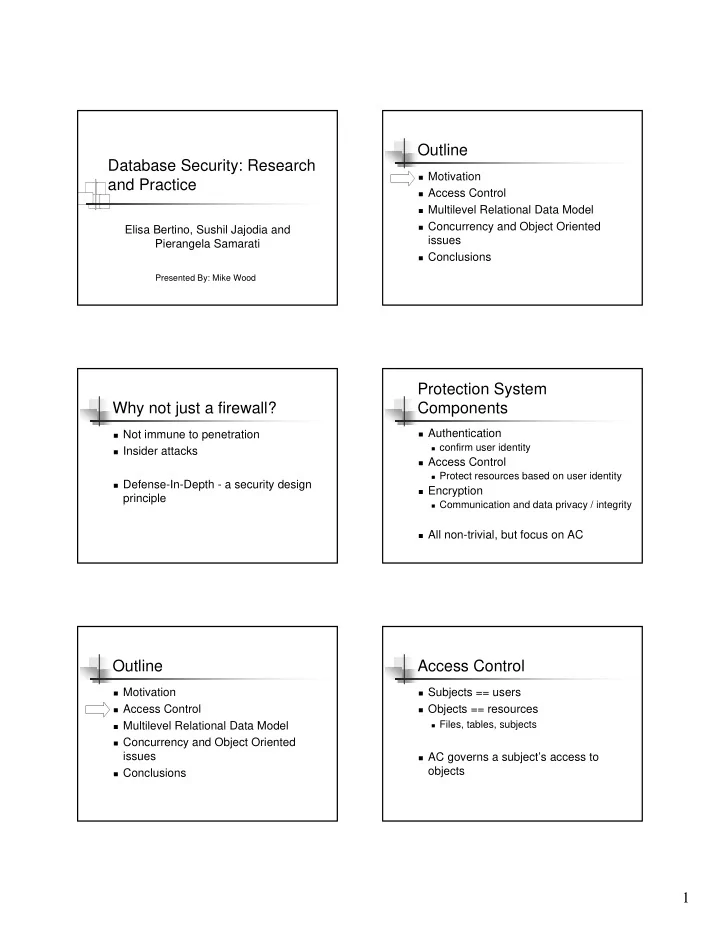
Outline Database Security: Research Motivation and Practice Access Control Multilevel Relational Data Model Concurrency and Object Oriented Elisa Bertino, Sushil Jajodia and issues Pierangela Samarati Conclusions Presented


slide-1
SLIDE 1

1

Database Security: Research and Practice

Elisa Bertino, Sushil Jajodia and Pierangela Samarati

Presented By: Mike Wood

Outline

Motivation Access Control Multilevel Relational Data Model Concurrency and Object Oriented

issues

Conclusions

Why not just a firewall?

Not immune to penetration Insider attacks Defense-In-Depth - a security design

principle

Protection System Components

Authentication

confirm user identity

Access Control

Protect resources based on user identity

Encryption

Communication and data privacy / integrity

All non-trivial, but focus on AC

Outline

Motivation Access Control Multilevel Relational Data Model Concurrency and Object Oriented

issues

Conclusions

Access Control

Subjects == users Objects == resources

Files, tables, subjects

AC governs a subject’s access to

  • bjects
slide-2
SLIDE 2

2

Discretionary Access Control

Users grant authorizations to other

users for access to objects

Centralized Ownership based Decentralized

Key advantage: flexibility Key disadvantage: flexibility

DAC extensions

Groups - similar to roles Non cascading revoke Negative authorizations Enriched semantics for auth. override

Strong overrides weak Specific weak overrides general weak

Mandatory Access Control

Ordered classes

Top Secret > Secret > Confidential …

Subjects and objects assigned a class No read-up

Subject can only read objects of the same or lower

class

No write-down

Subject can only write objects of the same or

higher class

MAC - categories

Example categories = { Ace, Bar }

Group discussion

  • 1. As explained in the paper access classes

can be associated to:

a relation as a whole individual tuples individual attributes individual elements(attribute values )

If you were to choose what kind of

association would you choose and what are some of the factors that will influence your choice?

Outline

Motivation Access Control Multilevel Relational Data Model Concurrency and Object Oriented

issues

Conclusions

slide-3
SLIDE 3

3

Multilevel Relational Model

Idea: use MAC for AC on data

Attribute and tuple granularity

Assign a class to the tuple and each

attribute in the tuple

Multilevel Relation Example

Attribute Classifications Tuple Classification

Multilevel Relation Constraints

No access to a value: appear as NULL Entity integrity

Attributes for PK must be uniformly

classified

Non-key attribute classification must

dominate key attribute classification

Polyinstantiation

Problem: tuples with same key data, but

different classifications

Solution: keep multiple instances

Low tuple High tuple

Invisible Polyinstantiation

Low inserts a tuple Avoids signaling channels

High blocks Low

Avoids integrity issue

Low deletes High

Visible Polyinstantiation

High inserts a tuple

Visible b/c High can read Low tuples

Avoids denial of service

Low blocks High

Avoids signaling channel

High deletes Low

slide-4
SLIDE 4

4

Group Discussion

2.The assignments of access classes to attributes values introduces the notion of multilevel relations . The question is

Why would people want multilevel relations or

polyinstantiations?

Can you name a scenario in which they

would work particularly well or poorly?

Outline

Motivation Access Control Multilevel Relational Data Model Concurrency and Object Oriented

issues

Conclusions

Concurrency Issues

Signaling channels with co-operative

transactions

High transaction modulates abort of Low

transaction

delay time = signal

Discussion

The paper introduced different and quite

sophisticated authorization models (negative authorization, temporal authorization, or authorization with exceptions).

My question is how feasible is to implement

such models in the industry? What are some techniques that might help to reduce the cost

  • f those algorithms?

Discussion

Although lots of work in security is done we all have witnessed how vulnerable the databases and especially web-databases are to malicious attackers. (example recently hackers accessing

  • ver 8 million credit card numbers)
  • Why is that happening ?
  • Is it because the database systems are not secure enough,
  • Is it because the people administrating db are not capable

enough to implement security practices.

  • or is it because of a lack of collaboration between different

parts in the process.

Object Oriented Issues

As discussed, OODB is dead, so who

cares…

slide-5
SLIDE 5

5

Outline

Motivation Access Control Multilevel Relational Data Model Concurrency and Object Oriented

issues

Conclusions

Conclusions & Future Work

No real wrap up Future work

Temporal constraints RBAC and Separation of Duty Derived authorizations Administration and audit tools