
SLIDE 1
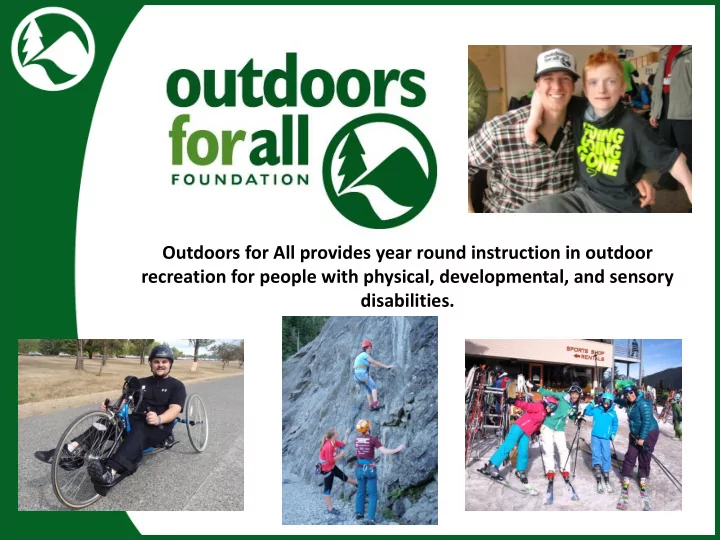
Outdoors for All provides year round instruction in outdoor recreation for people with physical, developmental, and sensory disabilities.
Outdoors for All provides year round instruction in outdoor - - PowerPoint PPT Presentation
Outdoors for All provides year round instruction in outdoor recreation for people with physical, developmental, and sensory disabilities. WHO WE ARE Our beginning : The Outdoors for All Foundation was first incorporated as a nonprofit
Outdoors for All provides year round instruction in outdoor recreation for people with physical, developmental, and sensory disabilities.
WHO WE ARE
Our beginning: The Outdoors for All Foundation was first incorporated as a nonprofit organization in 1979, then known as the Ski for All Foundation. We’ve been enriching the quality of life for children and adults with disabilities in the Pacific Northwest ever since. Our mission: To enrich the quality of life for children and adults with disabilities through outdoor recreation. Our team: We deliver our mission to over 2,400 participants with disabilities thanks to the efforts of 18 year round staff, 19 board members, and the support
Our priorities: Safety first, Fun second, Learning third
Designed to promote fitness, education, independence, socializing, a love of the outdoors -- and of course are a lot
Winter Programs: Downhill Ski, Snowboard, Snowshoe & Nordic Ski Summer Programs: Kayaking, Rock Climbing, Cycling, Hiking, Camping, Weekend Excursions, and Water Skiing Year Round Programs: Day Camps and Custom Events
OUR PROGRAMS
WINTER VOLUNTEER ROLES
SKIHAWKS
THE SUMMIT AT SNOQUALMIE
STEVENS PASS
SKIHAWKS
NORDIC AND SNOWSHOE
CUSTOM EVENTS
times (generally about 30-60 minutes before/after programs).
your school, have your Lead or staff person verify hours weekly or once at the end of the season.
EXPECTATIONS
lessons
students in case of inclement weather. Please consider penciling in an additional date on your calendar before the season starts, so that we have an adequate number of instructors in the event of a make-up lesson.
EXPECTATIONS
Downhill Programs 1st Year Instructors: December 10-11, 17-18 2nd Year Instructors: December 17-18 3rd+ Year Instructors: December 18 Assistant Instructors: December 17 Nordic Programs 1st Year Instructors: December 17-18 2nd+ Year Instructors: December 18 Snowshoe Programs All Instructors: December 18 *Downhill Instructors: Trainings on December 10-11 will be held at Summit West, trainings on December 17-18 will be held at your respective mountain locations. ** All NORDIC and SNOWSHOE trainings will be held at The Summit (Hyak).
ON-MOUNTAIN TRAININGS
Discounted Season Passes
Full-Time, Returning Non-Instructors
application after completing the Online Training
after attending the first weekend of On- Mt’s, only if they have completed the Online Training In-Season Clinics
West
certifications
BENEFITS
Tuesday, November 1st 6:30 – 9pm Pike Brewing Bring friends who are interested in volunteering!
WINTER KICK-OFF PARTY
GOAL SETTING
Types of Goals
SMART Goals
Specific
Measurable Attainable Relevant Time-Bound
Long Term Goals
Outcome of
multiple SMART goals
Examples: SMART Goals
Bad
Sally will link turns Sally will make a friend Sally will have funGood
By the end of the lesson Sally will link 5 turns on the magic carpet
Today, Sally will ask 1 peer if they would like to ski a run with her
By the end of the 7 weeks Sally will learn how to control speed with turns and safety stop so that she can enjoy going fast safely
Examples: Long Term Goals
Sally will ski independently Sally will increase physical fitness Sally will make friends Sally will make the SkiHawks racing team Sally will have fun skiing Teaching Cycle
Introduction Teaching / Learning Guided Discovery On Own / Observation Evaluation Summation
report and PIF
Set goals ParticipantAssessment
DetermineEquipment Needs
Preview yourlesson plan
Get to know yourstudent!
Are they wearingenough clothing? Did they have enough to eat before lesson?
What do we know nowthat will set us up for success and mitigate risk?
Learning Styles
Visual, Auditory, Kinesthetic Teaching Styles
Command Task Reciprocal Guided Discovery Problem Solving Set practice tasks to student’s level Provide specific feedback Set students up for meaningful
independent practice
Choose appropriate terrain
Old ski, new hill New skill, old hill Give student time to practice at his
Verify physical understanding by
comparing his or her performance to the given lesson objectives
Evaluate your student’s performance, be
Evaluate you lesson plan – do you need to
loop back to the “beginning” of the cycle to tweak something?
Review the lesson goals and discuss
accomplishments and/or areas for improvements
Preview the next lesson, establish
guidelines for independent practice
Complete Progress Report together
Assess the Student Introduce the Learning Segment Determine Goals and Plan Objectives Present and Share Information Guide Practice Check for Understand ing Summarize the Learning Segment
Progress Notes: Stand Ski
Progress Note: Sit Ski
1.Safety 2.Fun 3.Learning
Stay with your participant at all times unless they
are transferred to the care of EMS/Ski Patrol, Staff, or Leads.
Report lost participant immediately. Staff will
assist with missing persons search.
Stay Calm and Breathe. These things happen. Always strive to create the safest possible
environment for you and your participant. This means staying within your comfort zone, as an Instructor!
Go directly to Ski Patrol for any medical
treatment, and take head injuries seriously.
Get Help – Stay with the injured person, but send
a competent adult to Ski Patrol.
Protect the Accident Site Protect the Injured Skier/Rider – Stay calm, and
keep the injured person comfortable/calm.
Do Not Discuss the Incident (with anyone other
than Lead Volunteer, Staff, Ski Patrol)
Fill-Out an Incident Report Form – Be thorough
and objective, and complete within 24 hours.
Follow-Up – Staff will follow-up after treatment.
Always stay in control, and be able to stop or avoid other
people or objects.
People ahead of you have the right of way. It is your
responsibility to avoid them.
You must not stop where you obstruct a trail, or are not
visible from above.
Whenever starting downhill or merging into a trail, look
uphill and yield to others.
Always use devices to help prevent runaway equipment. Observe all posted signs and warnings. Keep off closed
trails and out of closed areas.
Prior to using any lift you must have the knowledge and
ability to load, ride and unload safely.
Outdoors for All’s helmet policy requires participants, volunteers and all participating family and caregivers to wear helmets when actively participating in Downhill Skiing, Downhill Snowboarding, and any
released parties. The selection and use of an appropriate helmet is the sole responsibility of the user. Outdoors for All will not be liable for any injury or damages resulting from failure to use a helmet or incorrect use or selection of a helmet.
Any participant who has experienced a grand mal seizure within the last 24 months is required to wear a retention harness while riding the chairlift. It is recommended that a participant who has experienced any other kind of seizure within the past 24 months wear a retention harness on the chairlift. Please bring the “chairlift bar” down on all lessons, and during all clinics, when available. Please ask your Staff or Lead Volunteer, if you are unsure how to bring the bar down because of equipment.
Instructors may not make any adjustments to a participant’s ski bindings. If your participant is having issues with his or her Outdoors for All rental equipment, please see you Equipment Manager or Program Manager for
Managers working with Outdoors for All’s rental ski bindings must be Marker Binding Certified for the current season. If your participant is having issues with his or her personal equipment, or with equipment rented from another
for All staff and volunteers, regardless of his or her training, may not make adjustment to a participant’s personal ski equipment, or equipment that is rented from another organization.
Disability Awareness
Objectives
Have a basic understanding of
who Outdoors for All serves
Person First Language Basic guidelines to work with
individuals with disability
Learn about various diagnoses,
and the equipment used during programs
Every person is different and unique. We all want to be treated with respect, regardless of our ability level.
Participants at Outdoors for All
65% Intellectual/Developmental Disabilities 8% Sensory Impairments 21% Physical Impairments 6% Other Participant ages range from 5 to 87 years
70% of participants are 21 years or younger.
ADD, ADHD), Epilepsy
Sensory Disabilities Visual and Hearing Impairments Physical Disabilities Spinal Cord Injury Cerebral Palsy, Muscular Dystrophy, MultipleSclerosis, Spina Bifida
Amputation (Congenital or Traumatic) Other PTSD, TBI, Stroke Person First Language
Person first language puts the identity of an individualbefore the label of disability.
Always use respectful language, even if theparticipant is derogatory towards themselves. You can say … … person with a disability INSTEAD OF handicapped or disabled person. … George uses a wheelchair INSTEAD OF George is wheelchair-bound. … Brittany has an intellectual disability INSTEAD OF Brittany is mentally retarded. … Paul has autism INSTEAD OF Paul is autistic.
Guidelines for working with individuals with disability:
Teach to independence. Always assume intelligence and
speech is un-impaired.
Never assume someone needs
assistance.
Ask permission to help, and ask how
to help.
Direct your attention to the
participant.
You have resources, we’re here to support you!
Participant Information Forms (PIFs) Progress Reports The participant, and his/her caregiver Previous instructors and Lead Volunteers Outdoors for All Staff
Confidentiality
Please be mindful of CONFIDENTIALITY
when discussing issues/questions/concerns relating to a specific participant.
Any reference to a person’s
appearance, features, religion, age, gender or ability is appropriate only when the reference is pertinent to the conversation.
Share your stories, not personal health
information.
Time to break up into groups!
Stand ID / ASD Stand Phys Dis. Sit