
SLIDE 1
AUTOMATED REASONING SLIDES 17: ORIENTED PARAMODULATION Using Orientation to control Paramodulation Failure in Knuth-Bendix Procedure Knuth Bendix and Theorem Proving KB - AR - 2009
17ai
Oriented Paramodulation
- We can use the idea of ordering an equation to control paramodulation steps:
- Restrict paramodulation by requiring the replacing term to be definitely not
greater than the one being replaced.
- In case an equation can be orientated (ie every instance satisfies LHS>RHS)
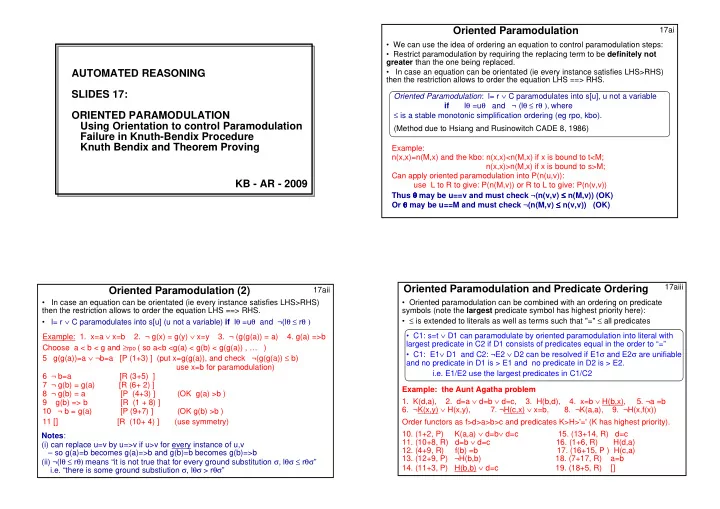
then the restriction allows to order the equation LHS ==> RHS. Oriented Paramodulation: l= r ∨ C paramodulates into s[u], u not a variable if lθ =uθ and ¬ (lθ ≤ rθ ), where ≤ is a stable monotonic simplification ordering (eg rpo, kbo). (Method due to Hsiang and Rusinowitch CADE 8, 1986) Example: n(x,x)=n(M,x) and the kbo: n(x,x)<n(M,x) if x is bound to t<M; n(x,x)>n(M,x) if x is bound to s>M; Can apply oriented paramodulation into P(n(u,v)): use L to R to give: P(n(M,v)) or R to L to give: P(n(v,v)) Thus θ θ θ θ may be u==v and must check ¬(n(v,v) ≤ ≤ ≤ ≤ n(M,v)) (OK) Or θ θ θ θ may be u==M and must check ¬(n(M,v) ≤ ≤ ≤ ≤ n(v,v)) (OK) 17aii Example: 1. x=a ∨ x=b 2. ¬ g(x) = g(y) ∨ x=y 3. ¬ (g(g(a)) = a) 4. g(a) =>b Choose a < b < g and ≥rpo ( so a<b <g(a) < g(b) < g(g(a)) , … ) 5 g(g(a))=a ∨ ¬b=a [P (1+3) ] (put x=g(g(a)), and check ¬(g(g(a)) ≤ b) use x=b for paramodulation) 6 ¬ b=a [R (3+5) ] 7 ¬ g(b) = g(a) [R (6+ 2) ] 8 ¬ g(b) = a [P (4+3) ] (OK g(a) >b ) 9 g(b) => b [R (1 + 8) ] 10 ¬ b = g(a) [P (9+7) ] (OK g(b) >b ) 11 [] [R (10+ 4) ] (use symmetry)
Oriented Paramodulation (2)
- In case an equation can be orientated (ie every instance satisfies LHS>RHS)
then the restriction allows to order the equation LHS ==> RHS.
- l= r ∨ C paramodulates into s[u] (u not a variable) if lθ =uθ and ¬(lθ ≤ rθ )
Notes: (i) can replace u=v by u=>v if u>v for every instance of u,v – so g(a)=b becomes g(a)=>b and g(b)=b becomes g(b)=>b (ii) ¬(lθ ≤ rθ) means “it is not true that for every ground substitution σ, lθσ ≤ rθσ” i.e. “there is some ground substiution σ, lθσ > rθσ” 17aiii
- Oriented paramodulation can be combined with an ordering on predicate
symbols (note the largest predicate symbol has highest priority here):
- ≤ is extended to literals as well as terms such that "=" ≤ all predicates
Example: the Aunt Agatha problem
- 1. K(d,a), 2. d=a ∨ d=b ∨ d=c, 3. H(b,d), 4. x=b ∨ H(b,x), 5. ¬a =b
- 6. ¬K(x,y) ∨ H(x,y), 7. ¬H(c,x) ∨ x=b, 8. ¬K(a,a), 9. ¬H(x,f(x))
Order functors as f>d>a>b>c and predicates K>H>'=' (K has highest priority).
- 10. (1+2, P) K(a,a) ∨ d=b∨ d=c 15. (13+14, R) d=c
- 11. (10+8, R) d=b ∨ d=c 16. (1+6, R) H(d,a)
- 12. (4+9, R) f(b) =b 17. (16+15, P ) H(c,a)
- 13. (12+9, P) ¬H(b,b) 18. (7+17, R) a=b
- 14. (11+3, P) H(b,b) ∨ d=c 19. (18+5, R) []
Oriented Paramodulation and Predicate Ordering
- C1: s=t ∨ D1 can paramodulate by oriented paramodulation into literal with
largest predicate in C2 if D1 consists of predicates equal in the order to “=”
- C1: E1∨ D1 and C2: ¬E2 ∨ D2 can be resolved if E1σ and E2σ are unifiable