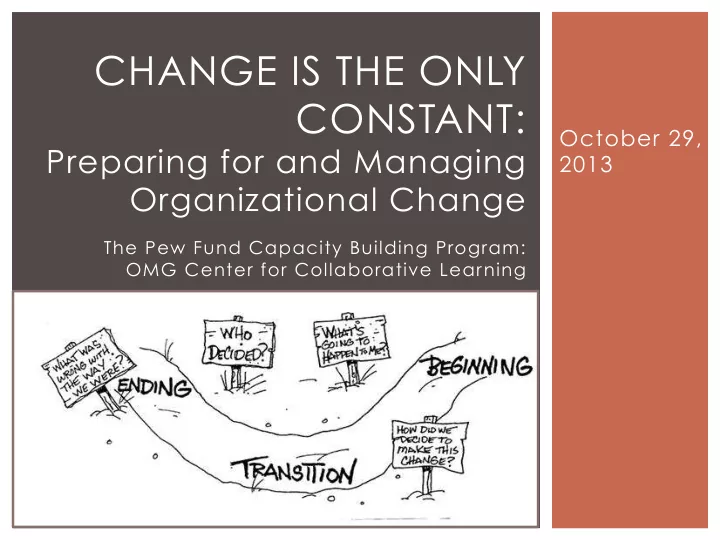
SLIDE 1 October 29, 2013
CHANGE IS THE ONLY CONSTANT:
Preparing for and Managing Organizational Change
The Pew Fund Capacity Building Program: OMG Center for Collaborative Learning
SLIDE 2
¡ Capacity: the ability or power to do, experience, or understand something. ¡ Change: to make or become different.
Workshop Presented By: Meghan McVety, Capacity for Change, LLC www.capacityforchange.com
CAPACITY FOR CHANGE
SLIDE 3
SLIDE 4 Change creates and offers windows for improvement (or decline). How an
acts determines the path.
SLIDE 5
Managing change successfully is possible, and more often than not, it is in your control.
SLIDE 6
Exploring today:
v How capacity building can effect change v Change interventions v Being prepared for planned versus unplanned change v Supporting people in times of change
SLIDE 7
UNDERSTANDING CHANGE
SLIDE 8
- 1. Unfreeze
- 2. Change
- 3. Refreeze
THREE STEPS
SLIDE 9 Slide from Charlie Rudd, based on Satir change model: www.solutionsiq.com
Planned ¡or ¡Unplanned ¡ ¡
SLIDE 10 Slide from Charlie Rudd, based on Satir change model: www.solutionsiq.com
SLIDE 11
UNDERSTANDING ORGANIZATIONS
SLIDE 12
ORGANIZATION AS A SYSTEM
SLIDE 13
ORGANIZATION AS A SYSTEM
¡ All parts of the system must be integrated ¡ Take into consideration how decisions affect all parts of the system
¡ A high-functioning system continually exchanges feedback among its various parts to ensure they remain closely aligned and focused on achieving the goal of the system.
SLIDE 14 Organizational Goals
Leadership Programs Administrative Support Communications Finance and Management
SLIDE 15 Organizational Goals Leadership Programs Administrative Support
Communications
Finance and Management
SLIDE 16 Organizational Goals Leadership Programs Administrative Support Communications Finance and Management
SLIDE 17 WHY ORGANIZATIONS ARE NOT ALIGNED…
Philosophical Considerations ¡ Are we operating with the same definitions? ¡ Are different views of
¡ Are different disciplines and models aligned? Operational Considerations ¡ Lack of systems approach – knowing and responding to what each part of the system needs and how it works together ¡ Understanding sub- systems ¡ Communicating across systems
SLIDE 18 WHY ORGANIZATIONS ARE NOT ALIGNED…
Philosophical Considerations Are we operating with the same definitions? How are our different views of our work integrated? How are different disciplines and models aligned? Operational Considerations Lack of systems approach and integration – knowing what each part of the system needs and how it works together Understanding sub- systems Communicating across systems
Diagnosis ¡if ¡not ¡aligned: ¡ ¡
- What ¡happened ¡that ¡caused ¡the ¡
mis-‑alignment? ¡(Or ¡made ¡you ¡ aware ¡of ¡it?) ¡
- What ¡intervention ¡is ¡needed ¡to ¡
achieve ¡alignment? ¡
SLIDE 19 Organizational Goals Leadership Programs Administrative Support Communications Finance and Management
Alignment is the ideal state to achieve optimal individual, team, and
performance.
Aligned
handle change well.
SLIDE 20
CHANGE INTERVENTIONS: ACHIEVING ALIGNMENT
SLIDE 21 CHANGE INTERVENTIONS
- 1. Management development
- 2. Organizational learning
- 3. Work systems
- 4. Organizational structure
- 5. Organizational culture
- 6. Strategic planning
SLIDE 22 Interventions
development
learning
- 3. Work systems
- 4. Organizational
structure
culture
planning
¡ Leadership turnover ¡ Funding (changes in revenue, funder priorities) ¡ Technology ¡ Low morale/conflict ¡ Community needs and opportunities ¡ Crisis ¡ Performance gaps ¡ Lack of focus ¡ Mergers
SOME MOMENTS TO INTERVENE
SLIDE 23
¡ Management: § Functions and styles § Development of managers through training and coaching ¡ Goal setting and performance appraisals ¡ Team-building ¡ Conflict management
MANAGEMENT DEVELOPMENT
SLIDE 24 ¡ Promoting, rewarding, and capturing
§ Creating continuous learning
§ Promoting inquiry and dialogue § Encouraging collaboration and team learning § Establishing systems to capture and share learning § Empowering people to have a collective vision
ORGANIZATIONAL LEARNING
SLIDE 25
¡ Technical processes: § Reporting § Technology § Finance and administration § Policies and procedures WORK SYSTEMS
SLIDE 26
¡ How responsibility and authority are assigned: § Must fit the organization’s environment, strategy, size, and focus § Must support and encourage the desired organizational culture § Includes individual job design § Clear work flow processes
ORGANIZATIONAL STRUCTURE
SLIDE 27
ORGANIZATIONAL CULTURE Strategy
Structure
Human Processes Technical Processes
Culture
SLIDE 28
WHAT IS ORGANIZATIONAL CULTURE?
“I don’t know how it started, either, but I would never come to work without my hat.”
SLIDE 29 Organizational Culture
SHARED NORMS AND PRACTICES
Culture
Stories Symbols
Power Structures
Control Systems Organiza
Structures
Rituals & Routines
SLIDE 30 STRATEGIC PLANNING
A systematic process of envisioning a desired future, and translating this vision into broadly defined goals or
- bjectives and a sequence of steps
to achieve them. Discovery | Design | Implementation
SLIDE 31
What happens when strategy and culture meet?
SLIDE 32
Turnover
Funding
Movements and Moments
SLIDE 33 DISCUSSION QUESTIONS
- 1. What stands out as a priority
for your organization?
- 2. What made you aware of the
change that’s needed?
- 3. What are your plans (and do
your colleagues have tips for you)?
SLIDE 34
MANAGING CHANGE
SLIDE 35
Force Field Analysis
Driving Forces Status Quo Resisting Forces
SLIDE 36 DIFFERING RESPONSES TO CHANGE
¡ Depends on a person’s perception
- f how change will affect them
¡ Driving Forces versus Resisting Forces
§ Empower Driving Forces § Manage Resisting Forces
SLIDE 37 Crossing the Chasm, Geoffrey Moore
SLIDE 38
A RULE TO THRIVE BY
People first.
SLIDE 39 FOR CHANGE TO WORK – POSITIVELY
Phase 1: Identify the Change Phase 2: Engage People in the Change Phase 3: Implement the Change
SLIDE 40 FOR CHANGE TO WORK – POSITIVELY
Phase 1: Identify the Change Phase 2: Engage People in the Change Phase 3: Implement the Change
SLIDE 41 IDENTIFY ENGAGE IMPLEMENT
- Name the change
- Get people’s
attention
change process – what to expect
potential frustrations
culture dynamics
the change – create a compelling vision
- f the future state
- Ask for input – how
to do it
drawn from your team, execute on the change
PHASES OF CHANGE
SLIDE 42
SIX CHANGE MANAGEMENT TIPS FOR LEADERS
SLIDE 43
6: Don’t fear failure — encourage it.
SLIDE 44
5: Engage people in designing solutions.
SLIDE 45
4: Document the intended change and the process for getting there.
SLIDE 47
2: Set the tone with a guiding vision that is desirable, feasible, and sustainable.
SLIDE 48 #1: com· mu· ni· cate
kəˈmyo͞onəˌkāt/ Verb
share or exchange information, news, or ideas. synonyms: be in touch, be in contact, have dealings, interface, interact, commune, meet, liaise
SLIDE 49
INSTITUTIONALIZING CHANGE
SLIDE 50 JOHN KOTTER’S 8-STEP PROCESS
- 1. Establish a sense of urgency
- 2. Create a guiding coalition
- 3. Develop a vision and strategy for the specific
change
- 4. Communicate the vision and plan
- 5. Empower employees for broad-based action
- 6. Generate short-term wins
- 7. Consolidate gains and produce more
change
- 8. Anchor the change in the culture
SLIDE 51 October 29, 2013
CHANGE IS THE ONLY CONSTANT:
Preparing for and Managing Organizational Change
The Pew Fund Capacity Building Program: OMG Center for Collaborative Learning