Options and Outcomes in the Consultant (ad hoc) Management of - - PowerPoint PPT Presentation

options and outcomes in the
SMART_READER_LITE
LIVE PREVIEW

Options and Outcomes in the Consultant (ad hoc) Management of - - PowerPoint PPT Presentation

12/3/2016 Disclosure Anthony J. Aldave, M.D. Options and Outcomes in the Consultant (ad hoc) Management of Corneal Limbal Stem 5AM Ventures Cell Deficiency Avellino Laboratories W. L. Gore & Associates The University of


slide-1
SLIDE 1

12/3/2016 1

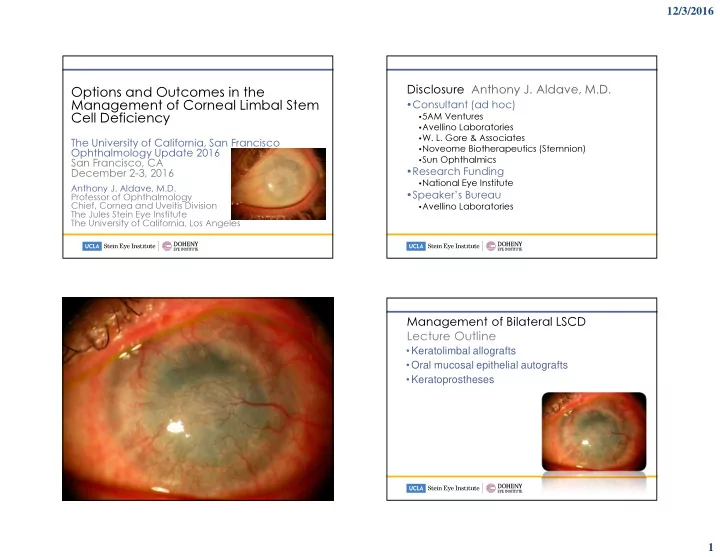
Options and Outcomes in the Management of Corneal Limbal Stem Cell Deficiency

The University of California, San Francisco Ophthalmology Update 2016 San Francisco, CA December 2-3, 2016

Anthony J. Aldave, M.D. Professor of Ophthalmology Chief, Cornea and Uveitis Division The Jules Stein Eye Institute The University of California, Los Angeles

Disclosure Anthony J. Aldave, M.D.

  • Consultant (ad hoc)
  • 5AM Ventures
  • Avellino Laboratories
  • W. L. Gore & Associates
  • Noveome Biotherapeutics (Stemnion)
  • Sun Ophthalmics
  • Research Funding
  • National Eye Institute
  • Speaker’s Bureau
  • Avellino Laboratories

Management of Bilateral LSCD Lecture Outline

  • Keratolimbal allografts
  • Oral mucosal epithelial autografts
  • Keratoprostheses
slide-2
SLIDE 2

12/3/2016 2 Management of Bilateral LSCD Lecture Outline

  • Keratolimbal allografts
  • Oral mucosal epithelial autografts
  • Keratoprostheses

Management of Bilateral LSCD Keratolimbal Allografts Indications

  • All 26 studies were noncomparative case series
  • No randomized clinical trials
  • 31% (8/26) of studies surveyed bilateral severe
  • r total LSCD alone
  • Keratolimbal allograft (KLAL) with systemic

immunosuppression in 75% (6/8)

  • Chemical or thermal burn (n = 67)
  • Aniridia (n = 40)
  • Stevens-Johnson syndrome (n = 27)

Cauchi PA, Ang GS, Azuara-Blanco A, Burr JM. A systematic literature review of surgical interventions for limbal stem cell deficiency in humans. Am J Ophthalmol. 2008;146:251-259.

Management of Bilateral LSCD Keratolimbal Allografts Vision

  • Improvement in CDVA > 2 Snellen lines
  • 56% (14/25) of eyes1
  • 67% (10/15) of eyes2
  • 81% (13/16) of eyes3
  • 90% (9/10) of eyes4
  • Not specified in 4 of the 8 studies5

1Holland EJ. Epithelial transplantation for the management of severe ocular surface disease. Trans Am Ophthalmol Soc.

1996;94:677-743.

2Inatomi T, Nakamura T, Koizumi N, et al. Midterm results on ocular surface reconstruction using cultivated autologous

  • ral mucosal epithelial transplantation. Am J Ophthalmol. 2006 ;141(2):267-275.

3Tsai RJ, Tseng SC. Human allograft limbal transplantation for corneal surface reconstruction. Cornea. 1994 ;13:389-400. 4Ivekovic R, Tedeschi-Reiner E, Novak-Laus K, Andrijevic-Derk B, Cima I, Mandic Z. Limbal graft and/or amniotic

membrane transplantation in the treatment of ocular burns. Ophthalmologica. 2005;219:297-302.

5Cauchi PA, Ang GS, Azuara-Blanco A, Burr JM. A systematic literature review of surgical interventions for limbal stem cell

deficiency in humans. Am J Ophthalmol. 2008;146:251-259.

slide-3
SLIDE 3

12/3/2016 3

Solomon A, Ellies P, Anderson DF, Touhami A, Grueterich M, Espana EM, Ti SE, Goto E, Feuer WJ, Tseng SC. Long-term

  • utcome of keratolimbal allograft with or without penetrating keratoplasty for total limbal stem cell deficiency.
  • Ophthalmology. 2002;109:1159-66.

Management of Bilateral LSCD Keratolimbal Allografts Survival

Ilari L, Daya SM. Long-term outcomes of keratolimbal allograft for the treatment of severe ocular surface

  • disorders. Ophthalmology. 2002;109:1278-84.

Management of Bilateral LSCD Keratolimbal Allografts Survival

Han ES, Wee WR, Lee JH, Kim MK. Long-term outcome and prognostic factor analysis for keratolimbal allografts. Graefes Arch Clin Exp Ophthalmol. 2011;249:1697-704.

Management of Bilateral LSCD Keratolimbal Allografts Survival

slide-4
SLIDE 4

12/3/2016 4

Holland EJ, Mogilishetty G, Skeens HM, Hair DB, Neff KD, Biber JM, Chan CC. Systemic immunosuppression in

  • cular surface stem cell transplantation: results of a 10-year experience. Cornea. 2012;31(6):655-61.

Management of Bilateral LSCD Lecture Outline

  • Keratolimbal allografts
  • Oral mucosal epithelial autografts
  • Keratoprostheses

Management of Corneal LSCD Oral Mucosal Epithelial Autograft

Nishida K, Yamato M, Hayashida Y, et al. Corneal reconstruction with tissue-engineered cell sheets composed of autologous oral mucosal epithelium. N Engl J Med. 2004;351:1187-96.

slide-5
SLIDE 5

12/3/2016 5

Inatomi T, Nakamura T, Koizumi N, Sotozono C, Yokoi N, Kinoshita S. Midterm results on ocular surface reconstruction using cultivated autologous oral mucosal epithelial transplantation. Am J Ophthalmol. 2006;141:267-275. Satake Y, Higa K, Tsubota K, Shimazaki J. Long-term outcome of cultivated oral mucosal epithelial sheet transplantation in treatment of total limbal stem cell deficiency. Ophthalmology. 2011;118: 1524-30.

slide-6
SLIDE 6

12/3/2016 6 Management of Bilateral LSCD Lecture Outline

  • Keratolimbal allografts
  • Oral mucosal epithelial autografts
  • Keratoprostheses

27% 25% 16% 13% 7% 6% 4%

SJS Graft failure Chemical injury Corneal scarring/vascularization MMP Aniridia MMC / Topcial medication toxicity Cicatrizing conjunctivitis

Management of Bilateral LSCD Boston Keratoprosthesis Indications 68 of 173 Procedures Management of Bilateral LSCD Boston Keratoprosthesis Visual Acuity

slide-7
SLIDE 7

12/3/2016 7 Management of Bilateral LSCD Comparative Visual Outcomes

  • Keratolimbal allografts
  • Post-op VA > 20/200 in 44% of eyes1,2
  • COMET
  • Pre-op VA > 20/200 in 0% of eyes
  • Post-op VA > 20/200 in 27% of eyes at 3-34 months3
  • Boston keratoprosthesis
  • Pre-op VA > 20/200 in 7% of eyes
  • Post-op VA > 20/200 in 77%, 88% and 86% of eyes

at 1, 3 and 5 years

1. Shi W, Gao H, Wang T, et al. Combined penetrating keratoplasty and keratolimbalallograft transplantation in comparison with corneoscleraltransplantation in the treatment of severe eye burns. Clin Experiment Ophthalmol 2008;36:501–7.

  • 2. Solomon A, Ellies P, Anderson DF, et al. Long-term outcome of keratolimbal allograft with or without penetrating keratoplasty for total limbalstem cell deficiency. Ophthalmology 2002;109:1159–66.
  • 3. Inatomi T, Nakamura T, Koizumi N, Sotozono C, Yokoi N, Kinoshita S. Midterm results on ocular surface reconstruction using cultivated autologous oral mucosal epithelialtransplantation. Am J
  • Ophthalmol. 2006;141:267-275.

Management of LSCD Boston Keratoprosthesis Retention

Cumulative Proportion of Retention

0.0 0.2 0.4 0.6 0.8 1.0

Length of Follow-up (Months)

24 48 72 96 120 LSCD Non-LSCD

Management of LSCD Boston Kpro vs KLAL Retention vs Survival

Solomon A, Ellies P, Anderson DF, Touhami A, Grueterich M, Espana EM, Ti SE, Goto E, Feuer WJ, Tseng SC. Long-term outcome of keratolimbal allograft with

  • r without penetrating keratoplasty for total limbal stem cell deficiency.Ophthalmology. 2002;109:1159-66.

Cumulative Proportion of Retention

0.0 0.2 0.4 0.6 0.8 1.0

Length of Follow-up (Months)

24 48 72 96 120 LSCD Non-LSCD

Management of LSCD Boston Kpro vs KLAL Retention vs Survival

Cumulative Proportion of Retention

0.0 0.2 0.4 0.6 0.8 1.0

Length of Follow-up (Months)

24 48 72 96 120 LSCD Non-LSCD Ilari L, Daya SM. Long-term outcomes of keratolimbal allograft for the treatment of severe ocular surface disorders. Ophthalmology. 2002;109:1278-84.

slide-8
SLIDE 8

12/3/2016 8 Management of LSCD Boston Kpro vs KLAL Retention vs Survival

Cumulative Proportion of Retention

0.0 0.2 0.4 0.6 0.8 1.0

Length of Follow-up (Months)

24 48 72 96 120 LSCD Non-LSCD Han ES, Wee WR, Lee JH, Kim MK. Long-term outcome and prognostic factor analysis for keratolimbal allografts. Graefes Arch Clin Exp Ophthalmol. 2011 Nov;249(11):1697-704.

Management of LSCD Boston Kpro vs COMET Retention vs Survival

Cumulative Proportion of Retention

0.0 0.2 0.4 0.6 0.8 1.0

Length of Follow-up (Months)

24 48 72 96 120 LSCD Non-LSCD Satake Y, Higa K, Tsubota K, Shimazaki J. Long-term outcome of cultivated oral mucosal epithelial sheet transplantation in treatment of total limbal stem cell

  • deficiency. Ophthalmology. 2011;118: 1524-30.

Management of LSCD Boston Keratoprosthesis Complications Management of LSCD Boston Keratoprosthesis Complications

slide-9
SLIDE 9

12/3/2016 9

Satake Y, Higa K, Tsubota K, Shimazaki J. Long-term outcome of cultivated oral mucosal epithelial sheet transplantation in treatment of total limbal stem cell deficiency. Ophthalmology. 2011;118: 1524-30.

  • Boston keratoprosthesis
  • Provides superior visual outcomes when compared to

the published literature on allogenic keratolimbal and

  • ral mucosal epithelial transplantation

Management of Bilateral LSCD Conclusions Visual Outcomes

  • Boston keratoprosthesis
  • Retention rate at 5 years is higher than survival rate
  • f keratolimbal allografts and oral mucosal epithelial

autografts

Management of Bilateral LSCD Conclusions Retention

  • Boston keratoprosthesis
  • Avoids expense and risks associated with systemic

immunosuppression

  • Only complication significantly more common in eyes

with LSCD compared to eyes without is persistent epithelial defect

Management of Bilateral LSCD Conclusions Complications

slide-10
SLIDE 10

12/3/2016 10

  • The Boston keratoprosthesis is the evidence-

based procedure of choice for managing bilateral limbal stem cell deficiency

Management of Bilateral LSCD Conclusions

Thank You for Your Attention!

  • aldave@jsei.ucla.edu