OPRA Issues and Workload Everything set forth in this document and - - PDF document

opra issues and workload
SMART_READER_LITE
LIVE PREVIEW

OPRA Issues and Workload Everything set forth in this document and - - PDF document

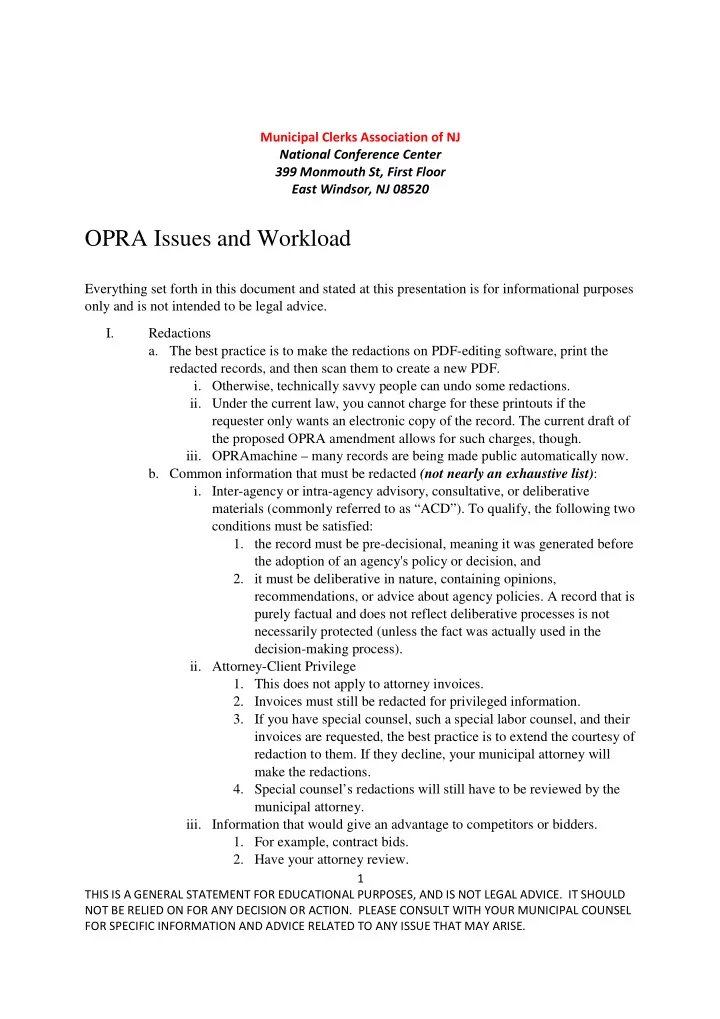
Municipal Clerks Association of NJ National Conference Center 399 Monmouth St, First Floor East Windsor, NJ 08520 OPRA Issues and Workload Everything set forth in this document and stated at this presentation is for informational purposes only


slide-1
SLIDE 1

1 THIS IS A GENERAL STATEMENT FOR EDUCATIONAL PURPOSES, AND IS NOT LEGAL ADVICE. IT SHOULD NOT BE RELIED ON FOR ANY DECISION OR ACTION. PLEASE CONSULT WITH YOUR MUNICIPAL COUNSEL FOR SPECIFIC INFORMATION AND ADVICE RELATED TO ANY ISSUE THAT MAY ARISE.

Municipal Clerks Association of NJ National Conference Center 399 Monmouth St, First Floor East Windsor, NJ 08520

OPRA Issues and Workload

Everything set forth in this document and stated at this presentation is for informational purposes

  • nly and is not intended to be legal advice.

I. Redactions

  • a. The best practice is to make the redactions on PDF-editing software, print the

redacted records, and then scan them to create a new PDF.

  • i. Otherwise, technically savvy people can undo some redactions.
  • ii. Under the current law, you cannot charge for these printouts if the

requester only wants an electronic copy of the record. The current draft of the proposed OPRA amendment allows for such charges, though.

  • iii. OPRAmachine – many records are being made public automatically now.
  • b. Common information that must be redacted (not nearly an exhaustive list):
  • i. Inter-agency or intra-agency advisory, consultative, or deliberative

materials (commonly referred to as “ACD”). To qualify, the following two conditions must be satisfied:

  • 1. the record must be pre-decisional, meaning it was generated before

the adoption of an agency's policy or decision, and

  • 2. it must be deliberative in nature, containing opinions,

recommendations, or advice about agency policies. A record that is purely factual and does not reflect deliberative processes is not necessarily protected (unless the fact was actually used in the decision-making process).

  • ii. Attorney-Client Privilege
  • 1. This does not apply to attorney invoices.
  • 2. Invoices must still be redacted for privileged information.
  • 3. If you have special counsel, such a special labor counsel, and their

invoices are requested, the best practice is to extend the courtesy of redaction to them. If they decline, your municipal attorney will make the redactions.

  • 4. Special counsel’s redactions will still have to be reviewed by the

municipal attorney.

  • iii. Information that would give an advantage to competitors or bidders.
  • 1. For example, contract bids.
  • 2. Have your attorney review.
slide-2
SLIDE 2

2 THIS IS A GENERAL STATEMENT FOR EDUCATIONAL PURPOSES, AND IS NOT LEGAL ADVICE. IT SHOULD NOT BE RELIED ON FOR ANY DECISION OR ACTION. PLEASE CONSULT WITH YOUR MUNICIPAL COUNSEL FOR SPECIFIC INFORMATION AND ADVICE RELATED TO ANY ISSUE THAT MAY ARISE.

  • 3. Usually will not apply to bids after the contract was awarded.
  • iv. Social security number, credit card number, unlisted telephone number,

driver license number, personal email addresses, unlisted cell phone numbers, banking/debit card numbers and related types of identifiers.

  • 1. For the personal email addresses, unlisted cell phone numbers, and

financial account number redactions, you will have to cite to GRC

  • r court precedent instead of N.J.S.A. 41:1A-1.1.
  • 2. The current draft of the proposed amendment includes the

exclusion of personal email addresses, etc… as part of the definition of a government record.

  • v. Personnel or pension records (cite N.J.S.A. 47:1A-10) except for:
  • 1. An individual’s name, title, position, salary, payroll record, length
  • f service, date of separation and the reason therefor, and the

amount and type of any pension received.

  • 2. When disclosure is required by another law.
  • 3. When disclosure is essential to the performance of official duties.
  • 4. When disclosure is authorized by an individual in interest.
  • a. It has to be clear that there was a voluntary waiver of the

individual’s privacy rights.

  • b. Per GRC precedent, custodians cannot require the

execution of a release form prior to releasing the records. But it must be clear from the request, or from the communications regarding the record, that the requester knows of his or her privacy rights in the records and knowingly waives them.

  • c. A request for the entire personnel file is overly broad and

fails to identify specific government records.

  • d. Resignation letters are a part of a personnel file. They are

sometimes part of the personnel file of someone other than the person resigning (e.g., a person resigns and in the resignation letter he complains about a co-worker – the co- worker may have the right to access the resignation letter).

  • e. Is the standard higher when a request is made through

OPRAmachine?

  • 5. Data showing specific experiential, educational or medical

qualifications required for government employment or for receipt

  • f a public pension, but not including any detailed medical or

psychological information.

  • a. Employment applications may be disclosed under OPRA to

the extent that this exception applies, but all other information must be redacted.

slide-3
SLIDE 3

3 THIS IS A GENERAL STATEMENT FOR EDUCATIONAL PURPOSES, AND IS NOT LEGAL ADVICE. IT SHOULD NOT BE RELIED ON FOR ANY DECISION OR ACTION. PLEASE CONSULT WITH YOUR MUNICIPAL COUNSEL FOR SPECIFIC INFORMATION AND ADVICE RELATED TO ANY ISSUE THAT MAY ARISE.

  • b. However, news organizations have a common-law right of

access to employment applications that goes beyond the scope of this exception. The applications must still be redacted to protect private information.

  • vi. Personal information when disclosure would violate a person’s reasonable

expectation of privacy (N.J.S.A. 47:1A-1).

  • c. A Vaughn index (also known as a privilege log) must accompany any redacted

records, setting forth the basis for each redaction and certain information such as the date, type of record, sender and recipient (if applicable), and general subject matter. II. Certain Timing Issues

  • a. Practice Tip: Date stamp every OPRA request immediately upon receipt.
  • b. Practice Tip: Create an OPRA log for internal tracking and set calendar

reminders.

  • c. Immediate access is required for: (1) budgets; (2) bills; (3) vouchers; (4)

contracts, including collective negotiations agreements and individual employment agreements; and (5) public employee salary and overtime information.

  • i. There is no definition of what “immediate access” means, but the records

should be provided as soon as possible.

  • ii. At the very least, you must respond to the requester immediately and

advise if you need to consult legal counsel or if the request is being denied.

  • iii. The current draft of the proposed amendment includes a definition of

immediate access, which is by 5 PM if the request is received before noon

  • f that day, and by noon of the next day if the request is received after

noon.

  • d. If a request is complex or requires many redactions, send it to your attorney

as soon as possible.

  • e. Practice Tip: Consider, and discuss with your attorney, denying improper portions
  • f requests instead of asking for clarification (the effect is the same).

III. Cell Phones and Social Media

  • a. Refer to NJ Law Journal Article provided with these materials (authored by the

presenter).

  • b. DO NOT use your private electronic devices or social media accounts to conduct
  • fficial business.
  • c. Logs of private cell phone calls are currently not considered government records,

but the best practice is even to limit those calls. IV. No Special Treatment V. OPRA Request Forms

  • a. Requesters do not have to use your official OPRA request form.
slide-4
SLIDE 4

4 THIS IS A GENERAL STATEMENT FOR EDUCATIONAL PURPOSES, AND IS NOT LEGAL ADVICE. IT SHOULD NOT BE RELIED ON FOR ANY DECISION OR ACTION. PLEASE CONSULT WITH YOUR MUNICIPAL COUNSEL FOR SPECIFIC INFORMATION AND ADVICE RELATED TO ANY ISSUE THAT MAY ARISE.

  • b. The still have to submit a valid request (e.g., cannot be oral, must mention

OPRA).

  • c. Indictable Offense Certification
  • i. Per N.J.S.A. 47:1A-2.2(a), a person convicted of an indictable offense

cannot obtain records relating to the victim.

  • ii. Per Subsection (c), “a custodian shall not comply with an anonymous

request for a government record which is protected under the provisions of this section.”

  • iii. Always consult your attorney if there is an anonymous request seeking

records containing personal information.

  • d. Discuss using the GRC model OPRA request form. Deficient forms can result in

requests being deemed denied. VI. Certain Issues with Denials

  • a. You are generally under no obligation to search outside your municipalities files

to find the documents being requested. However, as with ever other part of this

  • utline and presentation, always consult your attorney first.
  • i. This does not apply if there was an intent to circumvent OPRA by sending

the records to a different agency.

  • ii. We are seeing this issue in recent request for records from municipality

police departments where the municipality has no police department of its

  • wn.
  • b. The GRC has no authority to decide the types of records an agency must keep.
  • c. The GRC has no authority to create retention schedules.
  • d. What to do as a records custodian when agency employees or the governing body

are withholding the documents you request from them?

  • i. Try your best.
  • ii. This becomes a political question, and possibly a fight in the superior

court.

  • iii. Keep records of the refusals to turn over documents.

VII. Proposed Amendment (just some selected points)

  • a. Some notes already mentioned above (e.g., additional printing charges, definition
  • f “immediate access”).
  • b. Would allow agencies to charge a special administrative charge when a request is

for a commercial purpose.

  • c. Puts a burden on public agencies actually to make records required to be made by

law.

  • d. “3(b)” exception for information relating to criminal activity changed to records

containing such information, which must be produced in 24 hours.

  • e. Would allow employees who receive OPRA requests to respond to same at the

direction of the clerk, but the liability is still on the clerk.

slide-5
SLIDE 5

5 THIS IS A GENERAL STATEMENT FOR EDUCATIONAL PURPOSES, AND IS NOT LEGAL ADVICE. IT SHOULD NOT BE RELIED ON FOR ANY DECISION OR ACTION. PLEASE CONSULT WITH YOUR MUNICIPAL COUNSEL FOR SPECIFIC INFORMATION AND ADVICE RELATED TO ANY ISSUE THAT MAY ARISE.

  • f. Would require the GRC to render a decision within 150 days. If the GRC fails to

do so, the requester can file in superior court (even though the 45-day window to file there has ended).

  • g. Would give public entities a cause of action to obtain injunctions against

requesters who are abusing OPRA.