
SLIDE 1
creating
- pportunity
for families: a two- generation Approach
2015 Student Parent Support Symposium May 27, 2015
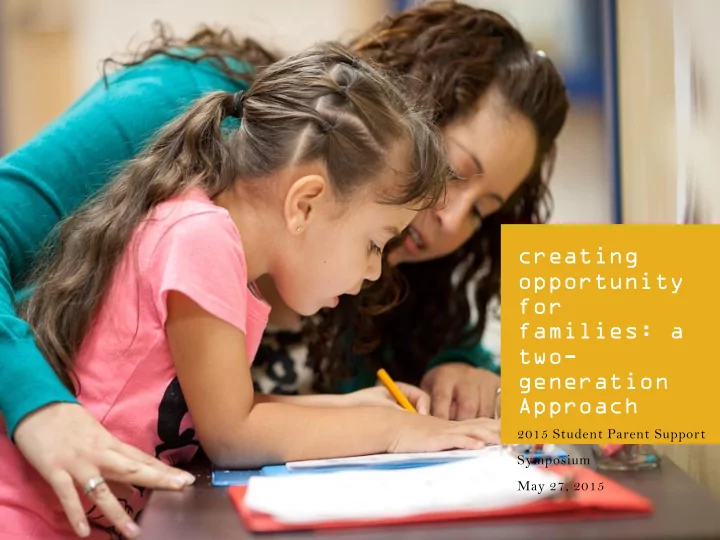
opportunity for families: a two- generation Approach 2015 - - PowerPoint PPT Presentation
creating opportunity for families: a two- generation Approach 2015 Student Parent Support Symposium May 27, 2015 Our Agenda Welcome and Introductions Creating Opportunities for Families The Data and Challenge The Approach
2015 Student Parent Support Symposium May 27, 2015
– The Data and Challenge – The Approach and Goals
– Youth Build – Family-Centered Community Change (FCCC) Columbus
2
3
4
5
6
7
8
Family Economic Success Strategies
development
work support benefits
education; access to affordable financial products
Capacity Building for Parents, Caregivers and Agencies
resources and partners to engage families
voice, advocacy and networks
stress and trauma
are culturally competent and see parents as assets
Early Care, Education and Quality Experiences
education programs (center- or home- based)
elementary school
elementary school experiences
Influencing Policy and Systems
9 PARENT OUTCOMES Less parental stress Stronger parenting skills Parent confidence as child’s first teacher and best advocate Recognition of parents as leaders and experts on caring for their kids CHILD OUTCOMES More positive, high- quality interactions with parents Improved social- emotional development Readiness for school Ability to meet school and life milestones FAMILY ECONOMIC OUTCOMES Ability to meet basic needs Greater income and financial stability Ability to achieve major economic outcomes Housing stability
into Practice
Goal: Increasing children and parent/caregiver
Performance Measures:
as measured by: increased parent education, employment and household income
relationships
social-emotional
Practice and Building Evidence
10
policy report in November with input from over 65 experts from policy and practice.
lessons on how to frame two- generation issues.
program reform ideas to help advance the knowledge base around outcomes
www.aecf.org.
11
12
13
Schools and early-education, home- visiting and job-training programs are some of the platforms that offer
that address in the needs of parents and children together.
Housing: Jeremiah
Program Building evidence with Jeremiah Program’s replication with Boston Housing Authority, ABCD Head Start and Endicott College. Early Care and Coaching: Crittenton Women’s Union Testing a Two-Gen design pilot with Crittenton Women’s Union, Nurtury and Frontiers of Innovation.
Home Visiting:
Children’s Home Society In Washington
Children’s Home
Society is training its home visiting staff in the area of financial coaching so they can help new mothers and fathers develop financial empowerment skills.
Community Schools
and FES: United Way of the Bay Area Working with community schools, United Way is linking parents with financial coaching, job-readiness assistance and
14
16
17
THE FAMILY ECONOMIC SUCCESS- EARLY CHILDHOOD PARTNERS (Educational Alliance, Garrett Co. CAP, Atlanta Civic Site and CAP Tulsa) GOAL Programs simultaneously combine family economic supports to parents, parent capacity building and high-quality early care and education for kids to significantly improve outcomes for parents, children and families. STRATEGIES 1) Assist four diverse sites to strengthen their two-generation approaches. 2) Document and evaluate implementation to support continuous improvement and to identify potential scalable models for the field.
18
FAMILY-CENTERED COMMUNITY CHANGE GOAL Programs simultaneously combine family economic supports to parents, parent capacity building and high-quality early care and education for kids. STRATEGY Participate as a strategic co-investor, bringing two-generation approaches into three established, local community development initiatives to strengthen their efforts.
Our long-term goal is to strengthen young families through a two-generation approach, as children and families do better when they both have every
Over the next 5 years, we plan to:
approach through lead agencies, public officials and collaborative partners focused on strengthening family outcomes.
for two-generation outcomes.
19
20
21