
SLIDE 1
Opportunities for Building Social Resilience through Public Health Practice
Emily York, MPH Margaret Braun, ?? Sandi Phibbs, PhD, MPH October 8, 2018
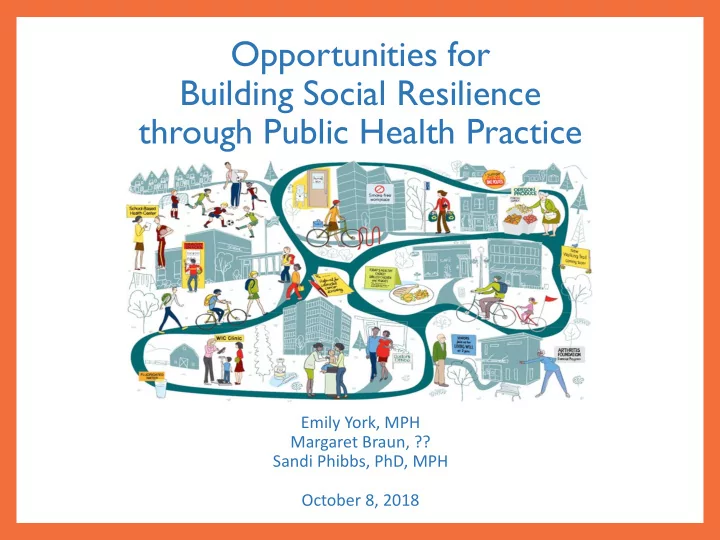
Opportunities for Building Social Resilience through Public Health - - PowerPoint PPT Presentation
Opportunities for Building Social Resilience through Public Health Practice Emily York, MPH Margaret Braun, ?? Sandi Phibbs, PhD, MPH October 8, 2018 Indicators of Social Resilience to Climate Change Literature review Bottom up: Classic
Emily York, MPH Margaret Braun, ?? Sandi Phibbs, PhD, MPH October 8, 2018
community psychology
articles and project-specific reports
In October of 2017 we surveyed state and local health department employees about: We received 197 usable responses. The survey contained both closed- ended and open-ended questions. Responses to closed-ended questions were tabulated. Responses to open-ended questions were coded thematically.
cohesion as a public health strategy
In the section below, please identify up to 3 public health strategies for strengthening or building social cohesion within the communities you serve, either directly or indirectly. (Your responses may include strategies you have used or that you know of.) Then, using the sliding scale (with 0=no confidence and 100=high confidence), indicate your confidence in your ability to use each strategy.
10 20 30 40 50 60 70 80 90 100
Strategy 1 Strategy 2 Strategy 3
Strategy Times Identified Confidence Range (0-100) Confidence Mean, SD Building coalitions, partnerships, and community collaborations 27 15-100 73.6, 23.5 Communication, Media campaigns 19 1-100 58.3, 25.3 Activities to reduce disparities or improve equity 14 21-100 69.9, 25.4 Input from community (e.g., community forums; dialogue session with community members) 13 3-100 47.3, 32.7 Participating or hosting community events or activities 12 5-100 62.3, 28.3 Don’t Know 10 Disaster or Emergency Preparedness 8 1-100 57.8, 38.3 Assessment, data collection or monitoring 8 50-81 68.8, 12.0 Collective Action 4 81-100 88.7, 10.0 Building capacity or local leadership development 2 11-38 24.5, 19.1
We could do a lot more but there's neither funding nor staff . . . Barriers include the bureaucracy in which stops us from being able to take off with great ideas. I feel that the voices of our more vulnerable populations are sometimes not heard or brought to the table. I am not sure if we are really getting to the heart of peoples health concerns or are finding effective ways to improve the health of all people in an empowering way. I am not knowledgeable about evidence-based public health programs to build social cohesion Administrative buy in. These things and relationships take time that is not directly measurable. Time, training, and management approval. Lack of financial and staff resources, lack
Resources Generally Requested
Training Generally Requested
“I think training is needed to define more specific goals that if achieved will directly result in more social
routines and activities.”