Slide 1 - http://www.pengutronix.de - 2017-10-23
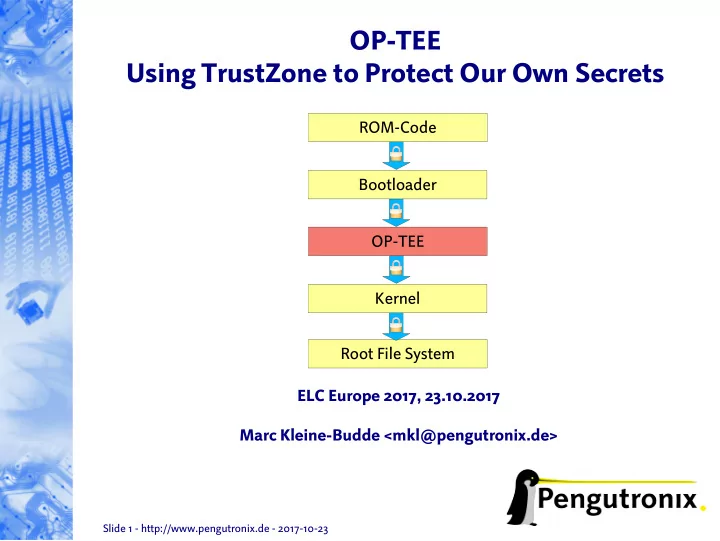
OP-TEE Using TrustZone to Protect Our Own Secrets ROM-Code - - PowerPoint PPT Presentation
OP-TEE Using TrustZone to Protect Our Own Secrets ROM-Code Bootloader OP-TEE Kernel Root File System ELC Europe 2017, 23.10.2017 Marc Kleine-Budde <mkl@pengutronix.de> Slide 1 - http://www.pengutronix.de - 2017-10-23 Overview ARM
Slide 3 - http://www.pengutronix.de - 2017-10-23
Overview
- ARM architecture overview
- ARM TrustZone
- Trusted Execution Environment
- Open Portable Trusted Execution Environment
Slide 4 - http://www.pengutronix.de - 2017-10-23
What is a TEE?
- Trusted Execution Environment
- small OS-like environment
- isolated from normal operating system (e.g. Linux) “rich OS”
- Allows Applications to execute, process, protect and store sensitive data
- Rich OS is often target of malware and attackers
- Design applications so that sensitive functions
can be offloaded to the TEE as Trusted Applications.
- API standardized by GlobalPlatform
- TEE internal APIs for Trusted Application
- communication interfaces between
rich OS Applications and Trusted Applications
Slide 5 - http://www.pengutronix.de - 2017-10-23
What is a TEE? (cont'd)
SE TEE Rich OS SE TEE SE Rich OS Security Functionality
Slide 6 - http://www.pengutronix.de - 2017-10-23
ARM architecture
usr
App App App
svc
OS ARM SoC
Slide 7 - http://www.pengutronix.de - 2017-10-23
ARM architecture with TrustZone
usr
App App App
svc
OS ARM SoC Normal world
usr (secure state)
App App Trusted App
svc (secure state)
Trusted OS Secure world
mon (secure state)
Secure Monitor
Slide 8 - http://www.pengutronix.de - 2017-10-23
ARM architecture with TrustZone (cont'd)
- Provides a complete “virtual system” for secure computing
- Divide hardware and software into separate partitions (“worlds”)
- one is trusted (“secure world”)
- the other not (“Normal world”)
- Limited and tightly defined ways to get from one world to the other
secure monitor →
Slide 9 - http://www.pengutronix.de - 2017-10-23
ARM TrustZone in detail
Source: http://genode.org/documentation/articles/trustzone
Slide 10 - http://www.pengutronix.de - 2017-10-23
ARM TrustZone in detail (cont'd)
- Security Extensions to ARM processors
- Supported by
- ARM1176
- Cortex-A series (ARMv7-A, ARMv8-A)
- ARMv8-M
- System-wide hardware isolation
- SRAM
- DRAM
- CPU configuration registers
- peripherals
- SoC design has impact on practical usefulness of security features
Slide 11 - http://www.pengutronix.de - 2017-10-23
ARM TrustZone switching worlds
- Secure World entry
- Hardware-controlled
- automatic
- partly configurable
- By exception
- Reset
- CPU always starts secure
- Secure Monitor Call
- SMC #n instruction
- analogous to Supervisor Call (SVC)
- always handled in Secure World
- IRQ, FIQ, Data abort
- configurable (by secure software)
- Non-Secure World entry
- Software-controlled
- Typically
- set SCR.NS
- return from execption
Secure Non-Secure Reset software hardware
Slide 12 - http://www.pengutronix.de - 2017-10-23
What is OP-TEE?
- Started as closed source implementation by some
mobile, telco and chip vendors
- Since 2015 Open Source (BSD license),
- wned and maintained by Linaro
- In 2017 the TEE driver went mainline with v4.12
- Small and simple TEE
- Relies on rich OS to schedule TEE
- Based on ARM TrustZone to provide isolation of
the TEE from the rich OS in hardware
- Runs on ~20 platforms
- 32 bit: ARMv7-A
- 64 bit: ARMv8-A
Slide 13 - http://www.pengutronix.de - 2017-10-23
OP-TEE architecture
usr
Native App svc
ARM SoC
Non-Secure world
mon (secure state) Secure Monitor GlobalPlatform TEE Client API TEE Supplicant Wrapper API (optional) TEE Driver Storage...
usr (secure state)
App App Trusted App
svc (secure state)
TEE core
Secure world
TEE functions/libs (crypto...) HAL GlobalPlatform TEE internal API
- ptee_client
- ptee_os
- ptee_linuxdriver
Source: https://www.linaro.org/blog/core-dump/op-tee-open-source-security-mass-market/
Slide 14 - http://www.pengutronix.de - 2017-10-23
OP-TEE in detail
- The OP-TEE consists of three parts
- Normal World, User Mode
- TEE client library
- tee-supplicant
- file system access
- access to shared resources
- Normal World, Priviledged Mode
- Linux kernel TEE subsystem
- Linux kernel TEE device driver
- Secure world, Priviledged Mode
- Trusted OS (optee_os)
- TEE contains public key
- Trusted Applications are singed and can be
loaded from the Normal World into the TEE
Slide 15 - http://www.pengutronix.de - 2017-10-23
OP-TEE - Trusted Boot ARMv7-A: i.MX6
SoC ROM- Code Fuses Boot Loader OP-TEE incl. Pubkey Signature Pubkey For details on trusted boot see my talk from ELCE 2016.
Slide 16 - http://www.pengutronix.de - 2017-10-23
OP-TEE - Boot sequence in ARMv7-A: i.MX6
Non-Secure world Secure world
Kernel initialize and run Reset ROM-Code load/check bootloader bootloader (barebox) load/check TEE kernel, DTB, initrd TEE initialize and run request secure service TEE - Perform secure service
Return from exeption SMC #n Return from exeption
Slide 17 - http://www.pengutronix.de - 2017-10-23
Observations & What's Missing?
- Better SoC support
- more SRAM
- TrustZone support missing in some peripherals
- TrustZone: From my (limited) point of view:
- The concept of moving peripherals into Secure World
is “complicated” on todays SoCs.
- Think about turning off the clock of the Secure World's
I2C, PWM or Ethernet Controller.
- Support for existing private key storages
- inside the Linux kernel
- opengpg/ssh
- TPM
- build system feels Android centric
- make use more use of DT
- convert config #ifdef to kconfig
Slide 18 - http://www.pengutronix.de - 2017-10-23
Summary
- TEE – Trusted Execution Environment
- Set of APIs to split applications into normal and secure part
- TrustZone
- Security extension for ARM processors to partition one SoC
into Normal and Secure World
- Practical usefulness depends on SoC design
- OP-TEE – Open Platform TEE
- Implements TEE on ARM using TrustZone
Slide 19 - http://www.pengutronix.de - 2017-10-23