On the relationship between Priestley and stably compact spaces - - PDF document

on the relationship between priestley and stably compact
SMART_READER_LITE
LIVE PREVIEW

On the relationship between Priestley and stably compact spaces - - PDF document

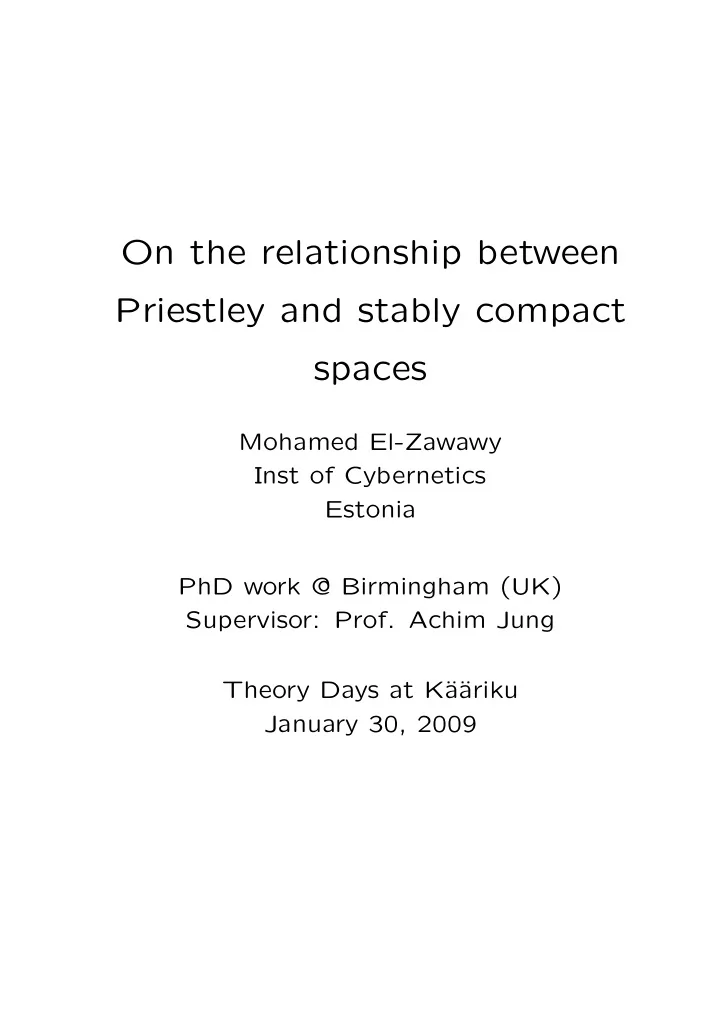
On the relationship between Priestley and stably compact spaces Mohamed El-Zawawy Inst of Cybernetics Estonia PhD work @ Birmingham (UK) Supervisor: Prof. Achim Jung Theory Days at K a ariku January 30, 2009 Stone duality Marshall


slide-1
SLIDE 1

On the relationship between Priestley and stably compact spaces

Mohamed El-Zawawy Inst of Cybernetics Estonia PhD work @ Birmingham (UK) Supervisor: Prof. Achim Jung Theory Days at K¨ a¨ ariku January 30, 2009

slide-2
SLIDE 2

Stone duality Marshall Harvey Stone (1936) Totally disconnected compact spaces (Stone spaces)

  • Boolean algebras.

This was the starting point of a whole area of research known as Stone duality. Dualities are generally good for translating prob- lems form one space to another where it could be easier to solve.

2

slide-3
SLIDE 3

Stone duality Marshall Harvey Stone (1937) Hillary Priestley (1970) spectral spaces (T0) 1937 bounded distributive lattices. 1970 Priestley spaces (Hausdorff) Definition. A Priestley space is a compact

  • rdered space X; T, ≤ such that for every x, y ∈

X, if x ≥ y then there exists a clopen upper set U such that y ∈ U and x / ∈ U. A spectral space is a stably compact space with a basis of compact open sets.

3

slide-4
SLIDE 4

Semantics of programming languages: is about developing techniques for designing and describing programming languages. Semantics approaches include:

  • axiomatic (the program logic) – an exam-

ple is Hoare logic.

  • operational – an example is Java Abstract

Machine.

  • denotational – gives mathematical mean-

ing of language constructs.

4

slide-5
SLIDE 5

Denotational semantics: uses a category to interpret programming lan- guage constructs;

  • data types ⇐

⇒ objects,

  • programs ⇐

⇒ morphisms.

5

slide-6
SLIDE 6

Domains – Dana Scott (1969): Sets, topological spaces, vectors spaces, and groups are not a good choice for denotational semantics. Domains = ordered sets + certain conditions. From now on:

  • data types ⇐

⇒ domains,

  • programs ⇐

⇒ functions between domains. Scott topologies on domains to measure com- putability.

6

slide-7
SLIDE 7

Stone duality and computer science Samson Abramsky(1991) Logical representation for bifinite domains (a particular Cartesian-closed category of domains). In this framework,

  • bifinite domains ⇐

⇒ propositional theories,

  • functions ⇐

⇒ program logic axiomatising the properties of domains. The domain interpretation via bifinite domains and the logical interpretation are Stone duals to each other and specify each other up to isomorphism.

7

slide-8
SLIDE 8

Stably compact spaces Abramsky’s work was extended by Achim Jung et al to a class of topological spaces, stably compact spaces defined as follows. Definition. A stably compact space is a topo- logical space which is sober, compact, locally compact, and for which the collection of com- pact saturated subsets is closed under finite intersections, where a saturated set is an in- tersection of open sets. These spaces contains coherent domains in their Scott topologies. Coherent domains include bifinite domains and

  • ther interesting Cartesian-closed categories of

domains such as FS.

8

slide-9
SLIDE 9

Achim Jung’s work in more detail If X, T is a stably compact space then its lat- tice BX of observable properties is defined as follows:

BX = {O, K | O ∈ T, K ∈ KX and O ⊆ K},

where KX is the set of compact saturated sub- sets of X. The computational interpretation is as follows. For a point x ∈ X and a property O, K ∈ BX:

  • x ∈ O ⇐

⇒ x satisfies the property O, K,

  • x ∈ X \ K ⇐

⇒ x does not satisfy the prop- erty O, K, and

  • x ∈ K \ O ⇐

⇒ the property O, K is unob- servable for x.

9

slide-10
SLIDE 10

Proximity relation On the lattice BX of observable properties a binary relation (strong proximity relation)was defined as: O, K ≺ O′, K′ def ⇐ ⇒ K ⊆ O′. The computational interpretation of the strong proximity relation ≺ can be stated as follows: O, K ≺ O′, K′

  • (∀x ∈ X) either O′, K′ is observably satisfied for x
  • r O, K is (observably) not satisfied for x.

Thus we can say that ≺ behaves like a classical implication.

10

slide-11
SLIDE 11

BX and ≺ abstractly:

Definition. A binary relation ≺ on a bounded distributive lattice L; ∨, ∧, 0, 1 is called a prox- imity if, for every a, x, y ∈ L and M ⊆fin L, (≺≺) ≺ ◦ ≺ = ≺, (∨− ≺) M ≺ a ⇐ ⇒

  • M ≺ a,

(≺ −∧) a ≺ M ⇐ ⇒ a ≺

  • M,

(≺ −∨) a ≺ x ∨ y = ⇒ (∃ x′, y′ ∈ L) x′ ≺ x, y′ ≺ y and a ≺ x′ ∨ y′, (∧− ≺) x ∧ y ≺ a = ⇒ (∃ x′, y′ ∈ L) x ≺ x′, y ≺ y′ and x′ ∧ y′ ≺ a. A strong proximity lattice is a bounded dis- tributive lattice L; ∨, ∧, 0, 1 together with a proximity relation ≺ on L. The lattice order is always a proximity relation.

11

slide-12
SLIDE 12

Approximable relations: Capturing continuous maps between stably compact spaces Definition. Let L1; ∨, ∧, 0, 1; ≺1 and L2; ∨, ∧, 0, 1; ≺2 be strong proximity lattices and let ⊢ be a binary relation from L1 to L2. The relation ⊢ is called approximable if for ev- ery a ∈ L1, b ∈ L2, M1 ⊆fin L1 and M2 ⊆fin L2, (⊢ − ≺2) ⊢ ◦ ≺2 = ⊢, (≺1 − ⊢) ≺1 ◦ ⊢ = ⊢, (∨− ⊢) M1 ⊢ b ⇐ ⇒

  • M1 ⊢ b,

(⊢ −∧) a ⊢ M2 ⇐ ⇒ a ⊢

  • M2,

(⊢ −∨) a ⊢

  • M2 =

⇒ (∃ N ⊆fin L1) a ≺1

  • N

and (∀n ∈ N)(∃ m ∈ M2) n ⊢ m.

12

slide-13
SLIDE 13

Basic aim of this work The primary aim is to introduce Priestley spaces to the world of semantics of pro- gramming languages. This can be done by answering the following question: How can Priestley duality for bounded distribu- tive lattices be extended to strong proximity lattices? Logically the answer is interesting because the-

  • ries (or models) of BX are represented by

prime filters, which are the points of the Priest- ley dual space of BX as a bounded distributive lattice.

13

slide-14
SLIDE 14

Apartness relations: To answer the question (MFPS 2006) we equip Priestley spaces with the following relation: Definition. A binary relation ∝ on a Priest- ley space X; ≤, T is called an apartness if, for every a, c, d, e ∈ X, (∝T) ∝ is open in X; T × X; T (↓∝↑) a ≤ c ∝ d ≤ e = ⇒ a ∝ e, (∝∀) a ∝ c ⇐ ⇒ (∀b ∈ X) a ∝ b or b ∝ c, (∝↑↑) a ∝ (↑c ∩ ↑d) = ⇒ (∀b ∈ X) a ∝ b, b ∝ c

  • r b ∝ d,

(↓↓∝) (↓c ∩ ↓d) ∝ a = ⇒ (∀b ∈ X) d ∝ b, c ∝ b

  • r b ∝ a.

The relation ≥ is always an apartness.

14

slide-15
SLIDE 15

The answer is: The dual of a strong proximity lattice L is the corresponding Priestley space of prime filters, equipped with the apart- ness, F ∝≺ G def ⇐ ⇒ (∃ x ∈ F)(∃ y / ∈ G) x ≺ y. Vice versa, the dual of a Priestley space X with apartness ∝ is the lattice of clopen upper sets equipped with the strong proximity, A ≺∝ B def ⇐ ⇒ A ∝ (X \ B). Up to isomorphism, the correspondence is one-to-one.

15

slide-16
SLIDE 16

Concerning the morphisms... We proof that: Continuous order-preserving maps that reflect the apartness relation are in one- to-one correspondence with lattice ho- momorphisms that preserve the strong proximity relation. Let X1 and X2 be Priestley spaces with apartness relation. Then (weakly) sep- arating relations from X1 to X2 are in

  • ne-to-one correspondence with (weakly)

approximable relations from the dual of X1 to the dual of X2.

16

slide-17
SLIDE 17

Separating relations: Definition. Let X1; ≤1; T1 and X2; ≤2, T2 be Priestley spaces with apartness relations ∝1 and ∝2, respectively, and let ⋉ be a binary relation from X1 to X2. The relation ⋉ is called separating (or a separator) if it is open in T1 ×

T2 and if, for every a, b ∈ X1, d, e ∈ X2 and

{di | 1 ≤ i ≤ n} ⊆ X2, (↓1⋉↑2) a ≥1 b ⋉ d ≥2 e = ⇒ a ⋉ e, (∀⋉) b ⋉ d ⇐ ⇒ (∀c ∈ X1) b ∝1 c or c ⋉ d, (⋉∀) b ⋉ d ⇐ ⇒ (∀c ∈ X2) b ⋉ c or c ∝2 d, (⋉n↑) b ⋉

  • ↓di =

⇒ (∀c ∈ X1) b ∝1 c

  • r (∃ i) c ⋉ di.

The relation ⋉ is called weakly separating (or weak separator) if it satisfies all of the above conditions, but not necessarily (⋉n↑).

17

slide-18
SLIDE 18

Priestley and stably compact spaces What is the direct relationship between the Priestley spaces equipped with apart- ness relations stably compact spaces? The answer is the following: Theorem. Let X; ≤, T be a Priestley space with apartness ∝. Then core(X), T′, where

core(X) = {x ∈ X | {y ∈ X | x ∝ y} = X \ ↓x}

and

T′ = {O∩core(X) | O is an open lower subset of X},

is a stably compact space. Moreover, every stably compact space can be

  • btained in this way and is a retract of a Priest-

ley space with apartness.

18

slide-19
SLIDE 19

Concerning morphisms again ... We show that continuous maps between stably compact spaces are equivalent to separators between Priestley spaces equipped with apartness.

19

slide-20
SLIDE 20

Thanks for your attention!

20