On the nature of suboxide formation during reactive DC magnetron - - PDF document

on the nature of suboxide formation during reactive dc
SMART_READER_LITE
LIVE PREVIEW

On the nature of suboxide formation during reactive DC magnetron - - PDF document

On the nature of suboxide formation during reactive DC magnetron sputtering R. Schelfhout, K. Strijckmans, D. Depla Dedicated Research on Advanced Films and Targets Ghent University Introduction In-vacuo XPS target analysis Ion Beam Oxidation


slide-1
SLIDE 1

On the nature of suboxide formation during reactive DC magnetron sputtering

  • R. Schelfhout, K. Strijckmans, D. Depla

Dedicated Research on Advanced Films and Targets Ghent University

  • R. Schelfhout

PSE 2018 www.DRAFT.ugent.be

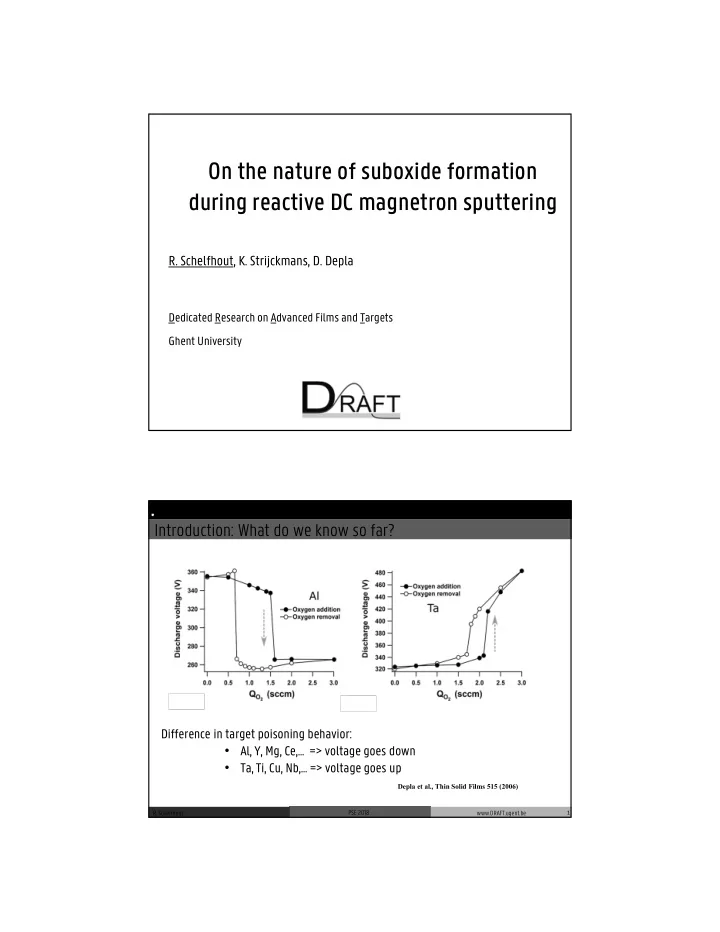
Introduction: What do we know so far?

Difference in target poisoning behavior:

  • Al, Y, Mg, Ce,… => voltage goes down
  • Ta, Ti, Cu, Nb,… => voltage goes up

Depla et al., Thin Solid Films 515 (2006)

1 Introduction In-vacuo XPS target analysis Ion Beam Oxidation Reactive magnetron sputtering Conclusion

slide-2
SLIDE 2
  • R. Schelfhout

PSE 2018 www.DRAFT.ugent.be

Introduction: What do we know so far?

Strong correlation between target (γISEE) and discharge voltage 1 = + (for fixed discharge conditions)

Depla et al., Thin Solid Films 515 (2006)

About DC magnetron discharges:

  • G. Buyle, “Simplified model for the DC planar

magnetron discharge”, PhD Dissertation, UGent, 2005

  • J. A. Thornton, J. Vac. Sci. Technol. 15 (2), (1978)

Altering (reactive) DC magnetron discharge Sputter cleaning experiments

2 Introduction In-vacuo XPS target analysis Ion Beam Oxidation Reactive magnetron sputtering Conclusion

  • R. Schelfhout

PSE 2018 www.DRAFT.ugent.be

Introduction: What do we know so far?

Sputter reduction of oxides by noble ion bombardment: R = 1.00: no reduction R ≥ 1.05: reduction R =

  • a) Malherbe et al., Appl. Surf. Sci. (1990)

b) Mitchell et al., Surf. Interface Anal. 15 (1990)

data taken from: Depla et al., Surface and Coatings Technology 200 (2006)

Rb)

1.46 1.26 1.25 1.12 1.33 1.05 1.12 1.11 1.00 1.00 1.22 1.00 1.50 2.22 2.50 1.50 1.33 1.00 2.26 1.00 1.00

Ra) Reduction factor R

3 Introduction In-vacuo XPS target analysis Ion Beam Oxidation Reactive magnetron sputtering Conclusion

slide-3
SLIDE 3
  • R. Schelfhout

PSE 2018 www.DRAFT.ugent.be

Introduction: What do we know so far?

Do reduced oxides have a low γISEE? Ion beam sputtering experiments: 5 or 3 keV O2

+ on Si

Wittmaack, Surface Science 419 (1999)

γISEE, oxide > γISEE, metal > γISEE, suboxide

impact angle (deg) electron yield (el./ion)

  • xide

suboxide metal

Alay et al., Phys. Rev. B 50 (20), (1994)

impact angle (deg) relative concentration (%)

4 Introduction In-vacuo XPS target analysis Ion Beam Oxidation Reactive magnetron sputtering Conclusion

  • R. Schelfhout

PSE 2018 www.DRAFT.ugent.be

Introduction: What do we know so far?

Depla et al., J. Appl. Phys. 101, (2007)

The Hypothesis: “The discharge voltage behavior upon target poisoning is linked to the target oxide stoichiometry”

5 Introduction In-vacuo XPS target analysis Ion Beam Oxidation Reactive magnetron sputtering Conclusion

slide-4
SLIDE 4
  • R. Schelfhout

PSE 2018 www.DRAFT.ugent.be

In-vacuo XPS determination of the target surface

anode ring anode ring holder 1” magnetron transfer stick target holder matching XPS dimensions target

6 Introduction In-vacuo XPS target analysis Ion Beam Oxidation Reactive magnetron sputtering Conclusion

  • R. Schelfhout

PSE 2018 www.DRAFT.ugent.be

In-vacuo XPS determination of the target surface

  • 1” magnetron
  • S = 30 l/s
  • Ptot = 1 Pa
  • PO2 varied
  • I = 70 mA (constant DC)

Sputter conditions: Pback= 3 x 10⁻⁴ Pa Pback= 1.6 x 10⁻⁷ Pa Pback= 4 x 10⁻⁶ Pa XPS specifications:

  • Surface Science Instruments (VG) S-probe
  • Monochromated Al Kα
  • Pass energy = 39.7 eV, resolution = 0.05 eV
  • Spot size in center of racetrack 250 x 1000 µm²
  • no charge compensation
  • transfer time < 5 min

hardly any contamination (XPS confirmed)

7 Introduction In-vacuo XPS target analysis Ion Beam Oxidation Reactive magnetron sputtering Conclusion

slide-5
SLIDE 5
  • R. Schelfhout

PSE 2018 www.DRAFT.ugent.be

In-vacuo XPS determination of the target surface

Schelfhout et al., Surface and Coatings Technology 353 (2018)

8 Introduction In-vacuo XPS target analysis Ion Beam Oxidation Reactive magnetron sputtering Conclusion

stoichiometric Al2O3 (Al3+) surface metal (Al0+) from bulk

Al 2p3/2 Al 2p1/2

different stoichiometry's (Ta5+ ,…,Ta0+) at the surface

Ta 4f7/2 Ta 4f5/2

  • R. Schelfhout

PSE 2018 www.DRAFT.ugent.be

In-vacuo XPS determination of the target surface

Depla et al., Surface and Coatings Technology 200 (2006) Schelfhout et al., Surface and Coatings Technology 353 (2018)

XPS analysis on target surface: “Direct experimental confirmation of suboxide occurrence on the target + elaborated discussion on its impact on γISEE” However, the hypothesis is based on sputter reduction of the native oxide (IBR) but during reactive DC magnetron sputtering, the metallic bulk continuously oxidizes (IBO) The Hypothesis: “The discharge voltage behavior upon target poisoning is linked to the target oxide stoichiometry”

9 Introduction In-vacuo XPS target analysis Ion Beam Oxidation Reactive magnetron sputtering Conclusion

slide-6
SLIDE 6
  • R. Schelfhout

PSE 2018 www.DRAFT.ugent.be

Ion Beam Oxidation (IBO)

Ion Beam Oxidation (IBO) = oxidation by reactive gas implantation Oxygen concentration is inversely proportional to the metal sputtering yield Ym

Janssens et al., Surface Science 601 (2007)

, , ~

  • = 1
  • Ym high

nO,s ≈ 0 metal Ym interm. nO,s= small suboxide Ym low nO,s= high

  • xide

10 Introduction In-vacuo XPS target analysis Ion Beam Oxidation Reactive magnetron sputtering Conclusion

  • R. Schelfhout

PSE 2018 www.DRAFT.ugent.be

Ion Beam Oxidation (IBO)

Ion Beam Oxidation (IBO) = oxidation by reactive gas implantation The lower the silicon sputtering yield, the higher the oxidation degree

  • xide

suboxide metal

Alay et al., Phys. Rev. B 50 (20), (1994)

impact angle (deg) relative concentration (%)

Wittmaack, Surf. Inter. Analysis 29 (2000)

metal

  • xide suboxide

impact angle (deg) sputtering yield (Si/ion)

11 Introduction In-vacuo XPS target analysis Ion Beam Oxidation Reactive magnetron sputtering Conclusion

slide-7
SLIDE 7
  • R. Schelfhout

PSE 2018 www.DRAFT.ugent.be

Reactive DC magnetron sputtering

What about reactive magnetron sputtering? The higher fO2 (constant Ym), the higher the oxidation degree IBO (fO2= 1): 1

  • ≈ ,

, = ′ 2 z’ = “average oxide stoichiometry” 2

= ′

  • IBO equivalent in

reactive magnetron sputtering:

P(x) vs

  • =
  • nO (x)

which is the oxygen balance between the implanted in and sputtered out

(assuming all oxygen reacts (lower limit))

12 Introduction In-vacuo XPS target analysis Ion Beam Oxidation Reactive magnetron sputtering Conclusion

  • R. Schelfhout

PSE 2018 www.DRAFT.ugent.be

Suboxide formation during reactive DC magnetron sputtering

R =

=

  • =
  • Alternative definition reduction factor R:

z’ = “average oxide stoichiometry” or what is actually on the target z = “native oxide stoichiometry” or what could be formed on the target

R<1: too few oxygen implanted suboxide formation R>1: excess oxygen implanted stoichiometric oxide formation

(assuming all oxygen reacts (lower limit)) Target generally poisons below fO2 = 0.1 Al at fO2 = 0.1

13 Introduction In-vacuo XPS target analysis Ion Beam Oxidation Reactive magnetron sputtering Conclusion

Aluminum

experimental procedure published in Schelfhout et al., J. Phys. D: Appl. Phys. 51 (2018)

R<1 R>1

slide-8
SLIDE 8
  • R. Schelfhout

PSE 2018 www.DRAFT.ugent.be

Suboxide formation during reactive DC magnetron sputtering

R =

=

  • =
  • Alternative definition reduction factor R:

z’ = “average oxide stoichiometry” or what is actually on the target z = “native oxide stoichiometry” or what could be formed on the target

R<1: too few oxygen implanted suboxide formation R>1: excess oxygen implanted stoichiometric oxide formation

(assuming all oxygen reacts (lower limit)) R>1

Tantalum

experimental procedure published in Schelfhout et al., J. Phys. D: Appl. Phys. 51 (2018)

R<1 Al at fO2 = 0.1 Target generally poisons below fO2 = 0.1 Ta at fO2 = 0.1

14 Introduction In-vacuo XPS target analysis Ion Beam Oxidation Reactive magnetron sputtering Conclusion

  • R. Schelfhout

PSE 2018 www.DRAFT.ugent.be

Suboxide formation during reactive DC magnetron sputtering

Alternative definition reduction factor R: R =

=

  • =
  • (assuming all oxygen reacts (lower limit))

if fO2 becomes large enough, Ta2O5 can be formed

  • XPS confirms stoichiometric oxide
  • The discharge voltage lowers again

fO2 > 0.5 :

15 Introduction In-vacuo XPS target analysis Ion Beam Oxidation Reactive magnetron sputtering Conclusion

slide-9
SLIDE 9
  • R. Schelfhout

PSE 2018 www.DRAFT.ugent.be

Conclusion and Acknowledgements

  • Experimental confirmation suboxide occurrence

by in-vacuo target surface XPS analysis

  • Ion Beam Oxidation (IBO) as alternative mechnanism

for suboxide formation

  • The absolute magnitude of the sputter yield after target poisoning

determines the target stoichiometry

16 Introduction In-vacuo XPS target analysis Ion Beam Oxidation Reactive magnetron sputtering Conclusion