On Media Development: An unorthodox empirical view Daniel Kaufmann, - - PowerPoint PPT Presentation

on media development an unorthodox empirical view
SMART_READER_LITE
LIVE PREVIEW

On Media Development: An unorthodox empirical view Daniel Kaufmann, - - PowerPoint PPT Presentation

On Media Development: An unorthodox empirical view Daniel Kaufmann, The Brookings Institution Presentation at event on Media Development at the Center for International Media Assistance (CIMA) at the National Endowment for Democracy (NED),


slide-1
SLIDE 1

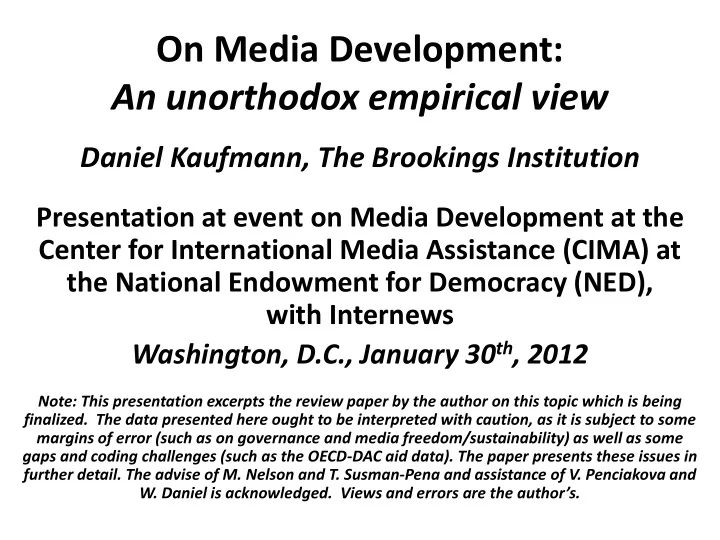
On Media Development: An unorthodox empirical view

Daniel Kaufmann, The Brookings Institution

Presentation at event on Media Development at the Center for International Media Assistance (CIMA) at the National Endowment for Democracy (NED), with Internews Washington, D.C., January 30th, 2012

Note: This presentation excerpts the review paper by the author on this topic which is being

  • finalized. The data presented here ought to be interpreted with caution, as it is subject to some

margins of error (such as on governance and media freedom/sustainability) as well as some gaps and coding challenges (such as the OECD-DAC aid data). The paper presents these issues in further detail. The advise of M. Nelson and T. Susman-Pena and assistance of V. Penciakova and

  • W. Daniel is acknowledged. Views and errors are the author’s.
slide-2
SLIDE 2

On Media Development: An unorthodox empirical view

  • What (is Media Development)?
  • Does it Matter?
  • Who Does it & how Much?
  • For Whom, and How Well Done (or not)?
  • Some Lessons?
slide-3
SLIDE 3

Table 1: Definitions of Media Development (I)

Author Publication Definition

African Media Development Initiative “Research Summary Report,” 2011, Link Media development is…the development of private, community, public and/or state media that are both independent and pluralistic. Banda, Fackson “The Politics of Media Development,” ThoughtLeader, February 2008, Link "[Media Development] is being viewed as the totality of all support mechanisms for the growth of media institutions into vibrant agents of social and political change in democratic and undemocratic polities." BBC Trust Service, OECD, World Bank “International Support for Media Discussion: Context, Evidence,,” Discussion Paper, Meeting Of The OECD-DAC Network On Governance, June 2011, Link Media development promotes voice, accountability and transparency through support to free and plural media. Center for International Media Assistance Cima.ned.org, Website, December 2011, Link "'Media development' generally refers to efforts by organizations, people, and sometimes governments to develop the capacity and quality of the media sector within a specific country or region." Coyne, Christopher, and Peter Leeson “Read all About It! Understanding the Role of Media in Economic Development,” Kyklos, 2005, Link The creation of an institution that facilitates democracy and economic development by correcting information asymmetries. Dutta, Nabamita, and Sanjukta Roy “The Changing Face of Culture: Gauging the Impact of a Free Media,” European Journal of Law and Economics, Forthcoming, Link The creation of a media sector that reduces information asymmetry and transaction costs, by reducing the costs of acquiring information. Global Forum for Media Development “Statues as Adopted by Steering Committee on September 2008,” GMFD Constitution, September 2008, Link "Media development includes actions in support of system of media regulation conducive to freedom of expression, pluralism and diversity, strengthening media capacity to inform; plurality and diversity of media, transparency…, respect for journalism that represents professional independence and diversity of views and interests, supporting institutions that underpin media freedom..." Governance and Social Resource Center Gsdrc.org, Website, December 2011, Link "Media development aims to create a media sector that is both independent and pluralistic."
slide-4
SLIDE 4

Table 1: Definitions of Media Development (II)

Author Publication Definition

African Media Development Initiative “Research Summary Report,” 2011, Link Media development is…the development of private, community, public and/or state media that are both independent and pluralistic. Jacobson, Tom “Defining and Evaluating Media Development,” blogs.worldbank.org, July 2008, "...media development refers to the nurturing of public spheres wherein two-way communications take place." International Commission for the Study of Communication Problems * “Many Voices, One World,” UNESCO, 1980 The development of “comprehensive national policies” linked to overall social, cultural, and economic development in accordance with national needs and traditions. Roy, Sanjukta “Overview Report: Measuring Media Development,” Internews, Media Map Document, March 2011, "Media Development for current purposes is the process of improving both the media's ability to communicate with the public, and the public ability to inform itself and communicate, using media." Sida (Ljungman, Ponning, Sigh, Pedersen, et al) “Sida’s Work with Culture and Media,” Sida Evaluation 04/38, October 2004, Link Media development is…the development of civil rights and political participation in the recipient country and to facilitate diversity of cultural expression. UNESCO “Media Development Indicators,” MDI, December 2011, Link "…media ecology to be constructed in order to ensure freedom of expression, pluralism and diversity of the media."

slide-5
SLIDE 5

Media Development: Focus & Definition

  • Media development should place ‘freedom’ center stage
  • From A. Sen’s ‘development as freedom’ to ‘media

development as media freedom’…

  • Media Freedom alone may not be sufficient condition but

is necessary condition for successful media development

  • Complementing media freedom: financial, infrastructure

and professional capacity factors for media development

  • A definition of Media Development that places Media

Freedom at the center, recognizing other components: Empowering a multitude of media institutions and actors to operate independently and professionally, without undue constraints by the state or elites, promoting freedom of expression and democratic accountability.

slide-6
SLIDE 6

Where have Media Freedoms in the real world gone?

slide-7
SLIDE 7
slide-8
SLIDE 8
slide-9
SLIDE 9
slide-10
SLIDE 10
slide-11
SLIDE 11

Does Media Development Matter?

  • Yes, overall it does, when done smartly
  • Substantive empirical research literature showing

that Media Freedom is associated with corruption control, higher incomes and investments, and political stability.

  • Media development initiatives associated with

improved public service delivery

  • Important complementarities that need to be taken

into account (and interactive effects, e.g. w. RoL)

  • Interpretation of each study with some caution –

data & methodological challenges

  • But overall: Preponderance of Evidence
slide-12
SLIDE 12
slide-13
SLIDE 13

Effect of Media Freedom on Control of Corruption (when Low Rule of Law)

  • 2.0
  • 1.0

0.0 1.0 2.0 Low Press Freedom/Low Rule of Law High Press Freedom/Low Rule of Law

Sources: Kaufmann D., A. Kraay, M. Mastruzzi (2010), The Worldwide Governance Indicators: Methodology and Analytical Issues , September 2010; Freedom House, Freedom of the Press, 2005-2009 editions

slide-14
SLIDE 14

Effect of Rule of Law on Control of Corruption (when Low Press Freedom)

  • 2.0
  • 1.0

0.0 1.0 2.0 Low Press Freedom/Low Rule of Law High Press Freedom/Low Rule of Law Low Press Freedom/Hight Rule of Law

Low RL High RL

Sources: Kaufmann D., A. Kraay, M. Mastruzzi (2010), The Worldwide Governance Indicators: Methodology and Analytical Issues , September 2010; Freedom House, Freedom of the Press, 2005-2009 editions

slide-15
SLIDE 15

Effect of Media Freedom and Rule of Law on Control of Corruption

  • 2.0
  • 1.0

0.0 1.0 2.0 Low Press Freedom/Low Rule

  • f Law

High Press Freedom/Low Rule

  • f Law

Low Press Freedom/Hight Rule

  • f Law

High Press Freedom/High Rule

  • f Law

Sources: Kaufmann D., A. Kraay, M. Mastruzzi (2010), The Worldwide Governance Indicators: Methodology and Analytical Issues , September 2010; Freedom House, Freedom of the Press, 2005-2009 editions

slide-16
SLIDE 16

Patterns of Financial Aid to Media Development: Initial Review

  • Caveats and interpretative caution applies in

particular in this section, given some gaps, coding issues and potential inaccuracies in the OECD-DAC aid database.

slide-17
SLIDE 17

Media Development Assistance Compared to Remainder

  • f ODA, 2002-2009

25 50 75 100 125 150 2002-2003 2004-2006 2007-2009

Annualized Average USD, (billions)

Media Development Rest of Aid

Source: OECD DAC Creditor Reporting System (last updated in April 2011). Disbursements by donor include all bilateral, regional and bilateral unspecified aid for media development. Media development includes aid for media and free flow of information; ICT, Telecommunications, radio/TV/print media and Communications policy and administrative management

Media Dev: 0.42 bn (0.51%

  • f total ODA)

Media Dev: 0.67 bn (0.52%) Media Dev: 0.70 bn (0.55%)

slide-18
SLIDE 18

31.0% 20.3% 13.9% 17.7% 17.0% Media and Free Flow of Info. Radio/TV/Print Media

  • Comms. Policy and
  • Admin. Management

Telecommunications ICT

Composition of Media Development Assistance, 2007-2009

Source: OECD DAC Creditor Reporting System (last updated in April 2011). Each slice represents the share of the total annualized average for each type of media development assistance

slide-19
SLIDE 19

Composition of Media Development Assistance, 2002-2009

200 400 600 800 2002-2003 2004-2006 2007-2009 Annualized Average USD, (millions) Media & Free Flow

  • f Info.

Radio/TV/Print Media

  • Comms. Policy &
  • Admin. Management

Telecomms. ICT

Source: OECD DAC Creditor Reporting System (last updated in April 2011).

slide-20
SLIDE 20

Media Development Assistance: Bilateral and Multilateral Disbursements, 2002-2009

200 400 600 800 2002-2003 2004-2006 2007-2009

Annualized Average USD, (millions)

Other Bilaterals UK Korea US Germany Japan Other Multilaterals IDA EU

Source: OECD DAC Creditor Reporting System (last updated in April 2011). Disbursements by donor include all bilateral, regional and bilateral unspecified aid for media development.

slide-21
SLIDE 21

0.0 20.0 40.0 60.0 80.0 100.0 120.0 140.0 160.0 180.0 2002 2003 2004 2005 2006 2007 2008 2009

Japan Germany United States United Kingdom EU Korea IDA Other Multilaterals

Media Development Assistance: Bilateral and Multilateral Disbursements, 2002-2009

Source: OECD DAC Creditor Reporting System (last updated in April 2011). Disbursements by donor include all bilateral, regional and bilateral unspecified aid for media development. Each point represents a three-year moving average for media development assistance.

slide-22
SLIDE 22

Average per Country (within each group) Annual Aid to Media Development, by Level of FH Press Freedom

Source: OECD DAC Creditor Reporting System (last updated in April 2011) & Freedom House, Freedom of the Press, 2010 edition

0.0 0.5 1.0 1.5 2.0 2.5 3.0 3.5 4.0 4.5 Not Free Partly Free Free

  • Avg. Annual Media Dev. Aid (USD mn.)

# countries: 15 # countries: 54 # countries: 57

23

slide-23
SLIDE 23

Share of Group Aid to Media Development, by Level of FH Press Freedom

2.6% 41.6% 55.8% Free Partly Free Not Free

Source: OECD DAC Creditor Reporting System (last updated in April 2011) & Freedom House, Freedom of the Press, 2010 edition. The number

  • f countries in the free group are 15; the number in the partly free group are 54 and the number in the not free group are 57.
slide-24
SLIDE 24

Average per Country (within each group) Annual Aid to Media Development, by Change in FH Press Freedom

Source: OECD DAC Creditor Reporting System (last updated in April 2011) & Freedom House, Freedom of the Press, 2010 edition

1 2 3 4 5 6 7 8 Deteriorating PF Little Change PF Improving PF

  • Avg. Annual Media Dev. Aid (USD mn.)

# countries: 24 # countries: 86 # countries: 16

25

slide-25
SLIDE 25

Share of Group Aid to Media Development, by Change in FH Press Freedom

25.4% 60.9% 13.7% Improving PF Little Change PF Deteriorating PF

Source: OECD DAC Creditor Reporting System (last updated in April 2011) & Freedom House, Freedom of the Press, 2010 editon. The number

  • f countries in the deteriorating group are 24; in the little change group are 86 and in the improving group are 16.
slide-26
SLIDE 26

Concluding: Some Implications for Discussion

1. Media Development as Media Freedom, with some additions. Media Freedom as a necessary condition, even if not sufficient 2. Media Freedom embattled: focus on policy, legal, regulations 3. Media Freedom & Media Development: They do Matter – with caution, smarts, selectivity & complementarities 4. Beyond State-owned: Capture as threat from media privates 5. Data, Monitoring & Evaluation: Sobering picture 6. Media Development Aid: compositional shift: decline in aid from key donors. And insufficient selectivity. [But data issues] 7. Traditional training vs. need for Innovative approaches 8. The Subsidy conundrum: Targeted Financial vs. ‘Infrastructure’