On Estimating the Size and Confidence of a Statistical Audit Raluca - - PowerPoint PPT Presentation

on estimating the size and confidence of a statistical
SMART_READER_LITE
LIVE PREVIEW

On Estimating the Size and Confidence of a Statistical Audit Raluca - - PowerPoint PPT Presentation

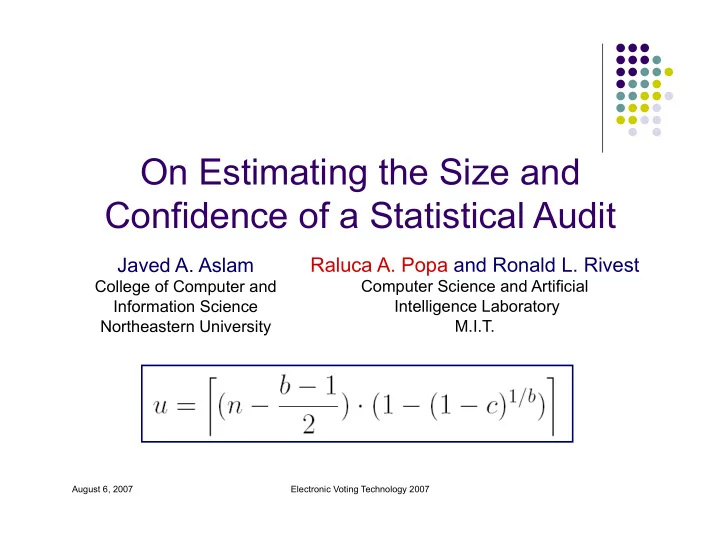
On Estimating the Size and Confidence of a Statistical Audit Raluca A. Popa and Ronald L. Rivest Javed A. Aslam College of Computer and Computer Science and Artificial Information Science Intelligence Laboratory Northeastern University


slide-1
SLIDE 1

August 6, 2007 Electronic Voting Technology 2007

On Estimating the Size and Confidence of a Statistical Audit

Javed A. Aslam

College of Computer and Information Science Northeastern University

Raluca A. Popa and Ronald L. Rivest

Computer Science and Artificial Intelligence Laboratory M.I.T.

slide-2
SLIDE 2

August 6, 2007 Electronic Voting Technology 2007 2

Outline

 Motivation  Background

 How Do We Audit?  The Problem

 Analysis

 Model  Sample Size  Bounds

 Conclusions

slide-3
SLIDE 3

August 6, 2007 Electronic Voting Technology 2007 3

Motivation

 There have been cases of electoral fraud

(Gumbel’s Steal This Vote, Nation Books, 2005)

 Would like to ensure confidence in elections  Auditing = comparing statistical sample of paper

ballots to electronic tally

 Provides confidence in a software independent

manner

slide-4
SLIDE 4

August 6, 2007 Electronic Voting Technology 2007 4

How Do We Audit?

 Proposed Legislation: Holt Bill (2007)

 Voter-verified paper ballots  Manual auditing

 Granularity: Machine, Precinct, County  Procedure

 Determine u, # precincts to audit, from margin of victory  Sample u precincts randomly  Compare hand count of paper ballots to electronic tally

in sampled precincts

 If all are sufficiently close, declare electronic result final  If any are significantly different, investigate!

slide-5
SLIDE 5

August 6, 2007 Electronic Voting Technology 2007 5

How Do We Audit?

 Proposed Legislation: Holt Bill (2007)

 Voter-verified paper ballots  Manual auditing

 Granularity: Machine, Precinct, County  Procedure

 Determine u, # precincts to audit, from margin of victory  Sample u precincts randomly  Compare hand count of paper ballots to electronic tally

in sampled precincts

Our formulas are independent of the auditing procedure

slide-6
SLIDE 6

August 6, 2007 Electronic Voting Technology 2007 6

The Problem

 How many precincts should one audit to

ensure high confidence in an election result?

slide-7
SLIDE 7

August 6, 2007 Electronic Voting Technology 2007 7

Previous Work

 Saltman (1975): The first to study auditing by

sampling without replacement

 Dopp and Stenger (2006): Choosing appropriate

audit sizes

 Alvarez et al. (2005): Study of real case auditing of

punch-card machines

slide-8
SLIDE 8

August 6, 2007 Electronic Voting Technology 2007 8

Hypothesis Testing

 Null hypothesis: The reported election outcome

is incorrect (electronic tally indicates different winner than paper ballots)

 Want to reject the null hypothesis

 Need to sample enough precincts to ensure that,

if no fraud is detected, the election outcome is correct with high confidence

slide-9
SLIDE 9

August 6, 2007 Electronic Voting Technology 2007 9

Model

n precincts

b corrupted (“bad”)

Sample u

precincts (without replacement)

 c = desired confidence  Want: If there are ≥ b corrupted precincts, then

sample contains at least one with probability ≥ c

 Equivalently: If the sample contains no corrupted

precincts, then the election outcome is correct with probability ≥ c

 Typical values: n = 400, b = 50, c = 95%

slide-10
SLIDE 10

August 6, 2007 Electronic Voting Technology 2007 10

 Minimum # of precincts adversary must

corrupt to change election outcome

 Derived from margin of victory  Our formulas are independent of b’s calculation

b = (half margin of victory) · n

What is b?

margin [times 5 (Dopp and Stenger, 2006)]

slide-11
SLIDE 11

August 6, 2007 Electronic Voting Technology 2007 11

Rule of Three

 If we draw a sample of size ≥ 3n/b with

replacement, then:

 Expect to see at least three corrupted precincts  Will see at least one corrupted precinct with c ≥

95%

 In practice, we sample without replacement

(no repeated precincts)

slide-12
SLIDE 12

August 6, 2007 Electronic Voting Technology 2007 12

Sample Size

 Probability that no corrupted precinct is detected:  Optimal Sample Size: Minimum u such that Pr ≤ 1- c

Problem: Need a computer

 Goal: Derive a simple and accurate upper bound that an

election official can compute on a hand-held calculator

Pr = ﴾ ﴿ / ﴾ ﴿

n-b u n u

slide-13
SLIDE 13

August 6, 2007 Electronic Voting Technology 2007 13

Our Bounds

 Intuition: How many different precincts are sampled

by the Rule of Three?

 Our without replacement upper bounds:

A C C U R A C Y

slide-14
SLIDE 14

August 6, 2007 Electronic Voting Technology 2007 14

Our Bounds

 Intuition: How many different precincts are sampled

by the Rule of Three?

 Our without replacement upper bounds:  Example: n = 400, b = 50 (margin=5%), c = 95%

slide-15
SLIDE 15

August 6, 2007 Electronic Voting Technology 2007 15

 Conservative: provably an upper bound  Accurate:

 For n ≤10,000, b ≤ n/2, c ≤ 0.99 (steps of 0.01):

 99% is exact, 1% overestimates by 1 precinct

 Analytically, it overestimates by at most –ln(1-c)/2,

e.g. three precincts for c < 0.9975

 Can be computed on a hand-held calculator

Our Bound

slide-16
SLIDE 16

August 6, 2007 Electronic Voting Technology 2007 16

Observations

Margin of Victory

10% 20% 1%

Precincts to Audit

1%

 Fixed level of auditing is not appropriate

n = 400, c=95%

slide-17
SLIDE 17

August 6, 2007 Electronic Voting Technology 2007 17

Observations (cont’d)

Margin of Victory

10% 20% 1%

Precincts to Audit

n = 400, c=65%

2%  Holt Bill (2007): Tiered auditing

Holt Tier

slide-18
SLIDE 18

August 6, 2007 Electronic Voting Technology 2007 18

Related Problems

Inverse questions

Estimate confidence level c from u, b, and n

Estimate detectable fraud level b from u, c, and n

Auditing with constraints

Holt Bill (2007): Audit at least one precinct in each county

Future work

Handling precincts of variable sizes (Stanislevic, 2006)

slide-19
SLIDE 19

August 6, 2007 Electronic Voting Technology 2007 19

 We develop a formula for the sample size:

that is:

 Conservative (an upper bound)  Accurate  Simple, easy to compute on a pocket calculator  Applicable to different other settings

Conclusions

slide-20
SLIDE 20

August 6, 2007 Electronic Voting Technology 2007 20

Thank you!

 Questions?