OLPC System Architecture Mark J. Foster VP Engineering/Chief - - PowerPoint PPT Presentation

olpc system architecture
SMART_READER_LITE
LIVE PREVIEW

OLPC System Architecture Mark J. Foster VP Engineering/Chief - - PowerPoint PPT Presentation

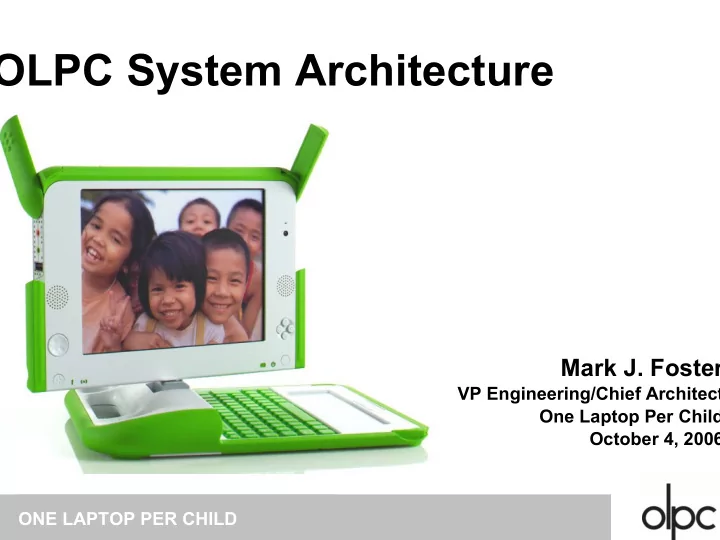
OLPC System Architecture Mark J. Foster VP Engineering/Chief Architect One Laptop Per Child October 4, 2006 ONE LAPTOP PER CHILD Agenda Introduction Core Architecture Mechanical Design Power System Design ASIC Architecture

slide-1
SLIDE 1

ONE LAPTOP PER CHILD

OLPC System Architecture

Mark J. Foster

VP Engineering/Chief Architect One Laptop Per Child October 4, 2006

slide-2
SLIDE 2

ONE LAPTOP PER CHILD

Agenda

  • Introduction
  • Core Architecture
  • Mechanical Design
  • Power System Design
  • ASIC Architecture
  • Power Management
  • Software
  • Summary / Q&A
slide-3
SLIDE 3

ONE LAPTOP PER CHILD

Introduction

  • One Laptop Per Child

– A non-profit corporation – Creating very inexpensive laptops for kids – Focused on education

  • OLPC is sponsored by:

– AMD, Brightstar, eBay, Google, Marvell, News

Corp, Nortel, Quanta, Red Hat, SES Astra, etc.

  • We sell to governments

– Governments must donate laptops to kids

  • Initial launch countries

– Brazil, Nigeria, Thailand…

slide-4
SLIDE 4

ONE LAPTOP PER CHILD

Our World

slide-5
SLIDE 5

ONE LAPTOP PER CHILD

Challenges

  • Infrastructure

– Power – Connectivity

  • Political uncertainty
  • Physical environment
  • Effective distribution
  • Inefficient software
  • Cost
slide-6
SLIDE 6

ONE LAPTOP PER CHILD

Cost Reduction

  • Architected for low cost

– Custom ICs – Consumer Electronics interfaces

  • Large volume is key

– Common configuration crucial

  • Direct distribution
  • Open source software
  • Optimized software
  • Power management!
slide-7
SLIDE 7

ONE LAPTOP PER CHILD

Core Architecture

  • AMD Geode GX2-500 CPU
  • On-chip LCD interface
  • 128MB DDR SD-RAM
  • 1MB SPI Serial Flash
  • USB 2.0 ports (3)
  • SD Card slot
  • Integrated wireless
  • Audio and video support
  • 512MB LPC NAND Flash Storage

– Compressed JFFS2 filesystem: ~1 GB

slide-8
SLIDE 8

ONE LAPTOP PER CHILD

Wireless Mesh

  • 802.11G-based ► IEEE 802.11S
  • Extended antennas: +3 dB gain
  • On-chip ARM9 CPU + 96K RAM
  • Autonomous mesh router
  • Complete infrastructure

– School Server w/DVB-S Receiver – Solar-powered Access Points – Segmentation: spatial & frequency domain

  • 24 hour/day wireless router
slide-9
SLIDE 9

ONE LAPTOP PER CHILD

LCD Display

  • Custom 7.5” TFT LCD
  • 1200x900 Resolution: 200 DPI
  • Dual-mode capability

– Reflective Monochrome – Transmissive Color

  • Unique pixel structure
  • Cost effective
  • Ultra low power consumption
slide-10
SLIDE 10

ONE LAPTOP PER CHILD

Mechanical Design

  • Safety first!

– No hazardous substances – Rounded, kid-friendly design

  • Moisture/dust/dirt resistant
  • Extra rigid shell
  • Internal “mainframe”
  • 3D connector reinforcement
  • Replaceable bumpers
  • Shock-mounted LCD
  • Transformer hinge
slide-11
SLIDE 11

ONE LAPTOP PER CHILD

slide-12
SLIDE 12

ONE LAPTOP PER CHILD

Input Devices

  • Game Pad/Controller
  • Sealed Keyboard

– Keyboard light

  • Dual-Mode Touchpad

– Capacitive input via fingers – Resistive input via stylus/stick

  • Internal microphone

– Sensor mode for learning

  • VGA Camera

– Still, Video, Sensor modes

slide-13
SLIDE 13

ONE LAPTOP PER CHILD

Power System Design

  • Power is unreliable, poor quality

– Wide-ranging DC input: 10-24V – Overrange/polarity/surge protection

  • Safety First!

– NiMH Battery

  • 2,000 battery cycles
  • Gang charger
  • Human power input
slide-14
SLIDE 14

ONE LAPTOP PER CHILD

slide-15
SLIDE 15

ONE LAPTOP PER CHILD

CAFÉ ASIC

  • Challenge:

– Seek faster storage interface – Countries desire storage expansion – Camera for new user interface

  • CAFÉ – Camera And Flash Énabler

– Bus-mastering PCI interface – NAND Flash controller: Storage interface – Secure Digital (SD) Slot: Expansion – Camera Interface

slide-16
SLIDE 16

ONE LAPTOP PER CHILD

DCON ASIC

  • Challenge:

– LCD pixel structure impacts system software – Power consumption too high

  • DCON - Display CONtroller

– DETTL Interface – Panel Compatibility – Mono/Color Mode Support – Antialiasing – Self-refresh capability

slide-17
SLIDE 17

ONE LAPTOP PER CHILD

DCON Architecture

AMD Geode AMD Geode 128 MB RAM 128 MB RAM TFT LCD TFT LCD AMD Geode AMD Geode 128 MB RAM 128 MB RAM TFT LCD TFT LCD DCON ASIC DCON ASIC 1 MB RAM 1 MB RAM

Conventional System

OLPC System

slide-18
SLIDE 18

ONE LAPTOP PER CHILD

Power Management

  • TANSTAAFL… NOT!
  • OLPC’s Top Priority
  • Suspend to RAM

– CPU shuts down, RAM contents preserved – Conventional notebooks: ~10 seconds – OLPC: < 100 mS

  • DCON: Screen stays active

– System appears to be running

  • User activity: instant wakeup
  • Target power consumption: 2.0 Watts avg.
slide-19
SLIDE 19

ONE LAPTOP PER CHILD

System Software

  • Fighting software bloat

– Focus on improved efficiency – Reduced CPU and memory requirements

  • System security

– Tempting hacker target – Theft resistance

  • Secured LinuxBIOS
  • Simple Linux Bootloader
  • Linux Operating System
  • “Sugar” User Environment
slide-20
SLIDE 20

ONE LAPTOP PER CHILD

Software Applications

  • Journal
  • Web browser
  • WIKI / WP
  • eBook
  • Chat
  • VoIP
  • Email
  • Logo
  • Etoys
  • Video support
  • Music manager
  • Audio support
  • Multimedia
  • Search
slide-21
SLIDE 21

ONE LAPTOP PER CHILD

Thank You!

slide-22
SLIDE 22

ONE LAPTOP PER CHILD

Questions?