Old English The Lords Prayer (Ot cen a s) Fder ure u e eart on - - PowerPoint PPT Presentation

old english the lord s prayer ot cen a s
SMART_READER_LITE
LIVE PREVIEW

Old English The Lords Prayer (Ot cen a s) Fder ure u e eart on - - PowerPoint PPT Presentation

Basics English & Czech Lg Change Lg families Reconstruction Old English The Lords Prayer (Ot cen a s) Fder ure u e eart on heofonum; Father our thou that art in heavens Si in nama gehalgod be thy name hallowed


slide-1
SLIDE 1

Basics English & Czech Lg Change Lg families Reconstruction

Old English – The Lord’s Prayer (Otˇ cen´ aˇ s)

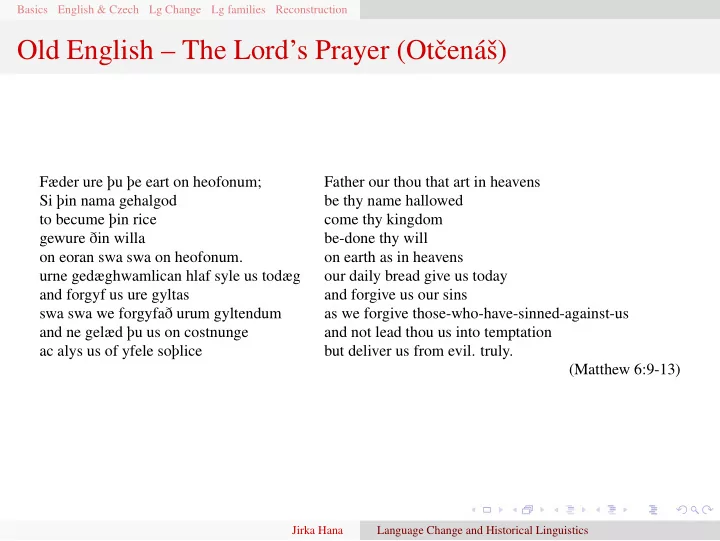
Fæder ure þu þe eart on heofonum; Father our thou that art in heavens Si þin nama gehalgod be thy name hallowed to becume þin rice come thy kingdom gewure Din willa be-done thy will

  • n eoran swa swa on heofonum.
  • n earth as in heavens

urne gedæghwamlican hlaf syle us todæg

  • ur daily bread give us today

and forgyf us ure gyltas and forgive us our sins swa swa we forgyfaD urum gyltendum as we forgive those-who-have-sinned-against-us and ne gelæd þu us on costnunge and not lead thou us into temptation ac alys us of yfele soþlice but deliver us from evil. truly. (Matthew 6:9-13)

Jirka Hana Language Change and Historical Linguistics

slide-2
SLIDE 2

Basics English & Czech Lg Change Lg families Reconstruction

Middle English – The Canterbury Tales

Whan that aprill with his shoures soote When April with his showers sweet with fruit The droghte of march hath perced to the roote, The drought of March has pierced unto the root And bathed every veyne in swich licour And bathed each vein with liquor that has power Of which vertu engendred is the flour; To generate therein and sire the flower; Whan Zephirus eek with his sweete breeth When Zephyr also has, with his sweet breath, Inspired hath in every holt and heeth Quickened again, in every holt and heath, The tendre croppes, and the yonge sonne The tender shoots and buds, and the young sun Hath in the ram his half cours yronne, Into the Ram one half his course has run, And smale foweles maken melodye, And many little birds make melody That slepen al the nyght with open ye That sleep through all the night with open eye (so priketh hem nature in hir corages); (So Nature pricks them on to ramp and rage)- Thanne longen folk to goon on pilgrimages, Then do folk long to go on pilgrimage, And palmeres for to seken straunge strondes, And palmers to go seeking out strange strands, To ferne halwes, kowthe in sondry londes; To distant shrines well known in sundry lands. And specially from every shires ende And specially from every shire’s end Of Engelond to Caunterbury they wende, Of England they to Canterbury wend, The holy blisful martir for to seke, The holy blessed martyr there to seek That hem hath holpen whan that they were seeke. Who helped them when they lay so ill and weal. (General Prologue, lines 1-18) Jirka Hana Language Change and Historical Linguistics

slide-3
SLIDE 3

Basics English & Czech Lg Change Lg families Reconstruction

Language Change and Historical Linguistics

Jirka Hana Charles University, 2011-12-17

Jirka Hana Language Change and Historical Linguistics

slide-4
SLIDE 4

Basics English & Czech Lg Change Lg families Reconstruction

Overview

1 Basics 2 English & Czech

Development of English Development of Czech

3 Language Change

Kinds of Language Change Why Do Languages Change? Attitudes Towards Language Change Sound Change

4 Language families 5 Comparative reconstruction

Jirka Hana Language Change and Historical Linguistics

slide-5
SLIDE 5

Basics English & Czech Lg Change Lg families Reconstruction

Historical linguistics

Historical linguistics studies: how languages change over time how languages are related.

Jirka Hana Language Change and Historical Linguistics

slide-6
SLIDE 6

Basics English & Czech Lg Change Lg families Reconstruction

Main theses

All languages change over time. The change is relatively slow. Languages do not change randomly. There are many patterns and generalizations we find out when examining the histories of various languages.

Jirka Hana Language Change and Historical Linguistics

slide-7
SLIDE 7

Basics English & Czech Lg Change Lg families Reconstruction

Note about speech and writing

Because devices for recording sounds have only been around for about a century, the vast majority of data used for historical linguistics is textual. This is only a matter of circumstance, however – as discussed before, the spoken language is primary; we only analyze the written language if we have no other options.

Jirka Hana Language Change and Historical Linguistics

slide-8
SLIDE 8

Basics English & Czech Lg Change Lg families Reconstruction

Two Approaches to the Study of Language

synchronic – Study of language at one point in time (usually “now” – the modern form of a language).

synchronic: From Greek: syn (same, together) + chronos (time)

  • Cf. synchronize, synonym, symphony, synergy; chronicle, chronology, chronic

diachronic – studies historic development of a language or

  • languages. (compares the language with itself at different stages
  • f its development)

diachronic: From Greek: dia (thru, accross) + chronos (time)

  • Cf. diagonal, diarrhea (thru + flow), diagram, diadem (bound across), dialect (across +

speak), dialog (across + speak), diameter (across + measure), diaspora

Jirka Hana Language Change and Historical Linguistics

slide-9
SLIDE 9

Basics English & Czech Lg Change Lg families Reconstruction Development of English Development of Czech

Development of English

1 Old English (OE, 450-1100) 2 Middle English (MidE, 1100-1450) 3 Early Modern English (1450-1700) 4 Modern English (ModE, 1700-present)

Jirka Hana Language Change and Historical Linguistics

slide-10
SLIDE 10

Basics English & Czech Lg Change Lg families Reconstruction Development of English Development of Czech

Indo-European to Germanic

Grimm’s law

  • vcd stop > fricative

+vcd stop > -vcd +vcd aspirated stop > fricative (> stop)

Jirka Hana Language Change and Historical Linguistics

slide-11
SLIDE 11

Basics English & Czech Lg Change Lg families Reconstruction Development of English Development of Czech

Indo-European to Germanic

Grimm’s law

  • vcd stop > fricative

+vcd stop > -vcd +vcd aspirated stop > fricative (> stop)

p pater f father, de: Vater pedis, epod (cz: under) f foot, de: Fuss t tres, tˇ ri (cz) θ three k kardia (Greek) h heart b labium p lip d decem, deset (cz) t ten g gyn¯ e (Greek) k queen

Jirka Hana Language Change and Historical Linguistics

slide-12
SLIDE 12

Basics English & Czech Lg Change Lg families Reconstruction Development of English Development of Czech

Germanic to W Germanic

Verner’s law (roughly):

proto-German High German V else *p f pf *t s ts *k x k (kx) *d t t

Jirka Hana Language Change and Historical Linguistics

slide-13
SLIDE 13

Basics English & Czech Lg Change Lg families Reconstruction Development of English Development of Czech

Germanic to W Germanic

Verner’s law (roughly):

proto-German High German V else *p f pf *t s ts *k x k (kx) *d t t English Modern German p

  • pen

f

  • ffen

path pfad t bite beissen t to ts zu [tsu] ten zehn [ts..] k book x Buch [..x] k come k kommen d ride t reiten door T¨ ur

Jirka Hana Language Change and Historical Linguistics

slide-14
SLIDE 14

Basics English & Czech Lg Change Lg families Reconstruction Development of English Development of Czech

Old English to Middle English

1 Loss of /x/ (usually written as gh, German preserved it) en: right [rait] night [naIt] neighbor [neIb@r] high [haI] through [Tru] de: rechts [rexts] Nacht [naxt] Nachbar [naxbar] hoch [hox] durch [durx]

Jirka Hana Language Change and Historical Linguistics

slide-15
SLIDE 15

Basics English & Czech Lg Change Lg families Reconstruction Development of English Development of Czech

Old English to Middle English

1 Loss of /x/ (usually written as gh, German preserved it) en: right [rait] night [naIt] neighbor [neIb@r] high [haI] through [Tru] de: rechts [rexts] Nacht [naxt] Nachbar [naxbar] hoch [hox] durch [durx] 2 Some allophones became distinct phonemes

[f]/[v], [D]/[T], etc.

Jirka Hana Language Change and Historical Linguistics

slide-16
SLIDE 16

Basics English & Czech Lg Change Lg families Reconstruction Development of English Development of Czech

Old English to Middle English

1 Loss of /x/ (usually written as gh, German preserved it) en: right [rait] night [naIt] neighbor [neIb@r] high [haI] through [Tru] de: rechts [rexts] Nacht [naxt] Nachbar [naxbar] hoch [hox] durch [durx] 2 Some allophones became distinct phonemes

[f]/[v], [D]/[T], etc.

3 Loss of many final vowels > loss of case endings

Jirka Hana Language Change and Historical Linguistics

slide-17
SLIDE 17

Basics English & Czech Lg Change Lg families Reconstruction Development of English Development of Czech

Old English to Middle English

1 Loss of /x/ (usually written as gh, German preserved it) en: right [rait] night [naIt] neighbor [neIb@r] high [haI] through [Tru] de: rechts [rexts] Nacht [naxt] Nachbar [naxbar] hoch [hox] durch [durx] 2 Some allophones became distinct phonemes

[f]/[v], [D]/[T], etc.

3 Loss of many final vowels > loss of case endings 4 Word order became more rigid

Jirka Hana Language Change and Historical Linguistics

slide-18
SLIDE 18

Basics English & Czech Lg Change Lg families Reconstruction Development of English Development of Czech

Old English to Middle English

1 Loss of /x/ (usually written as gh, German preserved it) en: right [rait] night [naIt] neighbor [neIb@r] high [haI] through [Tru] de: rechts [rexts] Nacht [naxt] Nachbar [naxbar] hoch [hox] durch [durx] 2 Some allophones became distinct phonemes

[f]/[v], [D]/[T], etc.

3 Loss of many final vowels > loss of case endings 4 Word order became more rigid 5 England under Norman (French) rule > about 10K French

borrowings

Jirka Hana Language Change and Historical Linguistics

slide-19
SLIDE 19

Basics English & Czech Lg Change Lg families Reconstruction Development of English Development of Czech

Old English to Middle English

1 Loss of /x/ (usually written as gh, German preserved it) en: right [rait] night [naIt] neighbor [neIb@r] high [haI] through [Tru] de: rechts [rexts] Nacht [naxt] Nachbar [naxbar] hoch [hox] durch [durx] 2 Some allophones became distinct phonemes

[f]/[v], [D]/[T], etc.

3 Loss of many final vowels > loss of case endings 4 Word order became more rigid 5 England under Norman (French) rule > about 10K French

borrowings

6 etc.

Jirka Hana Language Change and Historical Linguistics

slide-20
SLIDE 20

Basics English & Czech Lg Change Lg families Reconstruction Development of English Development of Czech

Old English Nominals

All nouns distinguished gender: guma ‘man’ – masculine, scip ‘ship’ – neuter, giefu ‘gift’ – femine, etc. All nouns where inflected for case, and number Adjective agreed with nouns in case, number and gender

Jirka Hana Language Change and Historical Linguistics

slide-21
SLIDE 21

Basics English & Czech Lg Change Lg families Reconstruction Development of English Development of Czech

Old English Adjectives

Weak forms – after determiners (articles, possessives, that, etc.)

singular plural masculine feminine neuter all genders nom til-a (good) til-e til-e til-an gen til-an til-ra, til-ena dat til-an til-um acc til-an til-e til-an

Strong forms – otherwise

singular plural masculine neuter feminine masculine neuter feminine nom sg til (good) til til-u til-e til-u til-e, -a gen til-es til-re til-ra dat til-um til-re til-um acc til-ne til til-e til-e til-u til-e, -a

Jirka Hana Language Change and Historical Linguistics

slide-22
SLIDE 22

Basics English & Czech Lg Change Lg families Reconstruction Development of English Development of Czech

Middle English to Early Modern English

1 The Great Vowel Shift – only [I] and [E] unaffected.

One vowel “pushed” another to a different place in the vowel chart.

Jirka Hana Language Change and Historical Linguistics

slide-23
SLIDE 23

Basics English & Czech Lg Change Lg families Reconstruction Development of English Development of Czech

Middle English to Early Modern English

1 The Great Vowel Shift – only [I] and [E] unaffected.

One vowel “pushed” another to a different place in the vowel chart.

2 Simplification of some initial consonant clusters:

[kn] > [n]: know, knee, knight [hr] > [r]: hring > ring [wr] > [r]: write, wrist

Jirka Hana Language Change and Historical Linguistics

slide-24
SLIDE 24

Basics English & Czech Lg Change Lg families Reconstruction Development of English Development of Czech

Development of Czech

1 Old Slavonic 2 Proto-Czech (1000-1150) 3 1300-1400’s 4 Humanistic period 5 Baroque period 6 The National Renaissance

Jirka Hana Language Change and Historical Linguistics

slide-25
SLIDE 25

Basics English & Czech Lg Change Lg families Reconstruction Development of English Development of Czech

Sources

Old Slavonic – no direct sources, reconstructed language Old Church Slavonic (staroslovˇ enˇ stina) Literary language based on the Thessaloniki Slavic dialect, created Saints Cyril and Methodius in 800’s.

Jirka Hana Language Change and Historical Linguistics

slide-26
SLIDE 26

Basics English & Czech Lg Change Lg families Reconstruction Development of English Development of Czech

Proto-Czech (1000-1150)

V j V > V: (dobraja > dobr´ a)

Jirka Hana Language Change and Historical Linguistics

slide-27
SLIDE 27

Basics English & Czech Lg Change Lg families Reconstruction Development of English Development of Czech

Proto-Czech (1000-1150)

V j V > V: (dobraja > dobr´ a) yers (ż and ž; reduced vowels): yer > 0 (odd yers from the end) / e (even yers)

  • kżno > okno but okżnż > oken

Jirka Hana Language Change and Historical Linguistics

slide-28
SLIDE 28

Basics English & Czech Lg Change Lg families Reconstruction Development of English Development of Czech

Proto-Czech (1000-1150)

V j V > V: (dobraja > dobr´ a) yers (ż and ž; reduced vowels): yer > 0 (odd yers from the end) / e (even yers)

  • kżno > okno but okżnż > oken

nasal vowels disappeared

Jirka Hana Language Change and Historical Linguistics

slide-29
SLIDE 29

Basics English & Czech Lg Change Lg families Reconstruction Development of English Development of Czech

Old Czech (1150-1250)

No continuous texts, mostly single words or glosses in Latin texts. In comparison with modern Czech, Old Czech has: a full system

  • f palatal and hard consonants, dual number, simple past tenses

(aorist, imperfect), etc.

[a/æ] > [jE] (ˇ e) after palatal/palatalized consonants. This led to differentiation between hard and soft paradigms g > h (gora > hora ‘mountain’)

Jirka Hana Language Change and Historical Linguistics

slide-30
SLIDE 30

Basics English & Czech Lg Change Lg families Reconstruction Development of English Development of Czech

category Old Czech Modern Czech infinitive p´ ec-i p´ ec-t ‘bake’ present 1sg pek-u peˇ c-u 1du peˇ c-evˇ e – 1pl peˇ c-em(e/y) peˇ c-eme : imperfect 1sg peˇ c-iech – 1du peˇ c-iechovˇ e – 1pl peˇ c-iechom(e/y) – 2pl peˇ c-ieˇ ste : aorist s 1sg peˇ c-ech – 1du peˇ c-echovˇ e – 1pl peˇ c-echom – 2pl peˇ c-este – : imperative 2sg pec-i peˇ c 2du pec-ta – 2pl pec-te peˇ c-te : verbal noun peˇ c-enie peˇ c-en´ ı

Jirka Hana Language Change and Historical Linguistics

slide-31
SLIDE 31

Basics English & Czech Lg Change Lg families Reconstruction Development of English Development of Czech

1300-1400’s

First longer written texts Depalatalization – Old Czech had a full system of palatal and hard consonants, most of this is lost Difference between i and y neutralized Beginnings of: ´ y > ej (b´ yt > bejt ‘to be’) and ´ u > ou (s´ ud > soud ‘court’) Beginnings of protetic v before initial o: vokno ‘window’ Simple past tenses disappeared Standardization of orthography (probably by Jan Hus), diacritics replaces digraphs. E.g., rz, rrz, rs, rzs, rzss, . . . > ˙ r

Jirka Hana Language Change and Historical Linguistics

slide-32
SLIDE 32

Basics English & Czech Lg Change Lg families Reconstruction Development of English Development of Czech

Humanistic period

Kralick´ a bible and several Czech grammars published masculine animacy as today Dual number disappears except for certain nouns and agreeing attributes (s dlouh´ yma rukama ‘with long arms’, dvˇ e stˇ e ‘200’, . . . )

Jirka Hana Language Change and Historical Linguistics

slide-33
SLIDE 33

Basics English & Czech Lg Change Lg families Reconstruction Development of English Development of Czech

Baroque period

Czech is replaced by German in many situations. ´ e > ´ ı: ˇ r´ eci > ˇ r´ ıci ‘say’, dobr´ e ml´ eko > dobr´ y ml´ ıko ‘good milk’ dual endings used instrumental plural (-ama)

Jirka Hana Language Change and Historical Linguistics

slide-34
SLIDE 34

Basics English & Czech Lg Change Lg families Reconstruction Development of English Development of Czech

The National Renaissance

Creation/resurrection of Literary Czech on the basis of humanistic Czech ignoring 200 years of development and resulting in the split between Literary and Common Czech.

Jirka Hana Language Change and Historical Linguistics

slide-35
SLIDE 35

Basics English & Czech Lg Change Lg families Reconstruction Kinds of LC Why Attitudes towards LC Sound Change

Kinds of Language Change

Languages undergo changes at all linguistic levels: phonetic, phonemic, morphological, syntactic, semantic, pragmatic

Jirka Hana Language Change and Historical Linguistics

slide-36
SLIDE 36

Basics English & Czech Lg Change Lg families Reconstruction Kinds of LC Why Attitudes towards LC Sound Change

Phonetic Language Change

Old English had [y] (as [I], but rounded), it was replaced by [I] or [aI]:

[pyt] > [pIt] pit, [my:s] > [mis] > [maIs] mice.

Old English had [x], Modern English does not [bro:xte] brohte > [brOt] brought Reduction of yers in Proto-Czech: dżnżsż > dnes ‘today’

Jirka Hana Language Change and Historical Linguistics

slide-37
SLIDE 37

Basics English & Czech Lg Change Lg families Reconstruction Kinds of LC Why Attitudes towards LC Sound Change

Phonemic Language Change

In Old English [v] and [f] were allophones (variants) of one phoneme. In Modern English they are two distinct phonemes.

Jirka Hana Language Change and Historical Linguistics

slide-38
SLIDE 38

Basics English & Czech Lg Change Lg families Reconstruction Kinds of LC Why Attitudes towards LC Sound Change

Morphological Language Change

In OE, nouns had case endings (nominative, genitive, dative, accusative) Past tense in Czech:

Old Czech: several simple past tenses (aorist, imperfect) Modern Czech: only analytical preterite some forms of aorist are used in the conditional auxiliary (bych)

Jirka Hana Language Change and Historical Linguistics

slide-39
SLIDE 39

Basics English & Czech Lg Change Lg families Reconstruction Kinds of LC Why Attitudes towards LC Sound Change

Syntactic Language Change

Question formation in English:

OE: all questions could be formed by inverting the subject and the verb. ModE: inversion possible only with auxiliaries, other verbs use do.

Jirka Hana Language Change and Historical Linguistics

slide-40
SLIDE 40

Basics English & Czech Lg Change Lg families Reconstruction Kinds of LC Why Attitudes towards LC Sound Change

Semantic & lexical Language Change

In OE, girl referred to young men and women. silly meant ‘blessed’: To whom the angel spoke, Saying, Be not afraid; Be glad, poor silly shepherds; Why are you so dismayed? (A Child This Day Is Born) Czech: pivo any drink > beer

Jirka Hana Language Change and Historical Linguistics

slide-41
SLIDE 41

Basics English & Czech Lg Change Lg families Reconstruction Kinds of LC Why Attitudes towards LC Sound Change

Language Change

Shakespeare’s time: What thinkest thou? Modern English: What do you think? syntactic change – no auxiliary do morphological change – verb endings lexical change – thou is now obsolete.

Jirka Hana Language Change and Historical Linguistics

slide-42
SLIDE 42

Basics English & Czech Lg Change Lg families Reconstruction Kinds of LC Why Attitudes towards LC Sound Change

Why Do Languages Change?

Economy: Speakers tend to use as little energy as possible to reach the goals of communication. Analogy: One part of the system (lexicon, morphology, ...) or even a single word or rule is modified to be more like other parts

  • f the system.

Change of context (society, culture, place)

Jirka Hana Language Change and Historical Linguistics

slide-43
SLIDE 43

Basics English & Czech Lg Change Lg families Reconstruction Kinds of LC Why Attitudes towards LC Sound Change

Why Do Languages Change?

Language split – A language may split into two or more languages if the speakers become separated into two or more groups with little or no contact. Latin > French, Spanish, Catalan, Romanian, . . . English > British, American, Indian, South African, . . .

Jirka Hana Language Change and Historical Linguistics

slide-44
SLIDE 44

Basics English & Czech Lg Change Lg families Reconstruction Kinds of LC Why Attitudes towards LC Sound Change

Why Do Languages Change?

Borrowing between languages in contact (because of trade, etc.) Mostly vocabulary. Less frequently in phonetics, phonology; sometimes also syntax, morphology and semantics.

English borrowed words from many languages (often via other languages), e.g., French (design, court, table), Latin (deficit, sponsor), Scandinavian lgs. (they, law), German (kindergarten, noodle), Spanish (canyon, tornado), Italian (isolate), Greek (comedy, theater), Native American lgs. (chipmunk, kayak), South Asian (sandal), Dutch (cruise), Arabic (algorithm, giraffe, alcohol), Chinese (tea), Russian (czar), Czech (robot, howitzer). Czech borrowings: English (g´

  • l, software), German (flaˇ

ska, l´ ahev), Russian (samovar), Latin (koˇ sile, norma, cirkus, minuta), French (toaleta), Spanish (arm´ ada), Italian (banka), Greek (kytara, symbol), Turkish (jogurt), Arabic (algebra, alkohol), Chinese (ˇ caj), ....

Jirka Hana Language Change and Historical Linguistics

slide-45
SLIDE 45

Basics English & Czech Lg Change Lg families Reconstruction Kinds of LC Why Attitudes towards LC Sound Change

Attitudes Towards Language Change

People have complained about the deterioration of language forever. There were many attempts to resist language change, defending it against: “invasion of barbaric” terms from other languages preventing “vulgar speech from corrupting” the language as a whole.

Jirka Hana Language Change and Historical Linguistics

slide-46
SLIDE 46

Basics English & Czech Lg Change Lg families Reconstruction Kinds of LC Why Attitudes towards LC Sound Change

Attitudes Towards Language Change

Many countries have/had language academies – institutions organized to attempt to regulate, stop, or even reverse language change. Academies & government can force newspapers and book publishers to conform to specific guidelines, but they cannot control how people speak, and that’s where the language change originates.

Jirka Hana Language Change and Historical Linguistics

slide-47
SLIDE 47

Basics English & Czech Lg Change Lg families Reconstruction Kinds of LC Why Attitudes towards LC Sound Change

A Sound Change is a phonological process which has been accepted by all speakers of a language (or dialect). Sound changes tend to spread from speaker to speaker gradually in a wave-like pattern until they are uniformly used by all speakers in a linguistics community. They do not spontaneously occur everywhere in a language.

Jirka Hana Language Change and Historical Linguistics

slide-48
SLIDE 48

Basics English & Czech Lg Change Lg families Reconstruction Kinds of LC Why Attitudes towards LC Sound Change

When:

Conditioned – the change happens only in certain phonetic environment e.g. all [s] in front of a vowel change into [S] Unconditioned – the change happens regardless of the phonetic environment e.g. all [s] change into [S]

Jirka Hana Language Change and Historical Linguistics

slide-49
SLIDE 49

Basics English & Czech Lg Change Lg families Reconstruction Kinds of LC Why Attitudes towards LC Sound Change

What:

Assimilation: Two sounds become more like each other when they are near or touching. e.g. [wulfas] > [wulvas] ([f] is voiceless, [l] & [v] are voiced) Dissimilation: Two sounds become less like each other when near or touching. e.g. [fifT] > [fift] fifth ([f] & [T] are fricatives, [t] is a stop)

Jirka Hana Language Change and Historical Linguistics

slide-50
SLIDE 50

Basics English & Czech Lg Change Lg families Reconstruction Kinds of LC Why Attitudes towards LC Sound Change

What:

Deletion: Sounds are deleted in certain environments. e.g. MidE [knIxt] > ModE [naIt] knight ([k] and [x] deleted) Insertion: Sounds are inserted in certain environments. e.g. [æTlit] > [æT@lit] athlete Monophthongization: Diphthongs become monophthongs. e.g. MidE [rIUl@] > ModE [rul] rule Diphthongization: Monophthongs become diphthongs e.g. MidE [u] > ModE [aU]: [hus] > [haUs] house, [maUs] mouse

Jirka Hana Language Change and Historical Linguistics

slide-51
SLIDE 51

Basics English & Czech Lg Change Lg families Reconstruction Kinds of LC Why Attitudes towards LC Sound Change

What:

Metathesis: The order of sounds change. e.g. ask > aks Raising/Lowering: The position of the tongue becomes either higher or lower when producing certain sounds. e.g. [met@] > [mit] meat Backing/Fronting: The position of the tongue becomes either more forward or more back. e.g. [paT] > [pæT] path

Jirka Hana Language Change and Historical Linguistics

slide-52
SLIDE 52

Basics English & Czech Lg Change Lg families Reconstruction Kinds of LC Why Attitudes towards LC Sound Change

Note: Always look at pronunciation not spelling: Pronunciation can change without spelling changing e.g. English name used to be pronounced [na:m@] but spelling did not change. Spelling can change without pronunciation changing Turkish switched it’s whole alphabet in 1928 without changing pronunciation Russian modified it’s spelling in 1917 without changing the pronunciation

Jirka Hana Language Change and Historical Linguistics

slide-53
SLIDE 53

Basics English & Czech Lg Change Lg families Reconstruction

Language Families

We can classify languages by their origin into a tree similar to family trees. Most of the European and some Asian languages evolved from a common ancestor called Proto-Indo-European.

Jirka Hana Language Change and Historical Linguistics

slide-54
SLIDE 54

Basics English & Czech Lg Change Lg families Reconstruction

Indo-European

Slavic: Czech, Russian, Polish, Croatian, Bulgarian, etc. Romance/Italic languages – Latin and its descendants: Spanish, Portuguese, French, Italian, Romanian, etc. Germanic languages: English, German, Dutch, Afrikaans, Yiddish, Norwegian, Swedish, Danish, etc. Celtic: Irish, Scots Gaelic, Welsh Indo-Iranian: Sanskrit, Hindi, Urdu, Romany (Gypsy), Pashto Hellenic: Greek etc.

Jirka Hana Language Change and Historical Linguistics

slide-55
SLIDE 55

Basics English & Czech Lg Change Lg families Reconstruction

Language Families

Except Indo-European there are many other language families, for example: Sino-Tibetan languages: Mandarin (Chinese), Cantonese (Chinese), Tibetan, Thai Uralic languages: Hungarian, Finnish Afro-asiatic: Semitic languages (Arabic, Hebrew, Maltese), Somali, Egyptian (Ancient Egypt), etc.

Jirka Hana Language Change and Historical Linguistics

slide-56
SLIDE 56

Basics English & Czech Lg Change Lg families Reconstruction

There is about 7000 languages, originating probably in a small number of proto-languages. For detailed classifications: http://www.ethnologue.com http://www.krysstal.com/langfams.html

Jirka Hana Language Change and Historical Linguistics

slide-57
SLIDE 57

Basics English & Czech Lg Change Lg families Reconstruction

Comparative reconstruction

How do we know about supposed mother languages if there are usually no speakers of these languages and frequently no texts? We reconstruct vanished languages by comparing their descendant languages.

Jirka Hana Language Change and Historical Linguistics