of the Hunter Estuary Robert Clemens The University of Queensland - - PowerPoint PPT Presentation
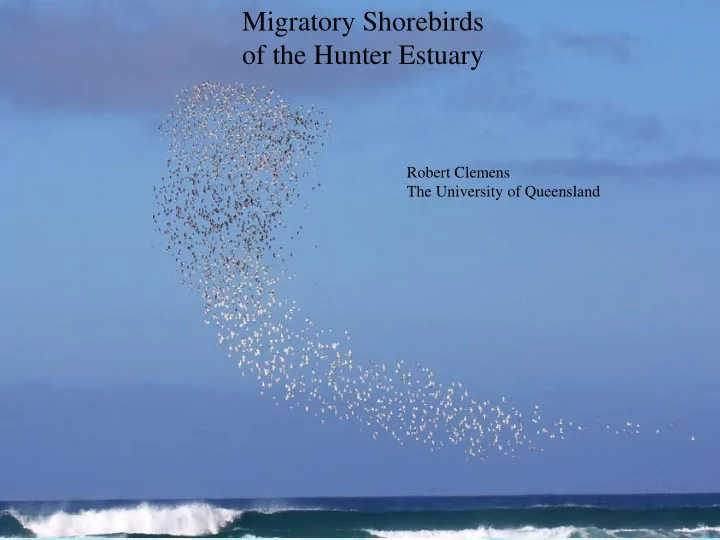
of the hunter estuary
SMART_READER_LITE
LIVE PREVIEW

of the Hunter Estuary Robert Clemens The University of Queensland - - PowerPoint PPT Presentation

Migratory Shorebirds of the Hunter Estuary Robert Clemens The University of Queensland Hunter Estuary Ramsar Site Ramsar wetlands are listed as a Matter of National Environmental Significance ( MNES under the EPBC Act Hunter meets Criterion 4


slide-1
SLIDE 1

Migratory Shorebirds

  • f the Hunter Estuary

Robert Clemens The University of Queensland

slide-2
SLIDE 2

Glenn Ehmke Chris Tzaros

Ramsar wetlands are listed as a Matter of National Environmental Significance (MNES under the EPBC Act Hunter meets Criterion 4 – supports animals at a critical life stage and Criterion 6 - regularly supports 1% of the individuals in a population of one species of waterbird.

Hunter Estuary Ramsar Site

slide-3
SLIDE 3
  • Bonn Convention
  • CAMBA China-Australia Migratory Bird Agreement
  • JAMBA Japan-Australia Migratory Bird Agreement
  • ROKAMBA Republic of Korea-Australia Migratory

Bird Agreement

International agreements to protect these birds

slide-4
SLIDE 4
  • All shorebirds are listed as MNES under the

EPBC Act

  • Curlew Sandpiper listed as Endangered

under the Threatened Species Conservation Act 1995 (NSW) (TSC Act).

  • Both the Eastern Curlew

and Great Knot are also listed as Vulnerable

  • n the IUCN’s Red List.
slide-5
SLIDE 5

Impacts are considered significant under MNES for shorebirds and Ramsar sites if:

  • An action destroys habitat
  • Disrupts the life cycle of a migratory species
  • Seriously affects invertebrates
slide-6
SLIDE 6

How do we know what a significant impact is?

  • RAMSAR ECD’s set limits of acceptable change for the Hunter –

record no fewer than 5,000 shorebirds or 600 Eastern Curlew for 5 yrs

  • EPBC has significant impact guidelines:

– Won’t impact more than 0.1% of the flyway population – Will consider the entire area of habitat which may include multiple roosts and feeding areas

slide-7
SLIDE 7

These levels of significant impact have been exceeded repeatedly in the Hunter Estuary But no action has been taken to reduce impacts, and the T4 project is likely to exacerbate

  • ngoing impacts
slide-8
SLIDE 8

Sandpipers Snipe Stints Pratincoles Plovers Avocets

Curlews

Oystercatchers

Ingwersen Tzaros Ingwersen Tzaros Ingwersen Tzaros

Knots

Clemens Clemens Clemens

What is a shorebird?

Ehmke

Godwits

slide-9
SLIDE 9

Migratory species vary in size and moult twice a year From a: Red-necked Stint

  • Body size of a sparrow
  • Weigh 25 grams (½ bag of chips)

To a: Eastern Curlew --- Over 1 kilogram 3-5 million migratory shorebirds visit Australia annually

Ingwersen Ingwersen Tzaros Tzaros Ehmke Ingwersen Adrian Boyle Jeff Davies

slide-10
SLIDE 10

Shorebird species in Australia

18* residents 37 migrants 24 vagrants

Hooded Plovers by Glenn Ehmke Eastern Curlew by Glenn Ehmke Dunlin by Alexandre Andreev

* The Australian Pratincole is known to migrate to islands north of Australia

slide-11
SLIDE 11

East Asian-Australasian flyway

Birds breed in Siberia, North China and Alaska in June and July Stopover at staging sites in Yellow Sea Migrate south to Australia & New Zealand

Joe Liebezeit Ken Gosbell Danny Rogers

slide-12
SLIDE 12

Ruddy Turnstone migration – tracked with geo-locators

slide-13
SLIDE 13

Where do they breed?

  • Sandpipers, godwits, some plovers, tattlers and

turnstones breed in the arctic tundra

  • Marsh Sandpiper, Greater Sand Plover and

Oriental Plover breed in the steppes and deserts of middle latitudes

  • Shanks breed in the belt of boreal forests across

the northern Hemisphere

Emily Weiser

slide-14
SLIDE 14

Different bills allow different shorebird species to capture different prey

Ingwersen Rogers Ingwersen Rogers Herrod Rogers Ingwersen Tzaros Clemens Ehmke

slide-15
SLIDE 15

Pictures – Sabine Dittmann

Polychaetes

Gastropod – Salinator fragilis Crustacea – Amphipod sp.

Examples of shorebird prey items

slide-16
SLIDE 16

The energetics of migration

  • Pre-migration,

body mass increases by up to 70-80%. 2-5% weight gain per day

Seasonal variation in weight of Red-necked Stints

Rogers et al. (1996). The Stilt 29, 2-23.

Clemens

slide-17
SLIDE 17

The Hunter Estuary, New South Whales

slide-18
SLIDE 18

Australia’s nationally important shorebird sites

slide-19
SLIDE 19

Shorebird Trends, at individual sites

Shorebird species Rates of decline % per year (bold = significant result) Moreton Bay, Qld

Wilson et al. (2011) Cons. Biol.

Corner Inlet, Vic

Minton et al. (2012) Stilt

NE, Tasmania

Cooper et al. (2012) Stilt

Curlew Sandpiper

  • 4.0%
  • 3.4%

3.4%

  • 2.9%

2.9% Eastern Curlew

  • 2.2%
  • 2.1%

.1%

  • 2.2%

.2% Great Knot

  • 4.4%

.4%

  • 3.2%

.2% NA Red Knot

  • 9.1%

.1%

  • 3.2%

.2% NA Ruddy Turnstone

  • 6.1%

.1%

  • 3.2%

.2%

  • 2.1%

.1% Greenshank

  • 5.9%

.9%

  • 2.6%

.6% 1.6% Bar-tailed Godwit

  • 6.4%

.4% 0.7%

  • 2.4%

.4%

slide-20
SLIDE 20

Eastern Curlew

1 2 4 5 6 1 2 4 5 6 7 8 7 8

100 27 6 5 59 14 3 Takuya Iwamura– University of Queensland

slide-21
SLIDE 21

1975: Low Tide

slide-22
SLIDE 22

2010: Low Tide

  • 1. How much intertidal habitat

is left?

  • 2. What is the rate of loss?
  • 3. What are the primary

drivers of loss?

slide-23
SLIDE 23

Spatially variable pattern of past habitat loss

slide-24
SLIDE 24

N = 229 shorebird areas throughout Australia, more birds are disappearing from the Hunter Estuary over the last 30 years than 75%+ of the other shorebird areas in Australia

Shorebirds declining more rapidly at the Hunter than most other places in Australia

slide-25
SLIDE 25

What’s most likely caused declines

Photo: Dean Ingwersen

Less Food

changes in water quality, sediment

More disturbance How will we respond

slide-26
SLIDE 26

Eastern Curlew by Glenn Ehmke

Conclusions

T4 project likely to exacerbate ongoing shorebird declines with increased indirect impacts - disturbance and degraded foraging habitat indirect impacts not addressed in assessment documents T4 will directly impacts nationally significant numbers of birds Tomango offset will not offset indirect impacts, and is not guaranteed to work in the long-term

slide-27
SLIDE 27

Thank you