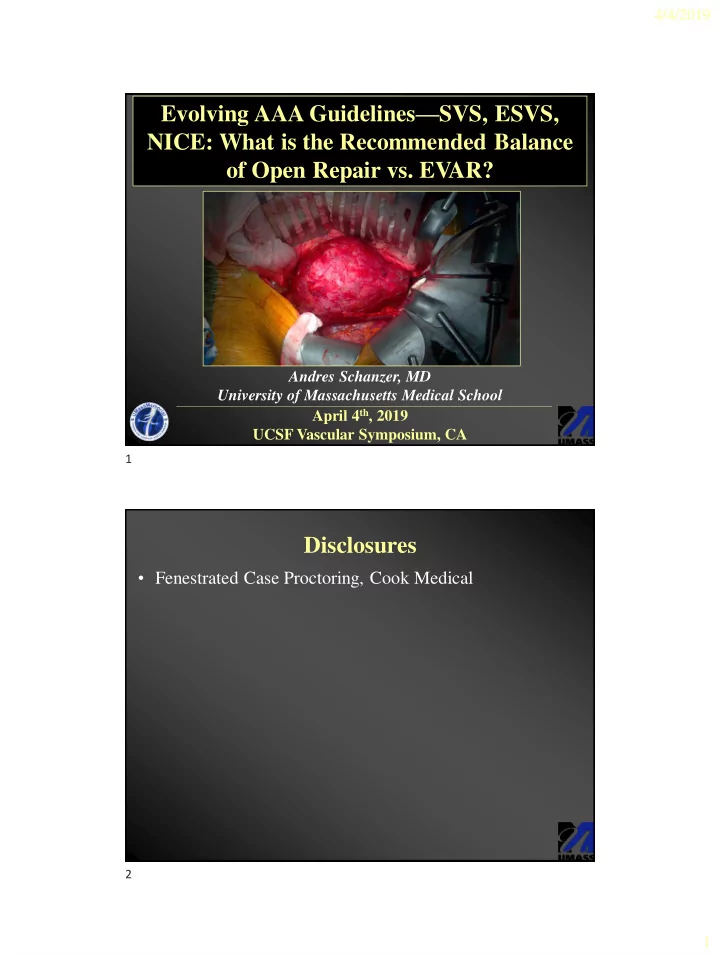
of Open Repair vs. EV AR? Andres Schanzer, MD University of - - PDF document

of open repair vs ev ar
SMART_READER_LITE
LIVE PREVIEW

of Open Repair vs. EV AR? Andres Schanzer, MD University of - - PDF document

4/4/2019 Evolving AAA Guidelines SVS, ESVS, NICE: What is the Recommended Balance of Open Repair vs. EV AR? Andres Schanzer, MD University of Massachusetts Medical School April 4 th , 2019 UCSF Vascular Symposium, CA 1 Disclosures


slide-1
SLIDE 1

4/4/2019 1

Evolving AAA Guidelines—SVS, ESVS, NICE: What is the Recommended Balance

  • f Open Repair vs. EV

AR?

Andres Schanzer, MD University of Massachusetts Medical School April 4th, 2019 UCSF Vascular Symposium, CA

Disclosures

  • Fenestrated Case Proctoring, Cook Medical

1 2

slide-2
SLIDE 2

4/4/2019 2

Abdominal Aortic Aneurysm

▪ Epidemiology*

▪ 16,000 deaths annually in U.S. ▪ 13th leading cause of death in U.S. ▪ 10th leading cause of death in men >55

*Dartmouth Atlas of Health Care, 2009.

Natural History

▪ Expansion followed by rupture

▪ 0.2-0.4 cm per year expected*

*UK Small Aneurysm, Lancet 1998; ADAM, NEJM, 2002.

3 4

slide-3
SLIDE 3

4/4/2019 3 5.5 CENTIMETERS

1998

Open Repair

▪ Direct exposure

▪ Transabdominal, retroperitoneal

▪ Proximal and distal control ▪ Prosthetic graft sutured to normal artery

5 6

slide-4
SLIDE 4

4/4/2019 4

Results of Open Repair

Effective and Durable

  • 5-10% mortality in population-

based studies

  • 15-30% significant morbidity;

substantially higher in elderly patients with co-morbidity

  • Recovery 2-3 months
  • High risk patients often denied

repair

BUT...

AAA Operative Mortality

J Endovasc Surg 1997;4:232 5.4% in >22,000 pts with non-ruptured AAA

7 8

slide-5
SLIDE 5

4/4/2019 5

Transformative Moment

1991

1991

9 10

slide-6
SLIDE 6

4/4/2019 6

Endovascular AAA Repair

▪ Device inserted from the groins ▪ Positioned with XRAY guidance ▪ Aneurysm excluded with a covered stent system

Exclusion of AAA from the circulation

11 12

slide-7
SLIDE 7

4/4/2019 7

In the United States, >80% of infrarenal elective repairs of AAA are performed utilizing EVAR*

*Lederle et al, NEJM, 2012. *Schanzer et al, JAHA, 2011.

13 14

slide-8
SLIDE 8

4/4/2019 8 DREAM trial EVAR trial I

EVAR Open EVAR Open Mean operative time (min) 135 151 182 205 Mean estimated blood loss (mL) 394 1654 n/r n/r Mean blood products transfused 0.09 units 0.44 units 164 mL 896 mL Mean length of intensive care unit stay (days) 0.67 3 0.7 2.4 Mean overall length of stay (days) 6 13 10.3 15.7 Perioperative mortality (%) 1.2 4.6 1.7 4.7

DREAM Trial: NEJM, October, 2004 EVAR Trial: Lancet, September 2004

EVAR versus Open RCTs

What about long-term

  • utcomes?

15 16

slide-9
SLIDE 9

4/4/2019 9

Goals: To evaluate the rate of compliance with imaging follow-up post EVAR and to identify factors associated with being lost to imaging follow-up.

17 18

slide-10
SLIDE 10

4/4/2019 10

Research Design and Methods

▪ Data Sources

▪ Linked data through 2010 from Medicare Inpatient, Outpatient, and Carrier files, to identify all abdominal imaging studies that may have been performed for EVAR follow- up. ▪ N=19,962

50% lost to imaging follow-up by 5 years

19 20

slide-11
SLIDE 11

4/4/2019 11

Imaging Follow-Up Compliance

Only 37% of those alive 6-8 years post EVAR had an imaging study in last 2 years

Compliance with imaging follow-up recommendations after EVAR in the United States is well below the recommended rate.

21 22

slide-12
SLIDE 12

4/4/2019 12

“…similar rates

  • f survival…”

“…increased rates of reintervention…”

23 24

slide-13
SLIDE 13

4/4/2019 13

“…equivalent long-term survival..increased complications, increased reinterventions…”

25 26

slide-14
SLIDE 14

4/4/2019 14

“…beyond 8 years of follow-up

  • pen-repair had a significantly

lower mortality..increased aneurysm- related mortality in the EVAR group after 8 years was mainly attributable to secondary aneurysm sac rupture.…”

27 28

slide-15
SLIDE 15

4/4/2019 15

“…similar rates

  • f survival…”

“…our results also indicate that late rupture remains a concern and that endovascular repair does not yet offer a long-term advantage over open repair…”

29 30

slide-16
SLIDE 16

4/4/2019 16

“…substantial early survival advantage that gradually decreased

  • ver time…”

“…late rupture was significantly higher after endovascular repair than after open repair…”

What about long-term

  • utcomes?

31 32

slide-17
SLIDE 17

4/4/2019 17

33 34

slide-18
SLIDE 18

4/4/2019 18 “…We suggest that elective EVAR be limited to hospitals with…documented mortality and conversion rate to open surgical repair of 2% or less and that perform at least 10 EVAR cases each year. “We…suggest that elective open aneurysm repair be limited to hospitals with a documented mortality of 5% or less and that perform at least 10 open aortic operations of any type each year.…”

“…111 evidence-based recommendations

  • n: screening; evaluation; medical, open

surgical, and endovascular..…”

35 36

slide-19
SLIDE 19

4/4/2019 19

Evolving AAA Guidelines—SVS, ESVS, NICE: What is the Recommended Balance

  • f Open Repair vs. EV

AR?

37 38

slide-20
SLIDE 20

4/4/2019 20

“…125 evidence- based recommendations

  • n: screening;

evaluation; medical,

  • pen surgical, and

endovascular..…”

39 40

slide-21
SLIDE 21

4/4/2019 21

“…OSR vs EVAR is a never ending story…we are unable to provide a recommendation”

Evolving AAA Guidelines—SVS, ESVS, NICE: What is the Recommended Balance

  • f Open Repair vs. EVAR?

41 42

slide-22
SLIDE 22

4/4/2019 22

43 44

slide-23
SLIDE 23

4/4/2019 23

“…set up..to reduce variation in…availability and quality…” “Legally recognized…a Non Departmental Public Body…” “…accountable to…Department

  • f Health and Social Care…”

“…guidance is officially England-only…”

  • Latest draft guideline issued in

May, 2018

  • Left open for comments for 1

month

  • Intended to update NICE guidance

published in February 2009

  • The most notable recommendation:

unruptured patients should not be

  • ffered endovascular repair (EVAR) if
  • pen surgical repair is suitable

45 46

slide-24
SLIDE 24

4/4/2019 24

  • A final publication date, which has been

repeatedly postponed since November 2018, remains “to be concluded” with no information currently available regarding potential amendments to the final recommendations.

  • the controversy continued with several

arguments against the proposed NICE recommendations in favor of open repair over endovascular aneurysm repair (EVAR).

Evolving AAA Guidelines—SVS, ESVS, NICE: What is the Recommended Balance

  • f Open Repair vs. EVAR?

47 48

slide-25
SLIDE 25

4/4/2019 25

Baseline aortic anatomy is a key determinant of EVAR appropriateness and long term clinical success.

49 50

slide-26
SLIDE 26

4/4/2019 26

39,996 EV AR patients. “Aneurysm rupture occurred in 5.4% of patients after EVAR….” 84 patients classified according to neck IFU. Outside IFU (30%): “Significantly higher migration, device-related complication, and secondary intervention rates.”

51 52

slide-27
SLIDE 27

4/4/2019 27

565 patients classified according to IFU. Outside IFU (39%): “…lower freedom from graft- related adverse event” “…EVAR treatment outside IFU should be performed cautiously, and perhaps not at all in…candidates for open. 238 patients classified according to neck length (>15, 10-15, <10). “…short necks associated with significantly higher early (12%, 42%, 54%) and late (8%, 54%, 53%) type 1 endoleaks”

53 54

slide-28
SLIDE 28

4/4/2019 28

258 patients classified according to neck IFU. Outside IFU (63%): “Significantly higher rates of early type I endoleak and intervention (9%

  • vs. 22%).”

156 consecutive patients classified according to neck

  • IFU. “A conical neck is…single

strongest factor associated with proximal failure.”

55 56

slide-29
SLIDE 29

4/4/2019 29

100 open conversions: “morbidity 48%, mortality 17%” “…The incidence of endograft failure continues to rise…. and can occur even after a decade

  • f successful EVAR repair”

“…31% of patients treated outside the most liberal Instructions For Use (IFU) parameters.”

57 58

slide-30
SLIDE 30

4/4/2019 30

“5-year post-EVAR rate of sac enlargement was 41%.” Anatomy deemed acceptable for EVAR has continued to liberalize and several of these factors are independently associated with aortic aneurysm sac enlargement.

59 60

slide-31
SLIDE 31

4/4/2019 31

  • Selection bias
  • Lack of outcome data

correlating enlargement with clinical events

  • Dated experience with

many first generation devices

  • No device-specific

data

BJS, October, 2012

478 patients classified according to IFU. Outside IFU (59%). Mean follow up 44 months.

61 62

slide-32
SLIDE 32

4/4/2019 32

BJS, October, 2012

NORMAL ARTERY NORMAL ARTERY

63 64

slide-33
SLIDE 33

4/4/2019 33

  • EVAR for appropriate anatomy is an excellent

therapy

  • EVAR for inappropriate anatomy is a step

backwards

  • Despite long-term merging of KM curves, the

early mortality benefit of EVAR is real and it is important

  • I believe the sentiment in the NICE guidelines is a

response to poor decision making by physicians

Evolving AAA Guidelines—SVS, ESVS, NICE: What is the Recommended Balance

  • f Open Repair vs. EV

AR?

Thank You.

65 66