OCaml Platform v0.1 Anil Madhavapeddy, Amir Chaudhry, Thomas - - PowerPoint PPT Presentation

ocaml platform v0 1
SMART_READER_LITE
LIVE PREVIEW

OCaml Platform v0.1 Anil Madhavapeddy, Amir Chaudhry, Thomas - - PowerPoint PPT Presentation

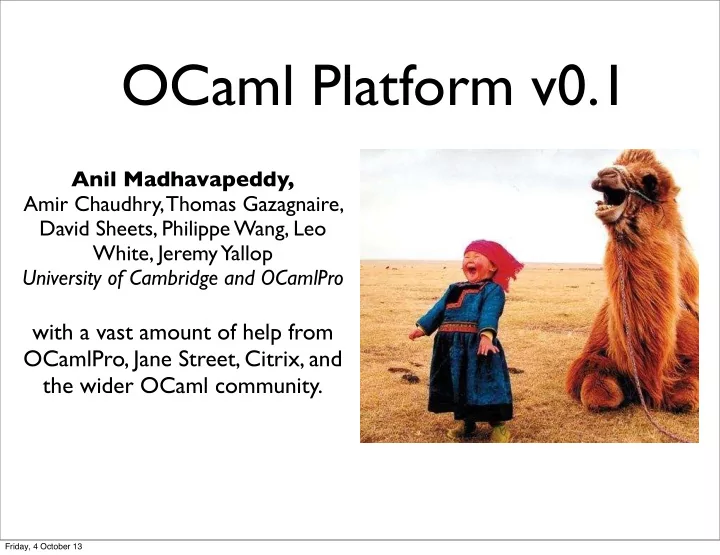
OCaml Platform v0.1 Anil Madhavapeddy, Amir Chaudhry, Thomas Gazagnaire, David Sheets, Philippe Wang, Leo White, Jeremy Yallop University of Cambridge and OCamlPro with a vast amount of help from OCamlPro, Jane Street, Citrix, and the wider


slide-1
SLIDE 1

OCaml Platform v0.1

Anil Madhavapeddy, Amir Chaudhry, Thomas Gazagnaire, David Sheets, Philippe Wang, Leo White, Jeremy Yallop University of Cambridge and OCamlPro

with a vast amount of help from OCamlPro, Jane Street, Citrix, and the wider OCaml community.

Friday, 4 October 13

slide-2
SLIDE 2

OCaml Platform v0.1

Alain Frisch Alessandro Strada Amir Chaudhry Andre Nathan Anil Madhavapeddy Anton Lavrik Arjun Guha Armael Gueneau Ashish Agarwal Aziem Chawdhary Benedikt Becker Benoit Montagu Benoit Vaugon Cagdas Bozman Cedric Cellier Christophe Troestler Claude Marche Dominik LoBraico Damien Doligez Daniel C. Bünzli, Dario Teixeira Dave Parfitt David Scott David Sheets Dmitry Grebeniuk Drup Eric Norige Fabrice Le Fessant Felix Ruess Florent Monnier Florian Pichlmeier Francisco Ferreira Francois Berenger Francois Bobot Frederic Bour Frederic Tuong Gabor Pali Gabriel Kerneis Garth Williams Guillem Rieu Hugo Heuzard iksnalybok Jacques-Pascal Deplaix Jean-Christophe Filliatre Jeremie Dimino Jeremy Yallop Jerome Vouillon John Else Jonathan Protzenko Jun Furuse Kaspar M. Rohrer Kaustuv Chaudhuri Kenji Maillard Leo White libkenta Louis Gesbert Louis Mandel Marc Simpson Markus Mottl Max Mouratov Maxence Guesdon Michal Kurcewicz Mike Lin Mike McClurg MIZUNO Hiroki Nicolas Braud-Santoni Oliver Gu orbitz Owen Gunden Paolo Donadeo Paul Pelzl Paul Snively Phil Scott Philippe Veber Philippe Wang Pierre Chambart Prashanth Mundkur Quentin Stievenart Radek Micek Richard Mortier Roberto Di Cosmo Roma Sokolov Romain Slootmaekers Rudi Grinberg Samuel Mimram Sean Mclaughlin Sebastien Fricker Sebastien Mondet Sergei Lebedev Seung Cheol Jung Simon Castellan Simon Cruanes Stephane Legrand Thomas Gazagnaire Thomas Refis Tom Ridge Vincent Bernardoff Vincent Hugot Vincent Monfort Virgile Prevosto william3 Wojciech Meyer Xavier Allamigeon ygrek Yury Sulsky

Friday, 4 October 13

slide-3
SLIDE 3

What a Platform isn’t

A group of motivated hackers sprint to build a replacement standard library.

Friday, 4 October 13

slide-4
SLIDE 4

What a Platform isn’t

A group of motivated hackers sprint to build a replacement standard library.

  • Hard to get adoption without a

domain-specific purpose.

  • Tends to be opinion based, and

fodder for infinite discussion.

  • Sustaining maintenance is tough.

Friday, 4 October 13

slide-5
SLIDE 5

What a Platform is!

  • Tooling that works together beyond just a

language, into the full dev lifecycle.

  • Quantitative metrics to judge if we are

succeeding or not.

  • Agility to judge the impact of changes

quickly to keep moving. Together, these let users judge if the Platform is suitable for their needs.

Friday, 4 October 13

slide-6
SLIDE 6

Design Space

Libraries Ctypes COW Omd

Friday, 4 October 13

slide-7
SLIDE 7

Design Space

Tools Libraries OPAM Ctypes COW OPAMdoc IDE tools Omd

Friday, 4 October 13

slide-8
SLIDE 8

Design Space

Tools Libraries Resources OPAM Ctypes COW OPAMdoc IDE tools OCaml.org Books OCamlot Omd

Friday, 4 October 13

slide-9
SLIDE 9

OPAM Progress in 2013

  • OPAM 1.0 released in March 2013
  • OPAM 1.1 beta released Sept 2013
  • Solid bug fixing and improvement

released based on lots of feedback.

  • Over 100 contributers, 500+ packages,

1500+ unique versions.

  • Migrating to opam.ocaml.org (CC0) as

a community-maintained effort.

Friday, 4 October 13

slide-10
SLIDE 10

OPAM contributors growth

Friday, 4 October 13

slide-11
SLIDE 11

OPAM package growth

http://opam.ocamlpro.com

Friday, 4 October 13

slide-12
SLIDE 12

OPAM 1.2 and onwards

  • Windows support for the tool.
  • Fast compiler switching (needs

relocatable compiler).

  • Binary packages to share OPAM

installations for teaching.

  • More expressive constraint

language for optional dependencies.

  • https://github.com/OCamlPro/opam/issues

Friday, 4 October 13

slide-13
SLIDE 13

OPAM Documentation

Goal: single source of cross-referenced documentation for all packages.

  • Why it’s hard:
  • not all packages can be installed

simultaneously (solved via OPAM)

  • resolving module inclusion statically leads

to huge output sizes.

  • touches almost all parts of the toolstack

(compiler, OPAM, build systems)

Friday, 4 October 13

slide-14
SLIDE 14

OPAM Documentation

Codesign: the Platform and compiler are evolving together, not developed in isolation

  • Examples:
  • Compiler exports itself as a library, which is

enough to build custom frontends.

  • cmt files expose typed AST (internals)

which is enough for IDEs and search tools.

  • -short-paths in 4.1 makes long module paths

much more usable.

Friday, 4 October 13

slide-15
SLIDE 15

OPAM Doc

  • Typed AST now written as cmt file

from 4.00.1 onwards.

  • New bindoc tool generates cmd files

which parse ocamldoc comments.

  • cmd files are separate for multiple

translations, tutorials, etc.

  • New opamdoc tools combines a cmt

database into a single website with a subset of packages.

Friday, 4 October 13

slide-16
SLIDE 16

Tooling: ocaml.org

  • http://ocaml-redesign.github.io/
  • http://ocaml-redesign.github.io/pkg/ (both WIP)

Friday, 4 October 13

slide-17
SLIDE 17

Quantitative: Packages

  • What are useful metrics for OCaml?
  • Portability: OS, CPU arch, compiler

version, C bindings, native/bytecode

  • Maintainer: responsiveness,

documentation coverage, issue URL

  • Tests: code coverage, benchmarks
  • Stability: interfaces changing a lot?

Friday, 4 October 13

slide-18
SLIDE 18

Quantitative: Packages

  • All of these are being built up in the

OPAM repository:

  • The opam file tracks compiler

constraints across 1500 packages.

  • Can statically analyze the archive

contents to determine build system.

  • Transitive cones of library coverage

(“when Core breaks, does anyone care?”)

Friday, 4 October 13

slide-19
SLIDE 19

Distributed workflow

Friday, 4 October 13

slide-20
SLIDE 20

Let’s evolve together

  • We’re building the framework for a

standard library tussle that will let us evaluate the fitness of libraries.

  • Plan to benchmark and test Core,

Batteries, Extlib, Lwt on a variety of platforms and circumstances.

  • We make these available on ocaml.org to

understand how to achieve consensus. “Why are there so many separate stdlibs?”

Friday, 4 October 13

slide-21
SLIDE 21

The current state

No one candidate is quite supreme yet.

  • Lwt: very portable, small, quite C heavy, separate

module namespace.

  • Batteries: comprehensive, no syntax

extensions, separate namespace, community developed.

  • Core: hugely comprehensive, weekly releases,

poor portability, single namespace, architected at Jane Street.

Friday, 4 October 13

slide-22
SLIDE 22

Open Problem: Build

  • None are quite satisfactory yet, and “almost

working” ones proliferate.

  • Tension between speed of compilation and

features and portability.

  • Library-based systems sorely needed.
  • The goal should be to statically analyze all

1,500 OPAM packages to test hypotheses.

Friday, 4 October 13

slide-23
SLIDE 23

Questions?

platform@lists.ocaml.org

  • Get involved with OPAM! Particularly

documentation + blogs.

  • Feedback on redesign to infrastructure:

http://amirchaudhry.com/ocamlorg-request-for- feedback/

Friday, 4 October 13