Observation and between 18 interest to disclose. organizations - - PDF document

observation and
SMART_READER_LITE
LIVE PREVIEW

Observation and between 18 interest to disclose. organizations - - PDF document

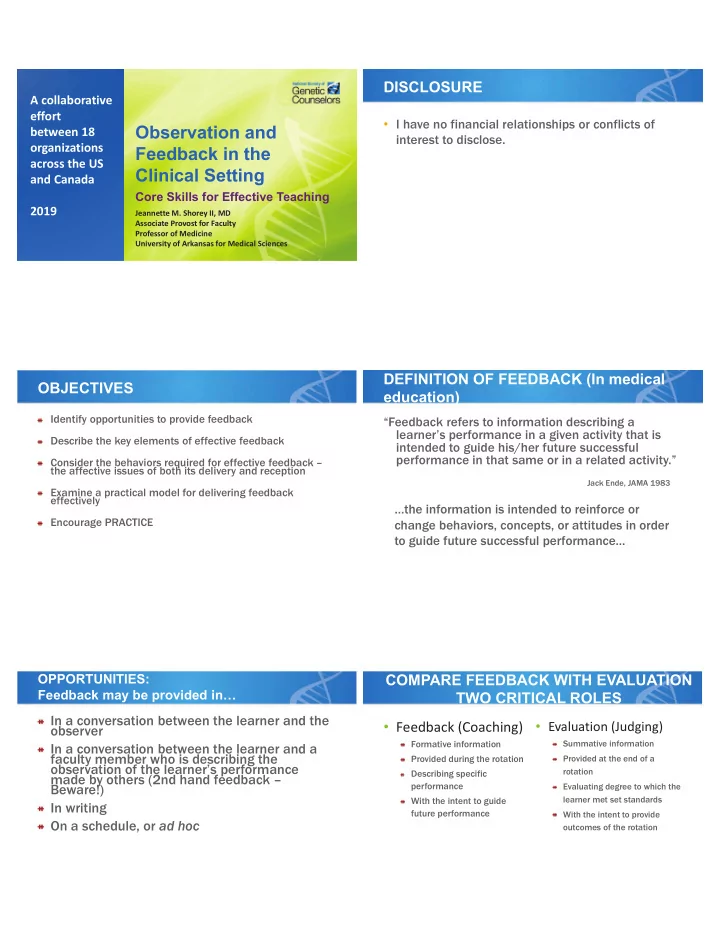
DISCLOSURE A collaborative effort I have no financial relationships or conflicts of Observation and between 18 interest to disclose. organizations Feedback in the across the US Clinical Setting and Canada Core Skills for Effective


slide-1
SLIDE 1

Observation and Feedback in the Clinical Setting

Core Skills for Effective Teaching

Jeannette M. Shorey II, MD Associate Provost for Faculty Professor of Medicine University of Arkansas for Medical Sciences

A collaborative effort between 18

  • rganizations

across the US and Canada 2019

  • I have no financial relationships or conflicts of

interest to disclose.

DISCLOSURE OBJECTIVES

Identify opportunities to provide feedback Describe the key elements of effective feedback Consider the behaviors required for effective feedback – the affective issues of both its delivery and reception Examine a practical model for delivering feedback effectively Encourage PRACTICE

DEFINITION OF FEEDBACK (In medical education)

“Feedback refers to information describing a learner’s performance in a given activity that is intended to guide his/her future successful performance in that same or in a related activity.”

Jack Ende, JAMA 1983

…the information is intended to reinforce or change behaviors, concepts, or attitudes in order to guide future successful performance… OPPORTUNITIES: Feedback may be provided in…

In a conversation between the learner and the

  • bserver

In a conversation between the learner and a faculty member who is describing the

  • bservation of the learner’s performance

made by others (2nd hand feedback – Beware!) In writing On a schedule, or ad hoc

COMPARE FEEDBACK WITH EVALUATION TWO CRITICAL ROLES

  • Feedback (Coaching)

Formative information Provided during the rotation Describing specific performance With the intent to guide future performance

  • Evaluation (Judging)

Summative information Provided at the end of a rotation Evaluating degree to which the learner met set standards With the intent to provide

  • utcomes of the rotation
slide-2
SLIDE 2

HAVE YOU HAD ENOUGH FEEDBACK? What are the potential barriers to providing “enough” effective feedback? POTENTIAL BARRIERS TO FEEDBACK

  • 1. Time
  • 2. Collusion of teachers and learners:

Learners fear negative comments Teachers fear hurting learners’ feelings Learners want praise Teachers want to be popular Both want to be treated fairly – is this a safe, trustworthy relationship?

  • 3. Absent or insufficient primary data
  • 4. Teacher’s lack of confidence in his/her skills

IMPORTANCE OF FEEDBACK

VITAL & TRANSFORMATIVE (if effective) Influences a professional’s outcomes in terms of acquired knowledge, skills, performance and attitudes Failure to provide feedback is not neutral (think “vitamin deficiency”) Enhances relationships Increases teacher and learner satisfaction

“In clinical medicine, the importance of feedback extends beyond pedagogy. The goal of clinical training is expertise in the care of patients. Without feedback, mistakes go uncorrected, good performance is not reinforced, and clinical competence is achieved empirically or not at all.” Jack Ende, JAMA 1983

CULTURAL BIAS

Culture of Medicine doesn’t support us – and needs to change Normative to hear about mistakes Normative to hear global praise: “good job” We need to create a climate of trust and safety Learners need to hear the “specifics” about their actions/decisions that yielded praise- worthy work and about their actions/decisions that produced “sub-par” work

REFLECTION

Encourage Learner self-reflection Encourage you to provide ad hoc feedback, and Encourage your learners to ask for feedback

slide-3
SLIDE 3

GOOD FEEDBACK REQUIRES

Good Observations

  • f our learners in action

GOOD OBSERVATIONS REQUIRE CONTENT OF FEEDBACK

Important Timely Specific – based on observations Pertaining to decisions & actions – not personality Best if based on stated objectives Digestible amount of information (3 items – max) Nonjudgmental & descriptive language Remember the “system”

  • LANGUAGE. . . MATTERS

Language can create reality Calibrate language accurately “More effective/Less effective” rather than “good/bad” Connector words – “but” has no place in a sentence of positive feedback FEEDBACK: A PRACTICAL MODEL

1) Prepare

  • Observe; Reflect; Identify the Important Content
  • Arrange timely meeting, in appropriate setting
  • Is rapport established?
  • Is feedback expected?

2) Provide non-evaluative information

  • Ask for recipient’s self-assessment
  • Reinforce desirable behaviors
  • Focus on specific observed behaviors
  • Be aware of own subjective feelings
  • Limit to 3 observations, or fewer

3) Respond to feelings 4) Plan adjustments and performance goals

  • Problem Solve
  • Tutor or self-study needed?

5) Closure

  • Ensure comprehension/agreement
  • Summarize
  • Plan follow-up

AACH – D. Duffy, R. Frankel, P. Williamson

VIDEO CLIP

slide-4
SLIDE 4

FEEDBACK: A PRACTICAL MODEL

1) Prepare are

  • Observe; Reflect; Identify the Important Content
  • Arrange timely meeting, in appropriate setting
  • Is rapport established?
  • Is feedback expected?

2) Provide non-evalu aluat ative in informa mation

  • n
  • Ask for recipient’s self-assessment
  • Reinforce desirable behaviors
  • Focus on specific observed behaviors
  • Be aware of own subjective feelings
  • Limit to 3 observations, or fewer

3) Respond nd to feeling ngs 4) Pla lan n adju justme stments nts and performa mance nce goals

  • Problem Solve
  • Tutor or self-study needed?

5) Clo losure

  • Ensure comprehension/agreement
  • Summarize
  • Plan follow-up

AACH – D. Duffy, R. Frankel, P. Williamson

REQUIREMENTS

Core Values Time Skill as an observer and communicator Confidence in your skills Practice – from which the confidence grows Appreciation helps – from your students, your department, your teaching institution

THANK YOU

REFERENCES

  • Duffy, D., Frankel, R. M., & Williamson, P. (1995). Academy of Communication in

Healthcare: Feedback Model “card”. (Note: The Feedback Model “card” was published within an American Academy of Communication in Healthcare curriculum. The AACH now goes by the Academy of Communication in Healthcare https://www.achonline.org/.)

  • Ende, J. (1983). Feedback in clinical medical education. Journal of the American

Medical Association, 250(6), 777 – 781. doi:10.1001/jama.1983.03340060055026

  • van der Vleuten, C. P. M. & Driessen, E. W. (2014). What would happen to education

if we take education evidence seriously? Perspective on Medical Education, 3(3), 222 – 232. doi:10.1007/s40037-014-0129-9

THANK YOU TO ALL THOSE THAT CONTRIBUTED

Indiana State University Bay Path University Columbia University Icahn School of Medicine at Mount Sinai Invitae Long Island University Post Sarah Lawrence Stanford Health Care University of Alabama at Birmingham University of Arkansas Medical Sciences University of British Columbia University of Colorado Anschutz Medical Campus University of Manitoba University of Nebraska medical Center University of Utah Vanderbilt University Virginia Commonwealth University Wayne State University Education SIG

THANK YOU!!!

https://indstate.qualtrics.com/jfe/form/SV_89cHJJ0n8YcyaRD Click link below to complete evaluation and submit CEU request