Objectives You should be able to ... Continuations It is possible - - PowerPoint PPT Presentation

objectives
SMART_READER_LITE
LIVE PREVIEW

Objectives You should be able to ... Continuations It is possible - - PowerPoint PPT Presentation

Introduction Defjning Continuations A Motivating Example Further Reading Introduction Defjning Continuations A Motivating Example Further Reading Objectives You should be able to ... Continuations It is possible to use functions to


slide-1
SLIDE 1

Introduction Defjning Continuations A Motivating Example Further Reading

Continuations

  • Dr. Mattox Beckman

University of Illinois at Urbana-Champaign Department of Computer Science

Introduction Defjning Continuations A Motivating Example Further Reading

Objectives

You should be able to ...

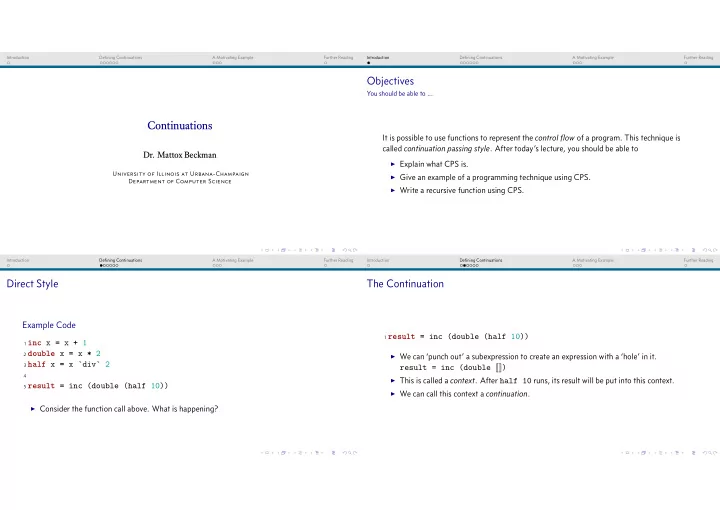
It is possible to use functions to represent the control fmow of a program. This technique is called continuation passing style. After today’s lecture, you should be able to

◮ Explain what CPS is. ◮ Give an example of a programming technique using CPS. ◮ Write a recursive function using CPS.

Introduction Defjning Continuations A Motivating Example Further Reading

Direct Style

Example Code

1 inc x = x + 1 2 double x = x * 2 3 half x = x `div` 2 4 5 result = inc (double (half 10))

◮ Consider the function call above. What is happening?

Introduction Defjning Continuations A Motivating Example Further Reading

The Continuation

1 result = inc (double (half 10))

◮ We can ‘punch out’ a subexpression to create an expression with a ‘hole’ in it.

result = inc (double [ [] ])

◮ This is called a context. After half 10 runs, its result will be put into this context. ◮ We can call this context a continuation.

slide-2
SLIDE 2

Introduction Defjning Continuations A Motivating Example Further Reading

Making Continuations Explicit

◮ We can make continuations explicit in our code.

1 cont = \ v -> inc (double v)

◮ Instead of returning, a function can take a continuation argument.

Using a Continuation

1 half x k = k (x `div` 2) 2 result = half 10 cont

◮ Convince yourself that this does the same thing as the original code.

Introduction Defjning Continuations A Motivating Example Further Reading

Properties of CPS

◮ A function is in Direct Style when it returns its result back to the caller. ◮ A Tail Call occurs when a function returns the result of another function call without

processing it fjrst.

◮ This is what is used in accumulator recursion.

◮ A function is in Continuation Passing Style when it passes its result to another function.

◮ Instead of returning the result to the caller, we pass it forward to another function. ◮ Functions in CPS “never return.”

◮ Let’s see some more examples.

Introduction Defjning Continuations A Motivating Example Further Reading

Comparisons

Direct Style

1 inc x = x + 1 2 double x = x * 2 3 half x = x `div` 2 4 5 result = inc (double (half 10))

CPS

1 inc x k = k (x + 1) 2 double x k = k (x * 2) 3 half x k = k (x `div` 2) 4 id x = x 5 result = half 10 (\v1 -> 6

double v1 (\v2 ->

7

inc v2 id))

Introduction Defjning Continuations A Motivating Example Further Reading

CPS and Imperative Style

◮ CPS look like imperative style if you do it right.

CPS

1 result = half 10 (\v1 -> 2

double v1 (\v2 ->

3

inc v2 id))

Imperative Style

1

v1 := half 10

2

v2 := double v1

3 result := inc v2

slide-3
SLIDE 3

Introduction Defjning Continuations A Motivating Example Further Reading

The GCD Program

1 gcd a b | b == 0 = a 2

| a < b = gcd b a

3

| otherwise = gcd b (a `mod` b) gcd 44 12 ⇒ gcd 12 8 ⇒ gcd 8 4 ⇒ gcd 4 0 ⇒ 4

◮ The running time of this function is roughly O(lg a).

Introduction Defjning Continuations A Motivating Example Further Reading

GCD of a List

1 gcdstar [] = 0 2 gcdstar (x:xs) = gcd x (gcdstar xx) 3 4 > gcdstar [44, 12, 80, 6] 5 2 6 > gcdstar [44, 12] 7 4

◮ Question: What will happen if there is a 1 near the beginning of the sequence? ◮ We can use a continuation to handle this case.

Introduction Defjning Continuations A Motivating Example Further Reading

Continuation Solution

1 gcdstar xx k = aux xx k 2

where aux [] newk = newk 0

3

aux (1:xs) newk = k 1

4

aux (x:xs) newk = aux xs (\res -> newk (gcd x res))

5 6 > gcdstar [44, 12, 80, 6] report 7 2 8 > gcdstar [44, 12, 1, 80, 6] report 9 1 Introduction Defjning Continuations A Motivating Example Further Reading

Other Topics

◮ Continuations can simulate exceptions. ◮ They can also simulate cooperative multitasking.

◮ These are called co-routintes.

◮ Some advanced routines are also available: call/cc, shift, reset.