Objectives You should be able to ... Right-Linear Grammars Dr. - - PowerPoint PPT Presentation

objectives
SMART_READER_LITE
LIVE PREVIEW

Objectives You should be able to ... Right-Linear Grammars Dr. - - PowerPoint PPT Presentation

a f s d Objectives Conversion to Right-Linear Grammar Objectives Conversion to Right-Linear Grammar Objectives You should be able to ... Right-Linear Grammars Dr. Mattox Beckman Convert between a regular expression and a right-linear


slide-1
SLIDE 1

Objectives Conversion to Right-Linear Grammar

Right-Linear Grammars

  • Dr. Mattox Beckman

University of Illinois at Urbana-Champaign Department of Computer Science

Objectives Conversion to Right-Linear Grammar

Objectives

You should be able to ...

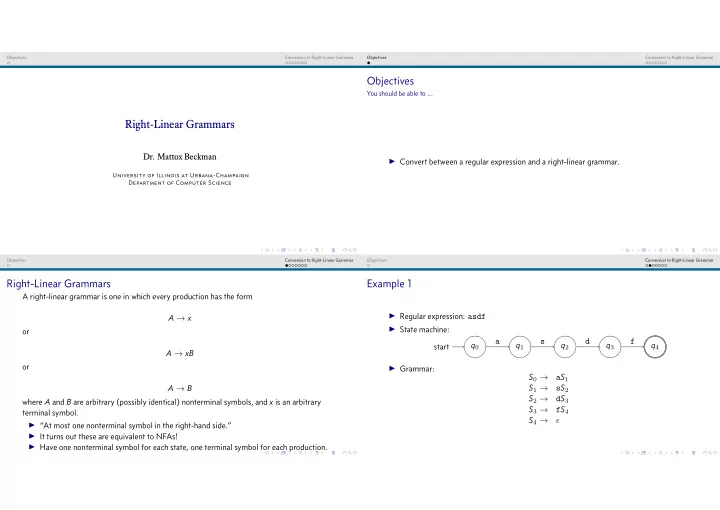
◮ Convert between a regular expression and a right-linear grammar.

Objectives Conversion to Right-Linear Grammar

Right-Linear Grammars

A right-linear grammar is one in which every production has the form A → x

  • r

A → xB

  • r

A → B where A and B are arbitrary (possibly identical) nonterminal symbols, and x is an arbitrary terminal symbol. ◮ “At most one nonterminal symbol in the right-hand side.” ◮ It turns out these are equivalent to NFAs! ◮ Have one nonterminal symbol for each state, one terminal symbol for each production.

Objectives Conversion to Right-Linear Grammar

Example 1

◮ Regular expression: asdf ◮ State machine: q0 start q1 q2 q3 q4 a s d f ◮ Grammar: S0 → aS1 S1 → sS2 S2 → dS3 S3 → fS4 S4 → ǫ

slide-2
SLIDE 2

Objectives Conversion to Right-Linear Grammar

Example 2

◮ Regular expression: a(s|d)+f S0 → aS1 S1 → sS2 | dS3 S2 → sS2 | dS3 | fS4 S3 → sS2 | dS3 | fS4 q0 start q1 q2 q3 q4 a s d d s s d f f

Objectives Conversion to Right-Linear Grammar

Going from Regular Expression to Right-Linear Grammar

◮ One way: regular expression → NFA → DFA → RLG ◮ Aonther way: direct conversion. We’ll use a “bottom up” strategy. Characters To convert a single character a, we make a simple production. S → a where S is the start symbol. Concatenation To concatenate two regular expressions, add the second start symbol to the end of any “accepting” states from the fjrst grammar. Regexp: a S1 → a Regexp: b S2 → b Regexp: ab S1 → aS2 S2 → b

Objectives Conversion to Right-Linear Grammar

Choice and Repetition

Choice To choose between two regular expressions, add a new start symbol that “picks”

  • ne of the choices.

Regexp: a S1 → a Regexp: b S2 → b Regexp: a|b S → S1|S2 S1 → a S2 → b Kleene Plus If S is the start symbol, then for every rule of the form A → x (“accepting states”) add another rule of the form A → xS. You may have to remove ǫ productions fjrst. Regexp: a|b S → S1|S2 S1 → a S2 → b Regexp: (a|b)+ S → S1|S2 S1 → a|aS S2 → b|bS

Objectives Conversion to Right-Linear Grammar

Choice and Repetition

Kleene Star If S is the start symbol, then for every rule of the form A → x (“accepting states”) add another rule of the form A → xS. Also add an ǫ rule. Regexp: a|b S → S1|S2 S1 → a S2 → b Regexp: (a|b)* S → S1|S2|ǫ S1 → a|aS S2 → b|bS

slide-3
SLIDE 3

Objectives Conversion to Right-Linear Grammar

Credits

The algorithm for converting a regular expression to a right-linear grammar is based partly on the discussion here: http://vasy.inria.fr/people/Gordon.Pace/Research/Software/Relic/Transforma- tions/RE/toRG.html