Objectives Screen cases for merit Identify key areas of OR - - PDF document

objectives
SMART_READER_LITE
LIVE PREVIEW

Objectives Screen cases for merit Identify key areas of OR - - PDF document

11/12/2012 Deciphering Operating Room Nursing Liability Retained Sponges and LNC Case Review 1 1 Objectives Screen cases for merit Identify key areas of OR documentation for timely case review Increase credibility with attorneys


slide-1
SLIDE 1

11/12/2012 1

Deciphering Operating Room Nursing Liability

Retained Sponges and LNC Case Review 1

1

Objectives

  • Screen cases for merit
  • Identify key areas of OR documentation for

timely case review

  • Increase credibility with attorneys
  • Discuss perioperative issues that may result in

allegations against nurses in lawsuits

  • Discuss the risk factors associated with RSI’s

2

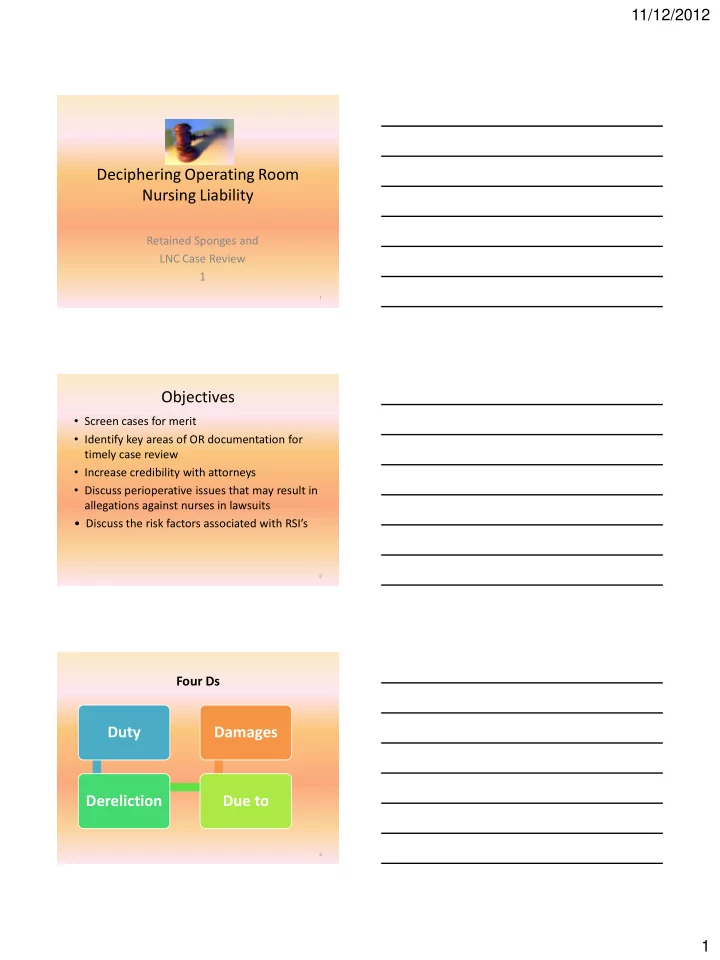
Four Ds

Duty Dereliction Due to Damages

3

slide-2
SLIDE 2

11/12/2012 2

Theories of Liability

Res ipsa loquitur – “the thing speaks for itself”

4

Theories of Liability

Failure to follow standards of care Failure to use equipment in a responsible manner

5

Theories of Liability

Failure to communicate Failure to document

6

slide-3
SLIDE 3

11/12/2012 3

Theories of Liability

  • Failure to assess and

monitor

7

Theories of Liability

Failure to act as a patient advocate

8

Retained Sponges And OR Nursing Malpractice

slide-4
SLIDE 4

11/12/2012 4

Screening Cases for Merit

10

Chart Review

11

Sources of SOC

12

slide-5
SLIDE 5

11/12/2012 5

The Perioperative Patient Experience

13

Preoperative Phase Preoperative Nurse Responsible for: Patient intake, review of medical and past surgical history. Initiating surgical preop checklists as per institution. First meeting with anesthesia provider(s)

Intraoperative Phase

14

First “meet and greet” with OR nurse assigned Review of chart, labs, etc. Hand off report from preop nurse Transfer to OR suite

IntraOperative Role of the RN Circulator

Assists the scrub technician, opening sterile supplies for the assigned surgical procedure. Performs a visual, audible, concurrent count with the scrub technician upon completion of setup, throughout and upon completion and according to OR policy.

15

slide-6
SLIDE 6

11/12/2012 6

Anesthesia Provider M.D. or CRNA

16

PACU Nurse

17

Risk Factors

  • Communication issues
  • Distractions
  • Human error
  • Change up in surgical procedure
  • Obesity
  • Emergency procedures

18

slide-7
SLIDE 7

11/12/2012 7

Retained Surgical Items

Most common: Sponges Can be left in a minor incision or as deep as the retroperitoneal cavity

19

Retained Surgical Items

  • Laparotomy pads
  • 4x8 inch sponges
  • Dissecting sponges
  • Cotton strips, sponges
  • Surgical or “Huck” Towels

20

Kittner/Dissecting sponge or “Peanuts”

21

slide-8
SLIDE 8

11/12/2012 8

Cottonoids or “Strips” and “Patties”

22 23 24

slide-9
SLIDE 9

11/12/2012 9

“Raytex” or 4x4 Sponge

25

Laparotomy Pad or “Lap Pad”/”Lap Sponge”

26 27

Huck Towels

slide-10
SLIDE 10

11/12/2012 10 Role of the Scrub technician

Prepares necessary sterile items for assigned surgeries Upon completion of sterile setup, performs an initial surgical count with the RN circulator of all items to be used in a surgical procedure according to O.R. policy.

28

Role of the Scrub technician

Assists the surgical team as needed throughout the surgical procedure. Maintains a visual awareness of the surgical field and and can account for laparotomy sponges left in the body cavity and relays this count to the circulating nurse. Conducts “closing counts” WITH the RN circulator

29

Role of the RN Circulator

Remains aware of number and types sponges using an Approved counting tool, such as a count sheet, count board, etc. (can be different from OR to OR) Initiates “closing counts” as the surgical team begins closure.

30

slide-11
SLIDE 11

11/12/2012 11

Symptoms of Gossypiboma

Can occur as early as 11 days post

  • surgery. Patient will present with:

 Pain, Fever  Infection OR  Asymptomatic

31

Parties Named in a Lawsuit

  • Hospital/ASC
  • Surgeon(s)/Fellow(s)
  • Residents/Physician Assistants/RNFA’s
  • Anesthesiologists/Nurse Anesthetists
  • Registered Nurses, LP/LV Nurses, Surgical

Technologists

32

LNC Documentation Review

Where to look: Perioperative Record Dictated OR Record. Look for notation of counts Note your team members Were they relieved?- Note the timelines

33

slide-12
SLIDE 12

11/12/2012 12

Best Case Scenario

  • Legible documentation!
  • E-docs are great but not the end all! Still need

to document either by computer or handwritten addendums

  • Good flow of information and timelines
  • Surgical counts performed and reflected in

perioperative record.

34

Worst Case Scenario

  • Illegible document
  • Gaps in documentation
  • Empty spaces –
  • Poor or missing timelines
  • No nursing documentation to reflect an

incident in the room or corrective action taken

35

National Association of Insurance Commissioners’ (NAIC’s) severity of injury scale and type of injuries:

  • Death (09) — resulted in death of

claimant.

  • Permanent injury
  • grave (08) — quadriplegia,

severe brain damage,

  • lifelong care or fatal prognosis.
  • major (07) — paraplegia,

blindness, loss of two

  • limbs, brain damage.
  • significant (06) — deafness, loss
  • f limb, loss of eye, loss of one

kidney or lung.

  • minor (05) — loss of fingers,

loss or damage to organs. Includes non-disabling injuries.

36

slide-13
SLIDE 13

11/12/2012 13

National Association of Insurance Commissioners’ (NAIC’s) severity of injury scale and type of injuries:

  • Temporary injury
  • Major (04) — burns, surgical

material left, drug side effects, brain damage. Recovery delayed.

  • Minor (03) — infections, mis-set

fractures, fall in hospital. Recovery delayed.

  • Insignificant/slight (02) —

lacerations, contusions, minor scars, and rash. No delay in recovery.

  • Emotional injury only (01) — fright,

no physical damage.

37

NAIC’s Statistics

  • Major and Grave Injuries are the serious

injuries that result in med mal claims

  • Median Payout for those injuries: is $278,000

to $350,000 ( Fl and Mo ) and almost $1,000,000 in Illinois.

  • Wrongful death claims do not result in huge

compensations as there is no long term medical care involved in these claims

38

Surgical Claims Data –

  • Retained Objects • Average award is$125,000.
  • Million dollar verdicts are rendered in

approximately 10% of plaintiff verdict.

  • NEJM reports that there are approximately 1,500

cases of retained objects per year.

  • NEJM study revealed 88% of surgical cases

involving incorrect counts were documented as correct.

39

slide-14
SLIDE 14

11/12/2012 14

Case Study

  • Mrs. G, 45 year-old female, was brought to the

OR for an elective open cholecystectomy.

40

Risk Factors

41

Hurried Schedule Loud Music Scrub is in training with a preceptor Inattentive to surgical field

Other Risk Factors

42

Lunch Relief

slide-15
SLIDE 15

11/12/2012 15

43

Minimal or No Hand off report during relief

Incorrect Closing Counts

44

Xray in the OR

45

slide-16
SLIDE 16

11/12/2012 16

Retained Sponge and Return to Surgery

46

  • Points to Consider on Malpractice Review:
  • How was the baseline count performed and

recorded?

  • What factors were involved that could have

affected the counting process?

  • What processes were missed or neglected

regarding placing a sponge in the surgical wound?

  • What part did the surgeon play in the closing

count process?

  • 47

48

slide-17
SLIDE 17

11/12/2012 17

Association of periOperative Registered Nurses (AORN)

The Recommended Practices for Sponge, Sharp, and Instrument Counts provide clear direction in the system for performing counts to decrease the risk of a retained foreign body. Recommendations are reviewed and updated annually Recommendations serve as guide for individual operating rooms to formulate policy and procedure.

49

Have an OR Case?

Avoid a Bad Hair Day

Call Med League

50