Obesity Management: Effective Clinical Strategies I have nothing - - PowerPoint PPT Presentation

obesity management effective clinical strategies
SMART_READER_LITE
LIVE PREVIEW

Obesity Management: Effective Clinical Strategies I have nothing - - PowerPoint PPT Presentation

Obesity Management: Effective Clinical Strategies I have nothing to disclose Alka M. Kanaya, MD Professor of Medicine, Epidemiology & Biostatistics UCSF, Advances in Internal Medicine May/June 2016 Prevalence of Obesity (BMI 30 kg/m 2


slide-1
SLIDE 1

1

Obesity Management: Effective Clinical Strategies

Alka M. Kanaya, MD

Professor of Medicine, Epidemiology & Biostatistics UCSF, Advances in Internal Medicine May/June 2016

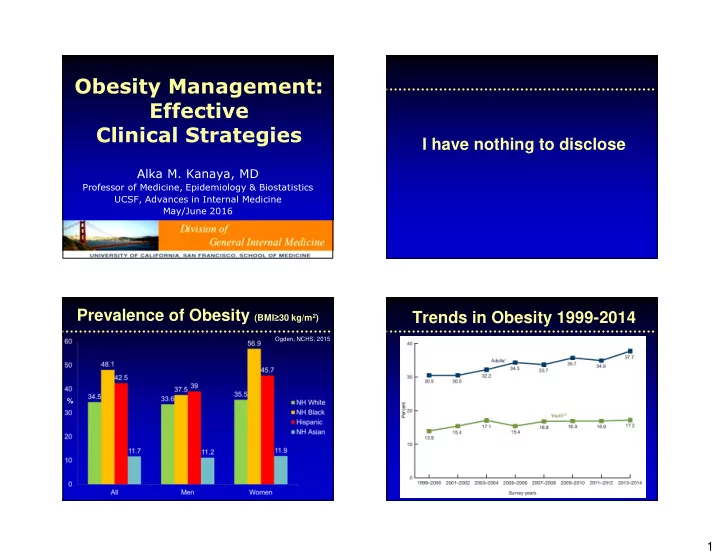
I have nothing to disclose Prevalence of Obesity (BMI≥30 kg/m2)

Ogden, NCHS, 2015

%

Trends in Obesity 1999-2014

slide-2
SLIDE 2

2

Overweight Trajectories

Communities Worksites Health Care Schools and Child Care Home Demographic Factors Psychosocial Factors Gene- Environment Interactions Other Government Public Health Health Care Agriculture Education Media Land Use and Transportation Communities Foundations Industry Food Beverage Retail Leisure and Recreation Entertainment Individual Factors Behavioral Settings Social Norms and Values Sectors of Influence Energy Intake Energy Expenditure

Energy Balance

Physical Activity Food & Beverage Intake

Roadmap

  • 1. Definitions and Outcomes
  • 2. Clinical management

a. The Clinic Visit b. Diet c. Exercise d. Mobile technology, Apps, wearables e. Medications f. Bariatric Surgery

Question #1

The same BMI categories should be used for determining

  • verweight and obesity

in all populations?

  • A. True
  • B. False

72% 28%

slide-3
SLIDE 3

3

Defining Obesity

“An increase in fat accumulation, to the extent that health may be adversely affected”

BMI (kg/m2)

1995: BMI < 18.5

Underweight 18.5 – 24.9 Healthy Weight 25 - 29.9 Overweight ≥ 30 Obese

WHO, 1995 Intl Obesity Task Force, 1997

Body Shape and Size

Body Labs, NY Times, 9/3/2015

All 6 people Are 5’9” 172 lbs BMI 25.4 kg/m2

Ectopic Fat Depots

Overweight & Obesity Definitions

WHO-general WHO-Asian Underweight <18.5 <18.5 Normal weight 18.5 – 24.9 18.5 – 22.9 Overweight 25.0 – 29.9 23.0 – 27.5 Obese ≥30.0 ≥27.5

Lancet, WHO expert panel, 2004

slide-4
SLIDE 4

4

CHD and Stroke Outcomes

ERFC, Lancet, 2011

BMI Waist BMI Waist

Metabolically Healthy Obesity?

CVD Mortality 14 studies; 299,000 participants

Fan, Intl J Cardiology, 2013

RR 1.47 > 15 years f/u

Policies and Recommendations

HEDIS: adults 18-74 years, receive BMI assessment annually at PCP visits USPSTF: screen all adults for obesity

– If BMI ≥ 30 kg/m2, offer or refer for counseling and behavioral interventions to promote weight loss

ACA: provides coverage, without cost sharing, for obesity screening and counseling on healthy eating and weight loss

Guidelines

AACE, ACC/AHA/TOS, Endocrine Society:

  • 1. Obesity is a chronic disease and needs long-term

management.

  • 2. Goal is to improve health.
  • 3. Cornerstone is comprehensive lifestyle change.
  • 4. Initial goal is weight loss of 5-10%
  • 5. Consider use of weight loss medication or possible

bariatric surgery as addition to lifestyle therapy to promote greater weight loss and maintain weight loss.

slide-5
SLIDE 5

5

The Clinic Visit

Measure BMI: the fifth vital sign. Document obesity as a problem. Talk to patient about their weight, “your BMI is above a healthy range”. Ask about eating habits, physical activity. What are their goals regarding weight? What changes are they willing to start making? Willing to work with a team including the PCP?

Question #2

45 y.o. African American woman, no other comorbidities, BMI = 33 kg/m2 She wants to start making dietary changes to lose weight. What type of diet would you recommend?

  • A. Low-fat diet
  • B. Low-carbohydrate diet
  • C. Weight Watcher’s diet
  • D. Any diet that she wants to try

12% 40% 14% 33%

Low Fat vs. Other Diets in weight loss trials

Tobias, Lancet Diab & Endo, 2015

Low-fat Vs. Low carb Low-fat Vs. Higher fat Low-fat Vs. Usual diets Favors low carb

  • 1.2 kg mean difference

No difference Favors low fat

  • 5.4 kg mean difference

Favors Low-fat Favors Low Carb

slide-6
SLIDE 6

6

Low Fat vs. Other Diets in weight loss trials

Tobias, Lancet Diab & Endo, 2015

Low-fat Vs. Low carb Low-fat Vs. Higher fat Low-fat Vs. Usual diets Favors low carb

  • 1.2 kg mean difference

No difference Favors low fat

  • 5.4 kg mean difference

Favors Low-fat Favors Low Carb

Low Fat vs. Other Diets in weight loss trials

Tobias, Lancet Diab & Endo, 2015

Low-fat Vs. Low carb Low-fat Vs. Higher fat Low-fat Vs. Usual diets Favors low carb

  • 1.2 kg mean difference

No difference Favors low fat

  • 5.4 kg mean difference

Favors Low-fat Favors Low Carb

Which Named Diet is Better?

48 RCTs of named diets evaluated Low carb: -7.3 kg at 12 mo vs. no diet Low-fat: -7.3 kg at 12 mo vs. no diet Weight loss differences between individual diets were minimal Supports recommending any diet that a patient can adhere to for weight loss.

Johnston, Jama, 2014

My Dietary Tips

Track what you eat (self-monitor) Be conscious of portion sizes (plate method) Beware of liquid calories (choose water) More fiber (whole grains, fresh fruit/veggies) Eat protein at each meal (legume, beans, nuts, fish, poultry…) Small snacks between meals (nuts, fruit) Take time to eat your meals (mindfulness)

slide-7
SLIDE 7

7

Question #3

45 y.o. African American woman, no other comorbidities, BMI = 33 kg/m2 She doesn’t have time to add exercise to her

  • day. She asks whether diet or exercise is more

effective for weight loss?

  • A. Diet is more effective
  • B. Exercise is more effective
  • C. Both diet + exercise are

most effective

18% 78% 4%

Diet vs. Exercise for Weight Loss

Meta-analysis of 21 trials

Schwingshackl, Sys Rev, 2014

Comparison Weight loss, kg Fat Mass, kg Diet vs. Exercise

  • 2.9 (-4.2 to -1.7)
  • 2.2 (-3.7 to -0.7)

D+E vs. Diet alone

  • 1.4 (-2.0 to -0.8)
  • 1.6 (-2.8 to -0.5)

D+E vs. Exercise

  • 4.1 (-5.6 to -2.6)
  • 3.6 (-6.1 to -1.0)

Diet vs. Exercise for Weight Loss

Meta-analysis of 21 trials

Moderate quality evidence that D+E is effective for long-term obesity management Moderate superiority of Diet over Exercise for weight loss outcomes

Schwingshackl, Sys Rev, 2014

Comparison Weight loss, kg Fat Mass, kg Diet vs. Exercise

  • 2.9 (-4.2 to -1.7)
  • 2.2 (-3.7 to -0.7)

D+E vs. Diet alone

  • 1.4 (-2.0 to -0.8)
  • 1.6 (-2.8 to -0.5)

D+E vs. Exercise

  • 4.1 (-5.6 to -2.6)
  • 3.6 (-6.1 to -1.0)
slide-8
SLIDE 8

8

Exercise is Key after Weight Loss

Weight loss leads to decreases in EE (activity-

related, nonexercise activity thermogenesis, and PA index)

RCT of 140 post-menopausal women who had lost 25 lbs with diet (800 kcal/day) Group 1: aerobic trained 3/week, 40 min/day Group 2: resistance trained 3/week Group 3: no exercise

Hunter, Med Sci Sports Exerc, 2015

Exercise is Key after Weight Loss

Weight loss leads to decreases in EE (activity-

related, nonexercise activity thermogenesis, and PA index)

RCT of 140 post-menopausal women who had lost 25 lbs with diet (800 kcal/day) Group 1: aerobic trained 3/week, 40 min/day Group 2: resistance trained 3/week Group 3: no exercise All measures of EE decline after wt loss, but either form of exercise ↑ TEE and NEAT

Hunter, Med Sci Sports Exerc, 2015

My Exercise Tips

Set exercise goals: – Be specific: walk 30 minutes per day – Attainable (doable): start with 3 days/week – Forgiving: Ok if I miss a day Find a fitness buddy Mix up your routine—walk, bike, swim, dance, step Add strength training Monitor your steps Reward yourself (but not with food) Bottom line : “You cannot outrun a bad diet”

slide-9
SLIDE 9

9

Existing (free) Apps

7-minute work-out My Fitness Pal: calorie counter and diet tracker Lose It! Noom Coach Fooducate Amwell Calorie counter PRO MyNetDiary ($ Ip/ free Android) Diet Assistance Endomondo

Physical Activity trackers

Case, Jama, 2015

Mobile Technologies

Mobile health interventions:

– Short message service (SMS) – majority of trials – Multimedia message service (MMS)

Meta-analysis of randomized trials of mobile phone interventions with weight change

  • utcomes

– 14 trials, total of 1,337 participants (trial n=30-250)

Liu, Am J Epidemiology, 2015

Meta-analysis of mHealth

Net Change in Weight:

  • 1.4 kg (-2.1 to -0.8)
slide-10
SLIDE 10

10

Apps + Program

Omada health Prevent: diabetes prevention

– App + health coach + tools – 16 week program ($120/month or $480 total cost) – Single arm longitudinal study (pre- and post-study)

  • 220 people, 187 started and 155 completed

Sepah, J Med Internet Res, 2015

Starters (4+ sessions) Completers (9+ sessions)

Weight loss % P A1c change P Weight loss % P A1c change P 16 week 5.0 <0.001 0.03 0.55 5.2 <0.001 0.03 0.62 1 year 4.7 <0.001

  • 0.38

<0.001 4.9 <0.001

  • 0.40

<0.001 2 years 4.2 <0.001

  • 0.43

<0.001 4.3 <0.001

  • 0.46

<0.001

Currently Available Meds

Drug Mechanism of Action

Phentermine

Noradrenergic sympathomimetic (IV)

Orlistat

Triacylglycerol lipase inhibitor

Lorcaserin

Selective serotonin 2c rec agonist (IV)

Phentermine/ topiramate

NA sympathomimetic/GABA receptor (IV)

Naltrexone/ bupropion SR

NA and dopamine reuptake inhibitor/opioid receptor antagonist

Liraglutide

GLP-1 receptor agonist

Currently Available Meds

Drug Weight loss in trials

Phentermine

No long-term data; 8% short-term efficacy

Orlistat

  • 5.8 kg vs. -3.0 kg Po (4 years);

Lorcaserin

  • 4.5% to -5.8% vs. -1.5% to -2.5% Po (1 yr)

Phentermine/ topiramate

  • 10.9% vs. 1.6% Po (56 wks)

Naltrexone/ bupropion SR

  • 5.0% to -9.3% vs. 1.2% to 5.1% Po (56 wks)

Liraglutide

  • 6.2 to -8.0% vs. -0.2 to -2.6% Po (56 wks)
slide-11
SLIDE 11

11

Currently Available Meds

Drug Side Effects

Phentermine

>10%: Dry mouth, insomnia, stimulant effects CVD risk?

Orlistat

>10%: GI symptoms, fatty stools, urgency <10%: fecal incontinence

Lorcaserin

>10%: headache <10%: Nausea, dizzy, fatigue, dry mouth, hypoglycemia FDA: Carcinogenicity, valvulopathy, CVD risk?

Phentermine/ topiramate

>10%: paresthesias, dry mouth, constipation <10%: dizzy, insomnia, nausea, depression, glaucoma FDA: Neurocognitive, tachycardia, birth defects?

Naltrexone/ bupropion SR

>10%: nausea, headache, constipation <10%: dizzy, insomnia, dry mouth FDA: CVD risk by ↑BP and ↑heart rate

Liraglutide

>10%: N/V/D, constipation, hypoglycemia, URI <10%: GI, infections, site effects, fatigue, cough FDA: CVD risk, medullary thyroid, breast cancer?

Pharmacological Treatments for Obesity : A Systematic Review and Meta-analysis

Khera, JAMA, 2016

Higher the Weight Loss, Higher the Side Effects Emerging Therapies

Pure CB1 receptor antagonists (different from rimonabant) Tesofensine: monoamine reuptake inhibitor Velneperit: Y5 receptor antagonist Beloranib: MetAP2 inhibitor Mirabegron: B3-adrenergic receptor agonist (OAB therapy)

Sweeting, 2015
slide-12
SLIDE 12

12

  • NIH: BMI > 30 kg/m2 or 27 kg/m2 with co-

morbidity (but almost never in practice)

  • Motivated to begin structured exercise and low

calorie diet

  • Begin medications at completion of one month

successful diet and exercise

  • Continue medications only if additional weight

loss achieved in first 3 months with meds

Principles of Drug Therapy Bariatric Surgery

Aron-Wisnewsky, 2012

Laparoscopic Adjustable Sleeve gastrectomy Roux-en-Y gastric band (Lap Band) gastric bypass

Bariatric Surgery

Refer if BMI≥40 or BMI 35-40 with a comorbidity, AND Must have tried and failed other medically managed weight-loss programs

Bariatric Surgery

Refer if BMI≥40 or BMI 35-40 with a comorbidity, AND Must have tried and failed other medically managed weight-loss programs Contraindications to Surgery: High risk surgical pt: severe CHD, coag., anesthesia risk Poor post-op adherence: untreated depression or psychosis; binge-eating, drug/ alcohol abuse, post-op diet compliance

slide-13
SLIDE 13

13

Long-term weight loss results

Sjostrom, Jama, 2012

Other Outcomes from SOS

Sjostrom, NEJM, 2007; Jama 2012; Jama 2004

Quality of Life after Bariatric Surgery

Meta-analysis of 15 controlled trials 7 compared surgery vs. non-surgical interven. 6 compared different types of surgery Bariatric surgery: > QOL improvements than

  • ther obesity treatments

– Few differences between the procedures

QOL improved in first 2 years after surgery, more physical QOL than mental QOL

Hachem, Obes Surg, 2015

The Down-sides to Surgery

Risk of death within 30 days post-op: 0.13%

– PE most common cause (30-50% of deaths)

Hospital readmission: 5.8% RYGB, 1.2% LAGB

– Risk factors: prolonged LOS, open surgery, DVT/PE history, asthma and OSA

Risk Factors for increased complications:

– T2DM, BMI>55, cardiomyopathy

Lifelong supplementation: MVI, Ca, Vit D, iron, B12, and more monitoring

slide-14
SLIDE 14

14

Take-home points

  • 1. Ask about weight, design a plan together, monitor.
  • 2. Monitor your weight, track diet and exercise.
  • 3. Diet + exercise is best lifestyle intervention.
  • 4. Choose a diet that works for the patient.
  • 5. Exercise is important after weight loss too.
  • 6. PA trackers can be helpful. Apps=wearables
  • 7. Medications can be helpful, but each has side effects.
  • 8. Bariatric surgery may have best outcomes, but need a

very motivated patient who will have close monitoring.

@alka_kanaya Alka.kanaya@ucsf.edu