
SLIDE 1
OPERATION ANACONDA OVERVIEW
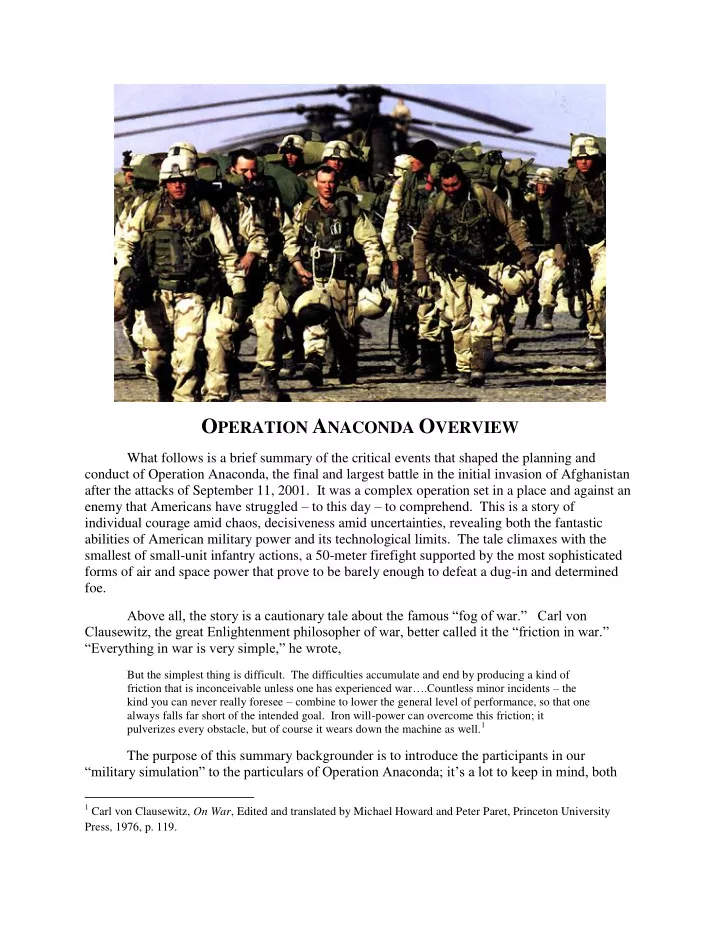
What follows is a brief summary of the critical events that shaped the planning and conduct of Operation Anaconda, the final and largest battle in the initial invasion of Afghanistan after the attacks of September 11, 2001. It was a complex operation set in a place and against an enemy that Americans have struggled – to this day – to comprehend. This is a story of individual courage amid chaos, decisiveness amid uncertainties, revealing both the fantastic abilities of American military power and its technological limits. The tale climaxes with the smallest of small-unit infantry actions, a 50-meter firefight supported by the most sophisticated forms of air and space power that prove to be barely enough to defeat a dug-in and determined foe. Above all, the story is a cautionary tale about the famous “fog of war.” Carl von Clausewitz, the great Enlightenment philosopher of war, better called it the “friction in war.” “Everything in war is very simple,” he wrote,
But the simplest thing is difficult. The difficulties accumulate and end by producing a kind of friction that is inconceivable unless one has experienced war….Countless minor incidents – the kind you can never really foresee – combine to lower the general level of performance, so that one always falls far short of the intended goal. Iron will-power can overcome this friction; it pulverizes every obstacle, but of course it wears down the machine as well.1
The purpose of this summary backgrounder is to introduce the participants in our “military simulation” to the particulars of Operation Anaconda; it’s a lot to keep in mind, both
1 Carl von Clausewitz, On War, Edited and translated by Michael Howard and Peter Paret, Princeton University
Press, 1976, p. 119.