
SLIDE 1
O ne year ago, over Fourth how it happens, how to stop it from - - PDF document
ESD Explained in agonizing pain. Less than a third of the electricity used to light a 40-watt What every boater needs to know about Electric Shock Drowning light bulb 100 ma passing directly through the heart is almost always fatal.
6 Seaworthy | July 2013
www.BoatUS.com/insurance
ne year ago, over Fourth
anderson, 13, and her brother Brayden anderson, 8, were swim- ming near a private dock in the Lake
started to scream. Their parents went to their aid, but by the time the siblings were pulled from the lake, they were
nounced dead after being transported to a nearby hospital. about two hours later, noah Winstead, a 10-year-old boy, died in a similar manner at Cherokee Lake, near Knoxville, Tennessee. ac- cording to local press reports, seven
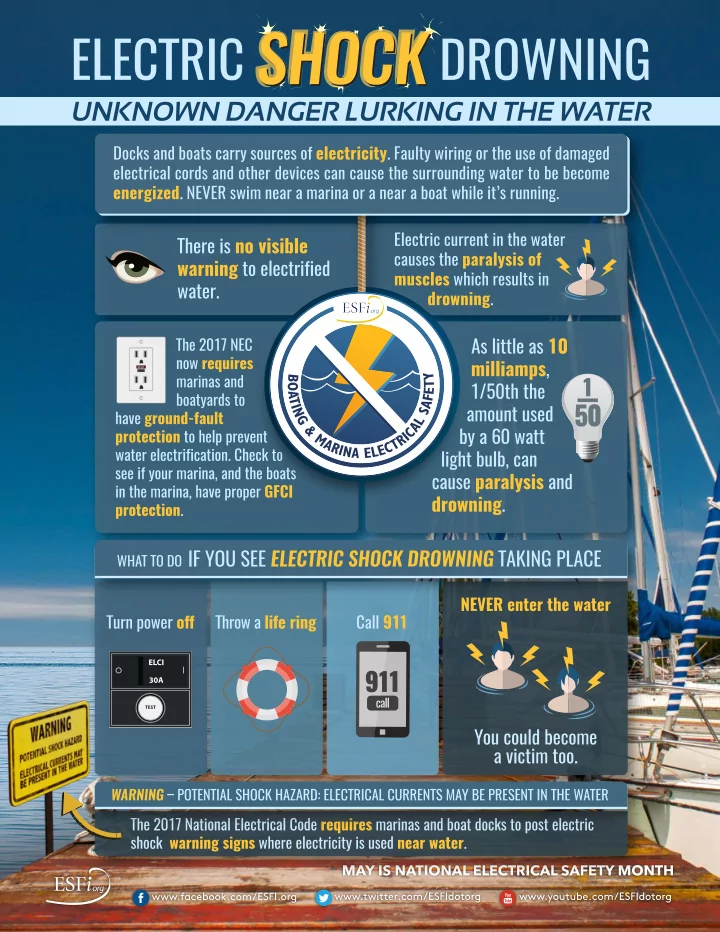
where noah died. These were not drowning victims. In all of these cases, 120-volt aC (alternating current) leakage from nearby boats or docks electrocuted or incapacitated swim- mers in fresh water. This little-known and often-unidentifjed killer is called electric Shock Drowning, or eSD, and these deaths and injuries were entirely
summer, there were seven confjrmed eSD deaths and at least that many near misses; in all likelihood, dozens more incidents went undetected. every boater and every adult who swims in a freshwater lake needs to understand how it happens, how to stop it from happening, and what to do — and not to do — if they ever have to help an eSD victim.
FRESH WATER + ALTERNATING CURRENT = DANGER
Kevin ritz lost his son Lucas to eSD in 1999, and he shared his story with Seaworthy in “a Preventable Dockside Tragedy” in october of 2009. Since his son’s death, ritz has become a tireless investigator, educator, and campaigner dedicated to preventing similar trag-
where minute amounts of alternating current are present,” ritz said. What does “minute” mean exactly? Lethal amounts are measured in mil- liamps, or thousandths of an amp. When fmowing directly through the human body, these tiny amounts of current interfere with the even smaller electrical potentials used by our nerves and muscles. Captain David riflin and James Shafer conducted exten- sive testing of all aspects of eSD for a Coast guard study in 2008, including exposing themselves to low-level cur- rents in fresh water. “anything above 3 milliamps (ma) can be very painful,” riflin said. “If you had even 6 ma go- ing through your body, you would be in agonizing pain.” Less than a third of the electricity used to light a 40-watt light bulb — 100 ma — passing directly through the heart is almost always fatal. Why fresh water and not salt? Salt- water is anywhere from 50 to 1,000 times more conductive than fresh
body when wet lies between the two, but is much closer to saltwater than
way back to ground unless the swim- mer grabs hold of something — like a propeller or a swim ladder — that’s elec-
“stuck” trying to return to its source and generates voltage gradients that will take a shortcut through the human
aC per foot in fresh water can deliver suffjcient current to kill a swimmer who bridges it. Many areas on watersheds and rivers may be salty, brackish, or fresh depending upon rainfall or tidal
treat the water as if it were fresh just to be on the safe side. Why alternating current and not direct current (DC)? The cycling nature
electrical signals used by our nerves and muscles far more than the straight fmow of electrons in direct current. “It would require about 6 to 8 volts DC per foot to be dangerous,” riflin said,
gradient as with aC. “regardless of the type of voltage, the larger the voltage, the larger the gradient over the same distance.” There have been no recorded eSD fatalities from 12-volt DC even in fresh water because there is less chance of the higher voltage gradient necessary developing with DC’s lower voltages. How does that electricity get into the water in the fjrst place? In a prop- erly functioning electrical system, all of the 120-volt aC current that goes into the boat through the shore power cord
by Beth A. Leonard Current Level Probable Effect On Human Body
1 mA Perception level. Slight tingling sensation. Still dangerous under certain conditions. 5 mA Slight shock felt; not painful but disturbing. Average individual can let go. How- ever, strong involuntary reactions to shocks in this range may lead to injuries. 6-16 mA Painful shock, begin to lose muscular control. Commonly referred to as the freez- ing current or let-go range. 17-99 mA Extreme pain, respiratory arrest, severe muscular contractions . Individual cannot let go of an electrified object. Death is possible. 100- Ventricular fibrillation (uneven, uncoordinated pumping of heart). Muscular 2,000 mA contraction and nerve damage begin to occur. Death is likely. 2,000+ mA Cardiac arrest, internal organ damage, and severe burns. Death is probable.
Source: oSHa
www.BoatUS.com/insurance July 2013 | Seaworthy 7 returns to its source — the transformer ashore or on the dock where it originat-
the water, three things have to occur.
must be escaping from the system and trying to find another path back to its source ashore.
grounding system must be compro- mised so that stray current cannot easily return to ground through the ground safety wire. any stray electric- ity then has only one path back to its source — through the water.
current returning to its source through the water will create a slight but detectable difference between the amount of current traveling to the boat and returning from it through the shore power cables. ground Fault Protection (gFP) devices, like ground Fault Circuit Interrupters (gFCIs) required in bathrooms ashore, are de- signed to detect differences measured in milliamps and to shut down the electricity within a fraction of a sec-
then electricity will continue to flow into the water. If all of these conditions exist, then some or all of the boat’s underwater metals, such as the propeller, stern drive, or through-hull fjttings, will be energized, and electricity will radiate
the boat is in saltwater, the current will dissipate without doing damage un- less a diver grabs hold of the energized
set up a dangerous voltage gradient that will pass through any swimmer who bridges it.
FINDING OUT IF YOUR BOAT IS LEAKING CURRENT
Figuring out if your boat has a problem requires two special- ized tools — a basic circuit tes- ter and a clamp meter — that together cost about $150. If you keep your boat in a freshwater marina, the marina operator should have both and be using them to check the boats on their docks. To determine if your boat is leak- ing aC, start by checking the dock
shore power cord receptacle you use on your pedestal. The lights on the circuit tester will tell you whether or not the shore power system is functioning as it should. There are situations where those lights can mislead you, but as a fjrst approximation, assume all is well if the circuit tester says it is. If you fjnd any problems, alert your marina man- ager or call an electrician certifjed to aByC (amerian Boat and yacht Coun- cil) standards.
dock’s electrical system is sound, take the clamp meter and put it around your shore power cord. Most electricians use a clamp meter to measure the current fmowing through the neutral, hot, and ground wires separately, but we are interested in whether or not all of the current entering the boat is leaving it. If that is the case, the current passing through all of the wires will sum to zero, and that’s what the meter will show when the clamp is put around the entire shore power cord. If the clamp meter shows anything but zero, either some of the current going to your boat is enter- ing the water, or current leaking from the dock or another boat is returning to its source ashore through the metal fjt- tings on your boat. To determine which, turn ofg the power at the pedestal. If the clamp meter continues to show the same reading it did when the pedestal was on, the current is coming from somewhere else. If any or all of the cur- rent goes away, then your boat is leak- ing some current into the water. Unfortunately, that’s not quite all there is to it. Many of the most danger-
tioning and refrigeration, are cycling
show up if that equipment is running when you clamp the cord. To be sure your boat is not leaking aC into the water, you must run all your aC loads while clamping the cord and look for any reading but zero. If you fjnd a prob- lem, unplug your boat and don’t plug it in again until you get an electrician trained to aByC standards to fjgure out what is wrong and fjx it.
ELIMINATING CURRENT LEAKAGE
That your boat is not leaking aC into the water right now is no guarantee that it never will. electrical faults and ground faults develop in the marine environ- ment all the time. There are two ways to eliminate the risk altogether. The fjrst — and best — alternative is to completely isolate the aC shore power system from the aC system on the boat. Then any stray aC on the boat will re- turn to its source on the boat and will not enter the water. an isolation transformer transfers electricity from the shore to the boat and back again using the magnetic fjeld generated by the electrical current rather than through shore wires physi- cally touching the boat’s wires. If you want to be absolutely certain your boat cannot leak alternat- ing current into the water, install an isola- tion transformer. The second alterna- tive is to install ground
Courtesy David riflin
For stray AC to get into the water, there must be an electrical fault and a fault in the safety ground. Top: An inexpensive circuit tester. Bottom: This clamp meter shows a 7-amp difgerence between the current going into the boat and coming out.
Courtesy David riflin
8 Seaworthy | July 2013
www.BoatUS.com/insurance
IN GENERAL
n ESD victims are good candidates for successful Cardiopulmonary Resuscitation (CPR).
Learn to perform CPR and maintain your training.
n To retrieve a person in the water, reach, throw, and row, but don’t go. n Tell others about ESD. Most people have never heard of it and are unaware of the danger. n Make sure your children understand the importance of not swimming anywhere there
could be electricity. Don’t let them roughhouse on docks. Tell them what to do if they feel a tingling or shock in the water (see below). IN MARINAS
n NEVER swim within 100 yards of any freshwater marina or boatyard. n Talk to marina owners or operators about the danger of ESD. Ask your marina operator
to prohibit swimming at their facility and post signs.
n Ask marina operators if they are aware of and following the guidelines from NFPA 303 (Fire
Protection Standard for Marinas and Boatyards) and National Electric Code (NEC) 555.
IF YOU HAVE A BOAT
n Have your boat tested once a year to see if it is leaking electricity, or buy a clamp meter
and test it yourself. If you find any problems, have your boat inspected by a qualified electrician trained to ABYC standards.
n Have a qualified ABYC electrician install an ELCI on your boat (refer them to the ABYC
E-11 Standard) or use an ELCI in the shore power cord. As an alternative, install an isola- tion transformer on the boat.
n Test the GFCI/ELCI at least once a month or per the manufacturer’s specifications. n DO NOT do your own 120-volt AC electrical work on a boat or hire an electrician who is
not familiar with ABYC standards to do it. Many of the problems that lead to electrical faults result from the differences between shore and boat electrical systems and standards.
n DO NOT use common household extension cords for providing shore power to your boat.
Use, and encourage other boaters to use, shore power cords built to UL standards.
n NEVER dive on your boat to work on underwater fittings when it is plugged in to shore
power, even in saltwater.
IF YOU HAVE A PRIVATE DOCK
n NEVER swim within 100 yards of ANY dock using electrical power! n If you have not electrified your dock or put an AC system on your boat, weigh the risks
carefully before doing so.
n If you need electricity on your dock, hire a licensed electrician and make sure the wiring
meets the requirements in NFPA 303 and NEC 555. If your dock is already wired, hire an electrician to check that it was done properly. Because docks are exposed to the ele- ments, their electrical systems should be inspected at least once a year.
n Exercise your GFCIs/ELCIs as recommended by the manufacturer. n If you normally run a power cord from your house or garage to charge your batteries,
make sure the outlet has a GFCI and include an ELCI somewhere in the shore power cord.
n NEVER swim off your dock without shutting down all shore power to the boat and the dock. n Even if you adhere to all of these rules, nearby docks can still present a shock hazard.
Educate your neighbors and work together with them to make the waterfront safe.
IF YOU’RE IN THE WATER AND YOU FEEL TINGLING OR SHOCKS
n DO NOT follow your instinct to swim toward the dock! n SHOUT! Drowning victims cannot speak, let alone shout. Let everyone know what’s hap-
pening so they’ll understand the danger and react appropriately.
n Try to stay upright and back out of the area the way you came, warn any other swimmers
in the area of the danger, and then head for shore 100 yards or more from the dock.
n Alert the dock or marina owner and tell them to shut the power off to the dock until they
locate the problem and correct it.
n Go to the hospital to make sure there are no lingering effects that could be dangerous.
IF YOU HAVE TO RESCUE AN ESD VICTIM
n Know how to distinguish drowning from ESD (see Alert for how to recognize “normal”
drowning; tingling, numbness, or pain all indicate ESD).
n Fight the instinct to enter the water
— many rescuers have died trying to help ESD victims.
n Call for help. Use 911 or VHF Channel 16 as appropriate. n Turn off the shore power connection at the meter base and/or unplug shore power cords. n Get the victim out of the water. Remember to reach, throw, row, but don’t go. n If the person is not breathing or you cannot get a pulse, perform CPR until the Fire
Department, Coast Guard, or ambulance arrives.
fault protection in the boat’s and the dock’s aC system that will shut ofg the current if the amount of electricity going out difgers by a certain amount from that returning. “The european, australian and new Zealand standards require ground fault protection on a ma- rina’s main feeders and power pedestals,” riflin said. “They’ve had zero eSD fatali- ties in the nearly 30 years they’ve had this in place.” In the U.S., nFPa (national Fire Protection association) 303 (Fire Protection Standard for Marinas and Boatyards) requires gFP devices that trip at 100 ma or lower on all docks. But these devices can be expensive to retrofjt and maintain in a large marina, need to be tested monthly to keep them working properly, and are subject to nuisance trips in the marine envi- ronment, so the requirements have not been adopted or enforced uniformly at the local level. The aByC made ground fault protection on boats part of the e-11 electrical standard this year. equipment Leakage Circuit Interrupters (eLCIs) that trip at 30 ma are to be installed on all new vessels built to aByC standards, but very few older boats are equipped with them. Companies like north Shore Safety have started to ofger easy to ret- rofjt eLCIs and UL-approved cords with integrated eLCIs — these run from $200 to $400. Home building suppliers like Lowe’s sell 15-amp pigtails equipped with gFCIs for around $30. either of these could be used with a shore power cord from a house to a private dock to charge a boat’s batteries. Since his son died 14 years ago, Kev- in ritz has comforted dozens of families who have lost children as he has, and he has encouraged them to join forces with him to educate others. His goal is to put himself out of business. If each and ev- ery boater takes responsibility for his or her boat, ritz could get his wish..
T
and for a more technical discussion of ESD, go to www.BoatUS.com/Seaworthy/ESD