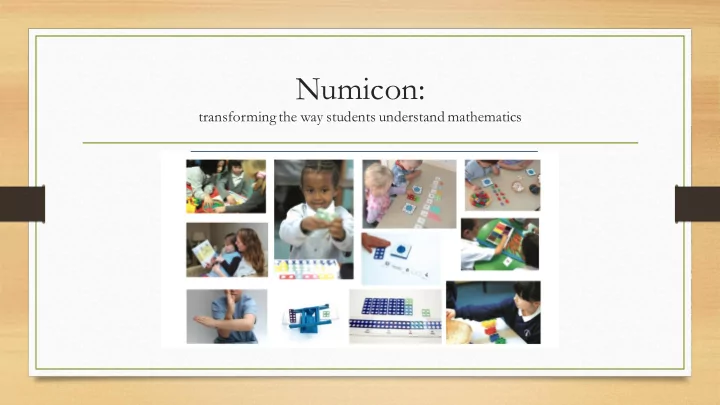
SLIDE 1 Numicon:
transforming the way students understand mathematics
SLIDE 2 Workshop Objectives:
- Learn more about Numicon theory and the evidence behind it.
- Understand why Numicon is an effective approach for a student with Down
syndrome.
- Learn practical mathematic applications through hands-on instruction and
exploration of various Numicon materials.
- Discuss methods of instruction that will help keep our learners motivated, engaged,
and included.
- Discover ways to create a number-rich learning environment at school and at home.
SLIDE 3
Math can be very abstract... especially for a learner with Down syndrome.
=
SLIDE 4
A "Sea" of Ones
SLIDE 5 What is Numicon?
- Multi-sensory approach using patterned
shapes, manipulatives, number lines, everyday objects, experiences, and contexts
- Makes calculations "real" by allowing
students to physically "do" what we want them to "think"
- Appeals to students with strong visual
thinking and memory skills
SLIDE 6
Making Math Real
SLIDE 7 Numicon: Origin & Theory
- Developed in UK by teachers through
classroom-based research
- Fosters self-belief to help students
persist through the difficulties of math
- Action + Imagery + Conversation
- Multi-sensory approach plays to
strengths and releases potential for learners to enjoy, understand, and achieve
SLIDE 8
Numicon and children with Down syndrome
In a Wiltshire project of 2001, the Numicon approach was used to support specifically children with Down syndrome, and the reporting educational psychologists found, "… results to be extremely pleasing in view of the fact that children with Ds do not normally make one month's progress per month, yet the average gain exceeds this, and many individuals have improved their skills at a much faster rate than the average." (Ewan and Muir, 2002)
SLIDE 9 More Evidence...
- Down Syndrome Education International - Working with Numicon since 2000.
- Research project undertaken with 16 children with Ds in the UK showed that all
children following Numicon approach made better progress than other children with Ds not using the system.
- Concluded that "Numicon enables teaching staff to "see" what the child is thinking,
which is important for identifying successes and confusions in the child's understanding" and "Children are motivated to engage with the materials as they are so attractive and they develop confidence in math work as they can succeed with the materials."
SLIDE 10
How does it work?
SLIDE 11 Numicon Materials:
- Number shapes
- Number line
- Feely bag
- Pegs/Rods
- Laces
- Spinner w/ overlay
- White board (100 board)
- White board overlay
- "Teaching Number Skills to Children with Ds Using Numicon" publication
- 101 Things to do with Numicon
SLIDE 12 Establishing a solid foundation:
- It is important that every child meeting Numicon for the first time learns the
foundation activities, regardless of ability level.
- Small steps!
- Eight broad stages – no timeline
- Games, not WORK!
- Advanced kits for advanced concepts
SLIDE 13 Stage 1: Introducing Shapes & Patterns
Getting Started:
- Recommend starting as early as 18
months, but there is no age limit!
- Students explore patterns and
shapes without naming numbers or numerals – just having fun
- Reinforce with visual number line
SLIDE 14 Stage 2: Putting Shapes in Order
- Start small and work up
- Reinforced with number line
- Work on ordering with a
variety of objects, large and small – this is an important concept to grasp
SLIDE 15 Stage 3: Assign Number Names to Shapes
- Reinforce by counting holes
and filling with pegs to reinforce number recognition
SLIDE 16 Stage 4: Ordering Shapes & Numbers Together
- BIG Step!
- Takes time to master
- Connecting counting AND
- rdering skills
SLIDE 17 Stage 5: Consolidation of Skills
- Learner confidently recognizes
Numicon shapes, number names, numerals, and makes connections between varied counting experiences and Numicon shapes
- Visualizing shapes in "mind's eye" to
prepare for the time they will cease to rely on actual Numicon shapes
- Will have a clear mental picture of the
number they can use
SLIDE 18 Stage 6: Relating Numicon to Early Math
understanding about size, order, and relationship of numbers
- Can begin to relate addition to
combining two or more Numicon shapes and learn vocabulary involved in adding
SLIDE 19 Stage 7: Adding "One More"
- Encourages mental math
- Can see with shapes if you add one
to any number, it’s the same as the next number
- Doubles – Special combination of
two numbers
SLIDE 20 Stage 8: Subtraction
- Hiding replaces "taking away" when using
Numicon shapes
- The tricky "comparison and
difference" structure of subtraction is easily seen when comparing two shapes.
- Example: What's the difference between 8
and 3?
- Use manipulatives/pegs in holes to
reinforce "taking away"
SLIDE 21
Numicon: Advanced Concepts
Multiplication Division Decimals Fractions Money Time
SLIDE 22
Multiplication & Division
SLIDE 23
Fractions & Decimals
SLIDE 24
Counting Money & Telling Time
SLIDE 25
SLIDE 26 Effective Instruction
- UDL framework (IDEA, 2004)) gives students of all abilities access to learning through
multiple means of instruction, expression, and engagement.
- Be creative and flexible. Find multiple ways to engage your learner by understanding what
motivates that individual. Customize your approach based on that child's individual learning profile – there's no "one size fits all" approach.
- Consistency and repetition are KEY.
- Patience is a necessity.
- Numicon is an EXCELLENT tool to promote inclusion. This approach benefits ALL early
learners!
- Make EVERY experience a learning experience.
SLIDE 27 Numicon for Purchase
Depository, Amazon
- Everything Numicon at Oxford
University Press