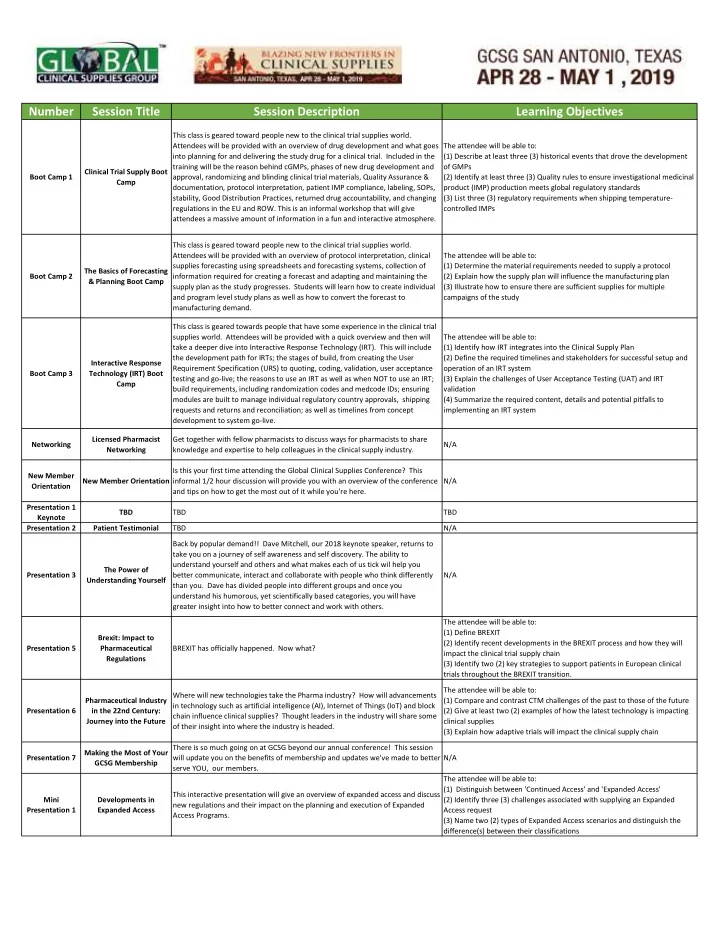
Number Session Title Session Description Learning Objectives This - - PDF document

number session title session description learning
SMART_READER_LITE
LIVE PREVIEW

Number Session Title Session Description Learning Objectives This - - PDF document

Number Session Title Session Description Learning Objectives This class is geared toward people new to the clinical trial supplies world. Attendees will be provided with an overview of drug development and what goes The attendee will be able


slide-1
SLIDE 1

Number Session Title Session Description Learning Objectives

Boot Camp 1 Clinical Trial Supply Boot Camp This class is geared toward people new to the clinical trial supplies world. Attendees will be provided with an overview of drug development and what goes into planning for and delivering the study drug for a clinical trial. Included in the training will be the reason behind cGMPs, phases of new drug development and approval, randomizing and blinding clinical trial materials, Quality Assurance & documentation, protocol interpretation, patient IMP compliance, labeling, SOPs, stability, Good Distribution Practices, returned drug accountability, and changing regulations in the EU and ROW. This is an informal workshop that will give attendees a massive amount of information in a fun and interactive atmosphere. The attendee will be able to: (1) Describe at least three (3) historical events that drove the development

  • f GMPs

(2) Identify at least three (3) Quality rules to ensure investigational medicinal product (IMP) production meets global regulatory standards (3) List three (3) regulatory requirements when shipping temperature‐ controlled IMPs Boot Camp 2 The Basics of Forecasting & Planning Boot Camp This class is geared toward people new to the clinical trial supplies world. Attendees will be provided with an overview of protocol interpretation, clinical supplies forecasting using spreadsheets and forecasting systems, collection of information required for creating a forecast and adapting and maintaining the supply plan as the study progresses. Students will learn how to create individual and program level study plans as well as how to convert the forecast to manufacturing demand. The attendee will be able to: (1) Determine the material requirements needed to supply a protocol (2) Explain how the supply plan will influence the manufacturing plan (3) Illustrate how to ensure there are sufficient supplies for multiple campaigns of the study Boot Camp 3 Interactive Response Technology (IRT) Boot Camp This class is geared towards people that have some experience in the clinical trial supplies world. Attendees will be provided with a quick overview and then will take a deeper dive into Interactive Response Technology (IRT). This will include the development path for IRTs; the stages of build, from creating the User Requirement Specification (URS) to quoting, coding, validation, user acceptance testing and go‐live; the reasons to use an IRT as well as when NOT to use an IRT; build requirements, including randomization codes and medcode IDs; ensuring modules are built to manage individual regulatory country approvals, shipping requests and returns and reconciliation; as well as timelines from concept development to system go‐live. The attendee will be able to: (1) Identify how IRT integrates into the Clinical Supply Plan (2) Define the required timelines and stakeholders for successful setup and

  • peration of an IRT system

(3) Explain the challenges of User Acceptance Testing (UAT) and IRT validation (4) Summarize the required content, details and potential pitfalls to implementing an IRT system Networking Licensed Pharmacist Networking Get together with fellow pharmacists to discuss ways for pharmacists to share knowledge and expertise to help colleagues in the clinical supply industry. N/A New Member Orientation New Member Orientation Is this your first time attending the Global Clinical Supplies Conference? This informal 1/2 hour discussion will provide you with an overview of the conference and tips on how to get the most out of it while you're here. N/A Presentation 1 Keynote TBD TBD TBD Presentation 2 Patient Testimonial TBD N/A Presentation 3 The Power of Understanding Yourself Back by popular demand!! Dave Mitchell, our 2018 keynote speaker, returns to take you on a journey of self awareness and self discovery. The ability to understand yourself and others and what makes each of us tick wil help you better communicate, interact and collaborate with people who think differently than you. Dave has divided people into different groups and once you understand his humorous, yet scientifically based categories, you will have greater insight into how to better connect and work with others. N/A Presentation 5 Brexit: Impact to Pharmaceutical Regulations BREXIT has officially happened. Now what? The attendee will be able to: (1) Define BREXIT (2) Identify recent developments in the BREXIT process and how they will impact the clinical trial supply chain (3) Identify two (2) key strategies to support patients in European clinical trials throughout the BREXIT transition. Presentation 6 Pharmaceutical Industry in the 22nd Century: Journey into the Future Where will new technologies take the Pharma industry? How will advancements in technology such as artificial intelligence (AI), Internet of Things (IoT) and block chain influence clinical supplies? Thought leaders in the industry will share some

  • f their insight into where the industry is headed.

The attendee will be able to: (1) Compare and contrast CTM challenges of the past to those of the future (2) Give at least two (2) examples of how the latest technology is impacting clinical supplies (3) Explain how adaptive trials will impact the clinical supply chain Presentation 7 Making the Most of Your GCSG Membership There is so much going on at GCSG beyond our annual conference! This session will update you on the benefits of membership and updates we've made to better serve YOU, our members. N/A Mini Presentation 1 Developments in Expanded Access This interactive presentation will give an overview of expanded access and discuss new regulations and their impact on the planning and execution of Expanded Access Programs. The attendee will be able to: (1) Distinguish between 'Continued Access' and 'Expanded Access' (2) Identify three (3) challenges associated with supplying an Expanded Access request (3) Name two (2) types of Expanded Access scenarios and distinguish the difference(s) between their classifications

slide-2
SLIDE 2

Number Session Title Session Description Learning Objectives

Mini Presentation 2 Cell & Gene Therapy Supply Chain Over the course of the last decade, there has been an increased emphasis on research and development into cell, gene and immunotherapy treatments. The

  • utlook is positive, due in part to advancements in science and the availability of

more sophisticated diagnostic tools, which are giving the medical community a better understanding of the human genome and making it easier to detect genetic mutations affecting individual patients. Come to this mini presentation to learn about the challenges of cell & gene therapies, the challenges of their unique supply chains and how to overcome them. The attendee will be able to: (1) Describe the process of developing supply chains for cell & gene therapies. (2) Compare and contrast the logistics requirements of standard cold chain products versus cell & gene therapy products (3) List at least two (2) concerns in the handling of cell & gene therapy clinical materials and how to mitigate those concerns (4) Describe the appropriate classification and labeling of cell & gene therapy products to ensure compliant transportation (5) Explain the difference between autologous and allogeneic sourced cells Mini Presentation 3 IP Requirements at Clinical Sites In order to maintain the clinical supply chain in accordance with GMPs and GCPs it is essential that we ensure controls of our IP at clinical sites. This is also a key requirement in ICH E6. This mini presentation will describe all of the requirements to ensure clinical supply control at investigator sites. The attendee will be able to: (1) Identify the documentation required to process a patient for a clinical trial (2) Explain the contents of a Pharmacy Manual as it relates to IP requirements (3) Identify the GCP regulations that govern how sites handle clinical supplies Mini Presentation 4 Aligning Clinical Supplies Documentation with Trial Master File Expectations A Trial Master File (TMF) should be set up at the beginning of a trial. A well maintained TMF can help with efficient trial management and can facilitate the reconstruction of the conduct of the trial during the audit/inspection process. Requirements for managing IP docmentation to be included in a TMF can be located in ICH E6. The attendee will be able to: (1) Summarize the ICH Guidelines that apply to clinical supplies and the TMF (2) Identify the clinical supplies documentation required to be in the TMF (3) List three (3) documents or reports that can be prepared in anticipation

  • f an inspection

Mini Presentation 5A A Culture of Accountability ‐ Part 1 (2 hour session) This session is part one of a two‐part mini‐presentation series. Each part will have a duration of two (2) hours and is geared towards Executives, VPs, Directors and Senior Managers. In this session, we will discuss and define accountability and case studies will be provided to demonstrate techniques and concepts to instill a culture of accountability within your team. The attendee will be able to: (1) Explain how accountability can have a direct and positive impact on quality and production (2) List three (3) tools that can be used to increase accountability in your teams (3) Give one (1) example of how building accountability into your team can directly impact patient safety Mini Presentation 5B A Culture of Accountability ‐ Part 2 (2 hour session) A continuation of A Culture of Accountability ‐ Part 1, this session is part two of a two‐part mini‐presentation series. Each part will have a duration of two (2) hours and is geared towards Executives, VPs, Directors and Senior Managers. In this session, we will continue our discussions about case studies demonstrating techniques and concepts to instill a culture of accountability within your team. The attendee will be able to: (1) Explain how accountability can have a direct and positive impact on quality and production (2) List three (3) tools that can be used to increase accountability in your teams (3) Give one (1) example of how building accountability into your team can directly impact patient safety Mini Presentation 6A BREXIT's Impact on Distribution This session will give you an understanding of how BREXIT will impact the distribution strategy for your clinical supply chain during transition and post‐ implementation. The attendee will be able to: (1) Explain how the distribution network should be configured to maintain clinical supply continuity within the UK and EU during transition and post‐ implementation of BREXIT (2) Generate a REMS (risk evaluation and mitigation strategy) for your supply chain (3) Establish a distribution strategy for transition and post‐implementation based on the BREXIT timeline Mini Presentation 6B BREXIT's Impact on QP Release This session will give you an understanding of how BREXIT impacts QP release and strategies to overcome challenges for your clinical supplies during transition and post‐implementation. The attendee will be able to: (1) Describe how BREXIT will change the documentation requirements for IP release in the UK (2) Explain how material released in the UK will be able to be used in the EU and vice versa (3) Understand how the roles and responsibilities will not change Mini Presentation 6C BREXIT's Impact on VAT Reclamation This session will discuss how BREXIT may change your ability to reclaim Value Added Tax (VAT) within the UK and EU for your clinical supplies during transition and post‐implementation. The attendee will be able to: (1) Determine options for establishing a VAT strategy post BREXIT (2) Identify the timeline to accomplish VAT reclamation (3) Identify responsible party for VAT reclamation for tax purposes Workshop 1 Quality Agreements When Sponsor companies and vendors work together, ensuring clarity of expectations and roles and responsibilities is essential. This workshop will explore why quality agreements are essential even if not required by regulation as well as what goes into the best quality agreements and how to create transparency and a mutually beneficial partnership before executing tasks and project goals in support of the clinical supply chain. The attendee will be able to: (1) Explain why quality agreements are required by regulation in the EU, but not in the US (2) Identify the key parts of a good quality agreement (3) Describe the value of the quality agreement and how it can be used to ensure clarity of roles and responsibilities Workshop 2 Clinical Operations / CRO Discussion As clinical trial supply specialists, we can get so focused on "right drug, right place, right time" that we forget that there are many other people and activities involved in conducting a clinical trial. This session will provide an insight into one

  • f those other areas by discussing the variety of activities a clinical site performs

in addition to dispensing IP when processing a patient in a clinical trial. The attendee will be able to: (1) Summarize at least three (3) functions the clinical site performs when processing a patient aside from drug dispensing. (2) Describe a typical flow for processing a patient during a visit where dispensing happens. (3) List at least three (3) documents that the clinical site must complete as part of processing a patient during a visit. Workshop 3 EU Regulation 536/2014 (Clinical Trial Regulation) and the Regulatory Impact on Clinical Supplies. Clinical supply chains are adjusting to recent changes in the regulations. This workshop will provide an opportunity to discuss the recent changes and ask questions of a QP from the EU. The attendee will be able to: (1) Compare and contrast how the requirements for CT Supplies in EU Regulation 536/2014 differ from those in Directive 2001/20/EC (2) Identify when EU Regulation 536/2014 became effective by law and when it will become effective in practice (3) Explain no fewer than two (2) reasons the Clinical Trial Regulation is being implemented

slide-3
SLIDE 3

Number Session Title Session Description Learning Objectives

Workshop 4 Artificial Intelligence in Clinical Supplies Artificial Intelligence (AI) is a term being bandied about the pharma and biotech

  • industry. So many companies say they use AI to help them perform an action or

to identify trends and patterns in huge amounts of data. Is it all that it's cracked up to be? This workshop will identify what it is, how it can be used to support clinical development and what are the myths of AI. The attendee will be able to: (1) Explain what AI is and how it can be used to support clinical development (2) Describe the limitations of AI and how any system needs to be "taught" how to interpret metadata (3) List some questions that can be asked to check the veracity of a statement when being told AI is an integral part of a software system Workshop 5 Challenges of Developing a Clinical Supply Chain in Asia Pac Developing and maintaining a robust clinical supply chain in Asia Pac doesn't have to be challenging. Planning up front for your Asia Pac distribution and import/ export strategy can greatly increase your chances of success within the region. This workshop will discuss best practices for storage, distribution, import/ export and reverse logistics in South Korea, Thailand, Malaysia, Singapore, China, New Zealand and Philippines. You will also get some hands on experience by working through a scenario for an Asia Pac study! The attendee will be able to: (1) Describe concerns with reverse logistics of clinical supplies from the various countries in Asia Pacific. (2) Effectively describe (on a basic level) requirements and license types for import/export of clinical supplies as well as issues with returns and destruction of clinical supplies from the Asia Pac countries (3) Be able to describe considerations for language requirements in countries where English is not a primary language. Workshop 6 Ancillary supplies ‐ Partnering with CROs Ancillary supplies are often the items no one wants to take responsibility for sourcing due to their unique procurement and distribution challenges. Over the years they have fallen squarely on the shoulders of clinical supply professionals. This workshop will be a discussion of the various practices used for procuring, stocking, and distributing ancillary items to clinical sites. The attendee will be able to: (1) Describe stocking and replenishment models used in the industry and how they are managed when partnering with a CRO. (2) Describe how far in advance an ancillary supply strategy should be discussed with your CRO partner and why (3) List special considerations for ancillary supplies managed by a CRO

  • utside the United States

Workshop 7 Vendor Management Outsourcing has become the norm in our industry, yet we still see issues on both sides of the table. This workshop will provide insights into how to decrease risk and increase success when partnering. The attendee will be able to: (1) Identify the at least three (3) risks and potential mitigations of

  • utsourcing core aspects of the IMP supply chain (manufacturing, packaging,

labeling, distribution). (2) List at least three (3) potential advantages of outsourcing IMP activities. (3) Describe at least two (2) high‐volume outsourcing models utilized for IMP activities. Workshop 8 Best Practices for Adaptive Trials For over 10 years, adaptive clinical trials have been discussed as an amazing way to shorten clinical development timelines, eliminate huge enrollment delays and support speed to market. The challenges that come with Adaptive Trials mostly focus on the clinical supply chain and how clinical supplies need to be globally available, in support of every change an adaptive trial can make. If not planned and forecasted well, these trials can cause huge amounts of clinical supplies to be packaged, left unused and wasted. This leads to huge cost overruns, expired supplies and comparators and supply chain interuptions. This workshop wil focus

  • n best practices to avoid these challenges while improving supply chain efficacy

and agility. The attendee will be able to: (1) Identify clinical supply strategies that help the supply chain respond to changes in adaptive trials (2) Explain the difference between adaptive trial design and unplanned changes based on interim results (3) Understand the motivation for the industry to use adaptive trial design. Workshop 9 Best Practices for Demand Forecasting Demand forecasting has become the industry norm in order to handle the growing costs and time constraints associated with comparator sourcing, packaging, labeling and temperature controlled distribution for global clinical trials. The attendee will be able to: (1) Identify no fewer than two (2) clinical supply tools that can be used to support clinical supply chain demand forecasting (2) Describe how you can avoid the loss of time and cost of waste associated with clinical studies executed without demand forecasting (3) Explain the data required to implement a demand forecast model at your company in order to increase cllinical supply chain efficiency Workshop 10 CMC Regulatory Workshop (Filings and how they relate to IP) The CMC section of the IND contains information that has a direct influence on clinical trial supplies. Failure to prepare IP that follows the requirements listed in this section can have a significant impact to a clinical trial. This session will discuss the CMC information contained in a clinical trial regulatory filing and how it should be monitored to avoid issues with clinical supplies. The attendee will be able to: (1) Describe the contents of the CMC section in a US IND. (2) State the functional areas responsible for the information contained in the CMC section (3) Summarize at least three (3) ways that information in the CMC section of a CTA can impact IP supplies Workshop 11 Direct to Patient Expanding access to patient populations, faster recruitment, increasing patient retention and decreasing time to market are all reasons sponsors are exploring direct to patient clinical trial models. This workshop is designed to discuss the use

  • f central pharmacies in a direct to patient supply chain model.

The attendee will be able to: (1) Describe two (2) benefits each for the clinical site, sponsor, and patient of a direct to patient (DtP) trial (2) Identify at least two (2) risks for sponsors conducting direct to patient trials and develop effective mitigation strategies for these risks (3) Identify how use of central pharmacies can support delivery of medication closer to the patient thus minimizing waste Workshop 12 Horror Stories ‐ How They Were Handled and How to Prevent Them Horror stories in clinical supplies…we've all had them! Share your stories and mitigations with your colleagues. N/A Workshop 13 Managing Importation Requirements for Your Products The global reach of today's clinical trials makes understanding your product and its specific transit & import/export requirements a must for any clinical supply

  • chain. This workshop will discuss ways to navigate the myriad of complex

regulations involved in the import and export of clinical trial supplies. The attendee will be able to: (1) Identify at least two (2) ways to ensure compliance with import/ export regulations for clinical trial supplies. (2) Articulate the accountability and responsibilities of the owner, the importer/ exporter of record and the customs broker (3) Describe a record‐keeping practice that would ensure the appropriate supporting documentation is available for import / export entries and VAT/ duty reporting.

slide-4
SLIDE 4

Number Session Title Session Description Learning Objectives

Workshop 14 Social Media and Its Influence on Clinical Trial Recruitment Social media has become a force to be reckoned with when it comes to pharma and biotech product development. People are more connected and informed than they have ever have been in the history of the species. Unfortunately, they are not always "well" informed as there is a staggering amount of information on the internet that is not even close to true. This workshop will discuss the impact

  • f social media on drug development as well as what to watch out for when

conducting investigator initiated studies (IIS) or utilizing expanded access programs (EAP). The attendee will be able to: (1) Explain the upside and downside of how social media has impacted drug development (2) Describe no fewer than three (3) things to consider when dealing with social media backlash (3) Compare and contrast the challenges of social media for IISs versus EAP studies Workshop 15 Impact of Right to Try Law

  • n the Pharmaceutical

Industry The Right to Try law passed in the US on May 30, 2018 giving critically ill patients the ability to request access to investigational materials anytime after Phase I

  • completion. Pharma companies have the challenge of determining if/ when they

allow access to these medications. Join us in this workshop to discuss how this legislation has impacted the clinical supply chain and the pharmaceutical industry. The attendee will be able to: (1) Accurately describe Right to Try (RTT) legislation. (2) Differentiate between RTT and Expanded Access (EA) requirements (3) Give examples of where RTT and EA are similar Workshop 16 Import and Export of Controlled Substances International shipping of IP can be an intricate process under normal circumstances but becomes exceptionally complex when dealing with controlled

  • substances. This workshop will discuss the requirements for shipping controlled

substances that go beyond those required for other shipments. The attendee will be able to: (1) Compare and contrast controlled substance import requirements in the US vs. the rest of the world. (2) List at least two (2) unique aspects of import/export for US C‐II controlled substances. (3) List at least three (3) challenges in handling controlled substances globally. Workshop 17 Temperature Data at the Clinical Site ‐ The Missing Piece of the Puzzle Temperature‐controlled shipping is now ubiquitous in the clinical supply chain and with the increase in the total number of shipments comes a corresponding increase in the number of temperature excursions that are occurring and being

  • reported. This session will discuss ways to effectively manage and document

temperature excursions for GMP compliance. The attendee will be able to: (1) Define what a temperature excursion is for an investigational medicinal product (IMP) (2) Identify how to thoroughly document and evaluate a temperature excursion (3) Define at least two (2) ways to proactively and reactively manage temperature excursions Workshop 18 Insource or Outsource cGMP Batch Documentation Reviewing manufacturing and packaging batch records for release of investigational product is an integral part of the clinical supply chain. The decision as to whether to retain the responsibility at the sponsor company or to fully/ partially outsource can be challenging. This session will look at the benefits and risks of outsourcing this key quality activity and how to appropriately manage communication of delegated responsibilities. The attendee will be able to: (1) Identify the party ultimately responsible for cGMP of the IP (2) Describe appropriate delegation of responsibility of key cGMP activities to a contract vendor (3) Give at least 2 examples of benefits of partnering with a contract vendor for batch record review of outsourced operations. Workshop 19 How to Develop SOP's to Meet Regulatory Expectations SOPs evolve as a company grows with the development of the drug being studied. Processes that may work for a small company will not function reliably for a larger company with a more established pipeline. This workshop will discuss the ways SOP details change as companies grow and how to maintain well‐controlled processes. The attendee will be able to: (1) Define the required elements for establishing a complete and thorough SOP. (2) Establish the proper personnel who should be included in the creation of an SOP. (3) Determine a strategy for establishing SOPs that matches your company's requirements. Workshop 20 Maintaining a Patient‐ First Perspective in Your Clinical Supply Chain As the industry shifts to a more site‐centric perspective, ensuring that our clinical supplies are user‐friendly to both site personnel and patients becomes essential. This workshop will discuss techniques for establishing and improving a clinical site and patient‐centric approach. The attendee will be able to: (1) Give at least two (2) examples of poorly designed or labeled IMP and how they could have been improved. (2) Identify at least three (3) techniques for packaging and labeling IMP that can enhance patient compliance (3) Explain the potential negative impact on patients who have poor experiences with IMP Workshop 21 How to Get the Most Value From Your GCSG Membership This workshop is a hands on session to work with GCSG team members to see, and try, membership perks such as getAbstract and SumTotal as well as ask your questions / get help with the GCSG App N/A Workshop 22 Speed, Quality & Cost ‐ Why You Should be Conducting Your Clinical Trials in Australia Over the last 20 years, Australia has grown to become a destination of choice for the conduct of early phase clinical trials. Rapid ethics approval and a simple notification to the Therapeutic Goods Administration (TGA) means that from submission to first patient, first dose (FPFD) takes, on average, 6 weeks. Coupled with the attractive R&D tax incentive program offered by the Australian Government this swift to study data can then be used to support an IND or IMPD application allowing companies to speed up their drug development process. The attendee will be able to: (1) Understand the specific considerations required for Phase I trial design in Australia (2) Have knowledge and understanding of Australia's R&D Tax incentive program and eligibility when conducting trials in Australia (3) Have an understanding of the specific requirements for importing, manufacturing, compounding and labelling product for Australian clinical studies Workshop 23 How to Partner with Your Clinical Sites, a Shared Perspective from a Site Pharmacist and CMO In our ever evolving clinical development world, we are realizing the value of a site‐centric approach to clinical trials and clinical supplies. This workshop will identify ways to better collaborate with clinical sites to enhance patient enrollment, patient retention throughout the clinical trial and decrease in clinical supply dosing and maintenance. The attendee will be able to: (1) Describe the clinical site's challenges when using clinical supplies in support of a clinical trial (2) Explain at least three (3) ways a clinical trial can experience a deviation at the site due to clinical supply issues (3) Summarize how clinical supplies can negatively impact site enrollment and what can be done to reverse those issues Workshop 24 Best in Class Temperature Controlled Distribution This workshop will discuss ways to ensure effective distribution of temperature controlled IMP. The attendee will be able to: (1) List three (3) ways to mitigate temperature excursions (2) Give two (2) examples of products used to control temperature within a shipment (3) Explain how the right combination of phase change materials (PCMs) and insulation can provide the best passive shipping system

slide-5
SLIDE 5

Number Session Title Session Description Learning Objectives

Workshop 25 Enrollment Accuracy & Forecasting This workshop will focus on industry best practices to improve and forecast study enrollment to positively impact the clinical supply chain. The attendee will be able to: (1) Identify three (3) factors linked to enrollment that influence forecast accuracy. (2) Differentiate the technologies available in the industry today to improve forecasting accuracy. (3) Summarize how IRT data can be integrated to improve clinical supply forecasting Workshop 26 The Future of Automated Systems for Clinical Supplies As technology advances at an exponential pace, new automated systems are being produced that will greatly improve the clinical supply chain. This workshop will discuss those technologies. The attendee will be able to: (1) Summarize how technology can positively impact the clinical supply chain (2) Identify which parts of the clinical supply chain could most benefit from new technology (3) Explain the greatest limitations of new technology and its integration into the pharma/biotech industry Workshop 27 Bridging the Cultural & Regulatory Gaps in Japan Awareness of the regulatory requirements across different agencies is critical for being a successful clinical trial supply professional. This workshop will contain a discussion comparing the regulatory requirements of Japan for packaging, labeling and distribution as well as how they impact CT supply timelines and planning. The attendee will be able to: (1) Describe three (3) situations where knowledge of Japanese regulatory requirements can positively influence clinical supply chain outcomes (2) Summarize how differences in Japanese regulatory requirements can affect shipping and distribution channels (3) Present the best way to be aware of and access changing regulations for clinical supplies used in Japanese clinical trials Workshop 29 Qualified Person The quality units and Qualified Persons (QPs) in the EU are adjusting to recent changes in the regulations and the impact of Brexit. This workshop will provide an update on what those changes are as well as provide an opportunity to ask questions and discuss requirements with a QP from the EU and UK. The attendee will be able to: (1) Identify the appropriate QP release process for clinical supplies that are packaged in the UK and distributed around the EU. (2) Name a minimum of two (2) challenges companies had to work through to plan for Brexit and changes in EU regulations in the past year and describe strategies to overcome them. (3) Describe an area of vulnerability for the pharmaceutical industry with the current exit strategy Workshop 30 Measuring Return on Investment (ROI) in Forecasting Clinical Supplies Methods for forecasting the IP requirements for a clinical trial range from a calculator and scratch pad to complex systems integrated with ERP and IXR. Which level of detail is needed to ensure drug supplies are sufficient without creating excessive waste? This workshop will discuss the various methods for determining clinical supply needs and their appropriate use. The attendee will be able to: (1) Describe three (3) methods for calculating a clinical forecast and the information required for each. (2) Summarize no fewer than six (6) factors that should be considered when creating a forecast. (3) Compare the advantages and disadvantages of manual versus commercial system forecasting methods Workshop 31 Strategies for Using Pooled Supplies This workshop will discuss the situations where establishing a pooled supply strategy is advantageous and should be considered. The attendee will be able to: (1) Explain at least two (2) different levels of pooling of supplies. (2) Identify at least three (3) factors that contribute to the success of a pooling strategy. (3) Describe at least one (1) real‐life case study where pooling of investigational product was done successfully. Workshop 32 New Chinese Regulations and Their Impact on Clinical Supplies Running a study in China? Come to this workshop to discuss the evolving Chinese regulations for clinical trials and how they impact your studies. Discuss challenges with our facilitator who lives and works in China! The attendee will be able to: (1) Identify at least two (2) regulations that impact clinical trial conduct in China (2) Define potential solutions/ options for maintaining compliance while ensuring patient continuity. (3) Describe three (3) situations where knowledge of regulatory requirements can positively influence clinical supply chain planning. Workshop 33 Planning Returns & Reconciliation in a Global Trial Following Regulations in Latin America Awareness of the regulatory requirements across different agencies is critical for being a successful clinical trial supply professional. This workshop will contain a discussion comparing the regulatory requirements of returns and reconciliation in Latin American countries and how they impact clinical trial supply timelines and planning. The attendee will be able to: (1) Describe three (3) situations where knowledge of regulatory requirements can positively influence clinical supply chain planning activities and outcomes. (2) Summarize how differences in regulatory requirements can impact reconciliation, returns and destruction of investigational product. (3) Present the best way to be aware of and access changing regulations within Latin American countries Workshop 34 Trade Compliance Customs considerations factor into every aspect of the clinical trial supply chain from sourcing raw materials to introducing a new product to market. Determining ownership of the material, an appropriate value and appropriate documentation needed to support compliant movements globally can be challenging to say the least. This workshop will discuss the challenges and how clinical supply chains can navigate through them to establish a robust and compliant supply chain. The attendee will be able to: (1) Identify an appropriate definition of "Value for Customs" for clinical trial materials. (2) Define "Restricted Party Screening" and why it is required for clinical trial shipments. (3) Describe classification of products for export and why accuracy is critical for clinical supplies. Workshop 35 Autologous Therapy Supply Chain Strategies Over the course of the last decade, there has been an increased emphasis on research and development into cell, gene and immunotherapy treatments. The

  • utlook for these treatment modalities is positive, due in part to advancements in

science and the availability of more sophisticated diagnostic tools, which are giving the medical community a better understanding of the human genome and making it easier to detect genetic mutations affecting individual patients. Come to this workshop to learn about the challenges of cell & gene therapies, their unique supply chain challenges and how to overcome them. The attendee will be able to: (1) Describe the process of developing supply chains for cell & gene therapies. (2) Compare and contrast the logistics requirements of standard cold chain products versus cell & gene therapy products (3) List at least two (2) concerns in the handling of cell & gene therapy clinical materials and how to mitigate those concerns. (4) Describe the appropriate classification and labeling of cell & gene therapy products to ensure compliant transportation (5) Explain the difference between autologous and allogeneic sourced cells

slide-6
SLIDE 6

Number Session Title Session Description Learning Objectives

Workshop 36 IRT Systems Development and Standards This workshop will discuss the development path for IRTs; the stages of build, from creating the User Requirement Specification (URS) to quoting, coding, validation, user acceptance testing and go‐live. The attendee will be able to: (1) Identify how IRT integrates into the clinical supply plan (2) Define the required timelines and stakeholders for successful setup and

  • peration of an IRT system

(3) Summarize the required content, details and potential pitfalls to implementing an IRT system Workshop 37 Embedding a CRO Within a Sponsor This workshop will discuss the advantages and challenges of outsourcing clinical supply operations to a vendor while leaving the vendor embedded at the sponsor company location The attendee will be able to: (1) Explain the advantages of creating a vendor‐sponsor embedded program (2) List three (3) challenges that must be overcome before this program is implemented (3) Identify all the points in the supply chain where a vendor could be embedded into the sponsor's clinical supply operation Workshop 38 Annex 13 and Annex VI Requirement Changes OR Changes to EU Regulation 536/2014 Although Regulation 536/2014 has not been fully implemented, aspects have been incorporated into the Directive that is still in effect. This workshop will discuss the changes that have been made in anticipation of the implementation of 536/2014 and how they are impacting clinical supplies. The attendee will be able to: (1) Summarize the rationale for replacing Directive 2003/94 with Regulation 536/2014. (2) Describe at least three (3) changes made in the amended Annex 13 and how they impact clinical supplies. (3) Describe the impact the new guidelines are having before the implementation of Regulation 536/2014. Workshop 39 Comparator Sourcing Strategies This session will discuss the options for establishing a successful comparator program that will include acquisition, pedigree, distribution and reconciliation. The attendee will be able to: (1) Identify three (3) key factors for establishing a successful comparator supply strategy (2) Compare and contrast a local versus global comparator sourcing strategy (3) Explain the regulatory requirements for ensuring track‐and‐trace of comparators used in a clinical trial Workshop 40 Managing a Recall We've all heard about the nightmares associated with clinical supply recovery/recalls. Thankfully, they are not common so many of us have been lucky enough to avoid having to actually implement a clinical supply recovery/recall. This workshop will provide the tools and recommended processes to prepare you for that worst case scenario. Having a plan in place can help you sleep even if you are faced with having to bring clinical supplies back to your depots or company. The attendee will be able to: (1) Identify ways to build contingency plans into the clinical supply chain that can be easily implemented in the case of a recovery/recall (2) Explain the value of having a mock clinical supply chain recovery/recall (3) Describe who will be involved, and no fewer than two (2) core processes that need to be put in place to ensure a seamless clinical supply recovery/recall Workshop 41 Flexible Solutions in a Changing Market

Clinical trial supply challenges such as: expiration management, pooled supply strategy and regulatory changes, are common in today’s clinical trial landscape; but shifts in the clinical trial market are further exasperating these challenges and introducing new ones. These challenges require innovative solutions that incorporate flexibility and agility into the supply

  • chain. This interactive workshop will identify these market challenges and

examine practical ways JIT Manufacturing can alleviate their impact.

The attendee will be able to: (1) List three (3) market drivers changing the clinical supply market (2) List three (3) challenges facing sponsors in a changing clinical supply market (3) List three (3) ways the just‐in‐time (JIT) manufacturing solution can help

  • vercome these challenges

Workshop 42 The Power of Understanding Yourself Attend this workshop presented by Dave Mitchell, our 2018 Keynote speaker, for a closer look at understanding yourself. Explore personal attributes related to interactive style, diving deeper into the concepts from the author's book, Explore how to connect your current life status to a desired future state. During this workshop, Mr Mitchell encourages attendees to engage in a deep exploration of their core values, beliefs, mission and vision in order to become their best self. The attendee will have the opportunity to: (1) Find the key to self‐discovery and personal development (2) Uncover their true purpose (3) Use helpful exercises to reveal their best self (4) Develop strategies to maximize their potential Workshop 43 Team Dynamics The best teams can accomplish the most amazing things and are an asset to their

  • rganization. The worst teams can waste thousands of manhours, cost millions of

dollars and still accomplish nothing. This workshop will identify the stages of team dynamics and provide ways to move your team from forming to high performing. The attendee will be able to: (1) Describe Tuckman's model of team development and dynamics (2) List three (3) ways to get teams stuck in "Storming" to move onto the next stage of development and productivity (3) Explain the value of trust as a core competency of team dynamics and success, and how to develop it in your teams