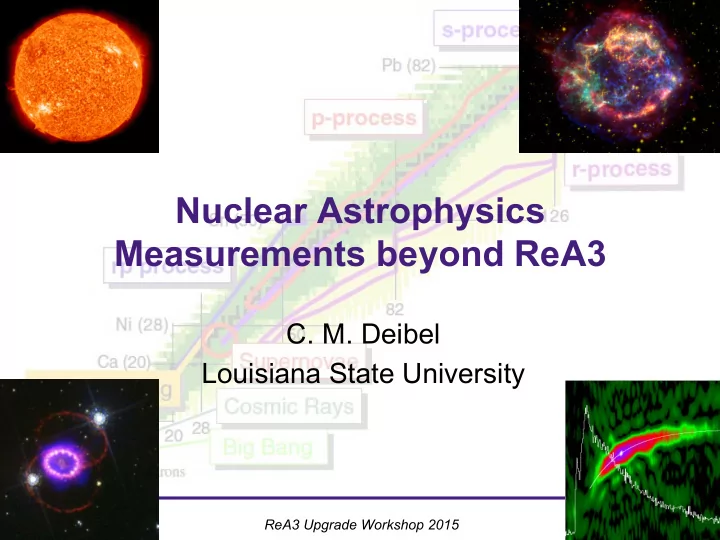
Nuclear Astrophysics Measurements beyond ReA3 C. M. Deibel - - PowerPoint PPT Presentation

nuclear astrophysics measurements beyond rea3
SMART_READER_LITE
LIVE PREVIEW

Nuclear Astrophysics Measurements beyond ReA3 C. M. Deibel - - PowerPoint PPT Presentation

Nuclear Astrophysics Measurements beyond ReA3 C. M. Deibel Louisiana State University 1 ReA3 Upgrade Workshop 2015 H. Grawe et al ., Rep. Prog. Phys. 70 , 1525 (2007). 2 ReA3 Upgrade Workshop 2015 Direct vs. Indirect measurements


slide-1
SLIDE 1

1

ReA3 Upgrade Workshop 2015

Nuclear Astrophysics Measurements beyond ReA3

  • C. M. Deibel

Louisiana State University

slide-2
SLIDE 2

2

ReA3 Upgrade Workshop 2015

  • H. Grawe et al., Rep. Prog. Phys. 70, 1525 (2007).
slide-3
SLIDE 3

3

ReA3 Upgrade Workshop 2015

Direct vs. Indirect measurements

  • Reaction rate combines

– thermal velocity distribution in stellar plasma (Maxwell-Boltzmann distribution) – probability of tunneling through Coulomb barrier (nuclear cross section)

  • For resonant reaction rates:

– exponentially dependent on resonance energy: Er – linearly dependent on resonance strength: ωγ

  • Measure reaction rates:

– directly – indirectly

Rolfs & Rodney (1988)

slide-4
SLIDE 4

4

ReA3 Upgrade Workshop 2015

Direct Measurements with SECAR

  • Recoil separator planned for ReA/FRIB
  • Targets:

– windowless gas target JENSA already installed at ReA – extended gas target to be developed

  • Direct measurements of (p,γ) and (α,γ) reactions

– capture on nuclei up to A = 65 – 1 x 10-17 rejection

SECAR Working Group: Tonight 16:00 (BPS 1400)

slide-5
SLIDE 5

5

ReA3 Upgrade Workshop 2015

  • Array for Nuclear Astrophysics and

Structure with Exotic Nuclei (ANASEN)

– active gas target detector – proportional counter surrounded by Si detector array

  • Successful runs with both stable and

radioactive beams at Florida State University

– 14N(α,p)17O – 18Ne(α,p)21Na

  • First experimental run with

reaccelerated RIB from ReA3:

– 37K(p,p) 37K

Direct (α,p) Reaction Measurements with Active Targets

RIB p

recoil

(via window)

14N(α,p)17O

slide-6
SLIDE 6

6

ReA3 Upgrade Workshop 2015

  • Support for future direct measurements

– nuclear structure must be well understood to make efficient use of ReA/FRIB beams

  • location of resonance energies
  • spins & branching ratios à strength of resonances
  • Alternatives to direct measurements

– low cross section reactions – low beam intensities – reactions between two unstable species

  • (n,γ) reactions for r-process
  • fusion reactions between unstable nuclei (e.g. 24C + 24C)

Indirect Measurements Needed

slide-7
SLIDE 7

7

ReA3 Upgrade Workshop 2015

  • Rapid proton capture (rp)

process:

– series of (p,γ) reactions and β decays – occurs in classical novae and X- ray bursts

  • Reaction rates often dominated

by specific resonances:

– affect final elemental abundances – determine observables (i.e. light curves)

  • Indirect (p,γ) and (α,γ) reaction

rate studies:

– (d,n) and (d,nγ) – (3He,d) – (6Li,d)

Indirect Measurements of rp-process

giant star

H-He-rich

white dwarf or neutron star

Cyburt et al., AJSS (2010) time (s)

slide-8
SLIDE 8

8

ReA3 Upgrade Workshop 2015

  • A. Parikh et al., ApJ SS 178, 110 (2008).

rp-process Sensitivity Studies

Type I X-ray bursts

  • C. Iliadis et al., APJ SS 142, 105 (2002)

Classical Novae

  • Reaction rates
  • f interest:

– (p,γ) – (α,γ) – (α,p) – (p,α)

slide-9
SLIDE 9

9

ReA3 Upgrade Workshop 2015

  • 57Cu(p,γ)58Zn largest, unmeasured uncertainty in

XRB nucleosynthesis around 56Ni waiting point

  • Studied d(57Cu,58Zn)n at NSCL

58Zn identified with S800

– γ rays from 58Zn* detected with GRETINA

  • Measurements of resonance energies and

tentative spins reduce reaction rate uncertainties by 3 orders of magnitude

57Cu(p,γ)58Zn via 57Cu(d,n)58Zn* with GRETINA

  • C. Langer et al., PRL 113, 032502 (2014)
slide-10
SLIDE 10

10

ReA3 Upgrade Workshop 2015

  • 57Cu(p,γ)58Zn largest, unmeasured uncertainty in

XRB nucleosynthesis around 56Ni waiting point

  • Studied d(57Cu,58Zn)n at NSCL

58Zn identified with S800

– γ rays from 58Zn* detected with GRETINA

  • Measurements of resonance energies and

tentative spins reduce reaction rate uncertainties by 3 orders of magnitude

  • Similar studies with ReA for (p,γ) reactions in

XRBs:

– d(59Cu,60Zn)n – d(61Ga,62Ge)n – d(65As,66Se)n

57Cu(p,γ)58Zn via 57Cu(d,n)58Zn* with GRETINA

  • C. Langer et al., PRL 113, 032502 (2014)
slide-11
SLIDE 11

11

ReA3 Upgrade Workshop 2015

(3He,d) in HELIOS

500 mbar D2 (gas target)

!"#$%&'()&*+,-.*

3He gas target Z (cm)

Proton energy (MeV)

(a) (b) (c)

Prototype Si array Si array Recoil Detector Target fan Beam

  • HELIcal Orbit Spectrometer (HELIOS)

– particle ID via time-of-flight – no kinematic compression à better resolution – high geometrical efficiency

  • Measurements of (p,γ) resonances using

target coupled with HELIOS via (3He,d)

14C(3He,d)15N used as commissioning experiment

for gas target – resolutions of better than 275-keV FWHM achieved . . . improvements to come

slide-12
SLIDE 12

12

ReA3 Upgrade Workshop 2015

Solenoid Device at ReA6-12

Step 1: Implement detectors in AT-TPC magnet for ReA3 energies Step 2: New larger, higher-field magnet in ReA12 area using existing detectors, for E>5 MeV/u 1 2 Transfer studies:

  • e.g. 30P(3He,d)31S
  • ~5 mb/sr
  • ~105 pps; ~15 MeV/u

Addition of γ–ray detection?

  • e.g. APOLLO

Courtesy A. Wuosmaa

slide-13
SLIDE 13

13

ReA3 Upgrade Workshop 2015

  • JENSA (Jet Experiments in Nuclear Structure and

Astrophysics):

– installed at ReA3 – first RIB experiment scheduled for Spring 2016:

34Ar(α,p)37K

– Advantages:

  • high density: 3 – 10 x 1018 atoms/cm2 (~50 µg/cm2 3He)
  • target purity
  • no target ladder “shadowing”

Transfer Reactions with

  • S. D. Pain, AIP 4, 041015 (2014)
slide-14
SLIDE 14

14

ReA3 Upgrade Workshop 2015

JENSA Data

Potential new levels

  • 14N(p,t)12N study with

JENSA

  • Study of unbound

states in 12N

  • 38 MeV proton beam
  • 20Ne(d,p)21Ne study

– Blue: implanted Ne target – Red: JENSA Ne gas target

  • Performed at ORNL:

– 30 MeV proton beam – θlab = 37°

  • Little to no contamination from

target using JENSA

Courtesy K. Chipps

slide-15
SLIDE 15

15

ReA3 Upgrade Workshop 2015

  • JENSA (Jet Experiments in Nuclear Structure and

Astrophysics):

– installed at ReA3 – first RIB experiment scheduled for Spring 2016:

34Ar(α,p)37K

– Advantages:

  • high density: 3-10 x 1018 atoms/cm2 (~50 µg/cm2 3He)
  • target purity
  • no target ladder “shadowing”
  • ReA6/12 opportunities:

– transfer reaction studies:

  • gas target needed:

– e.g. 56Ni(3He,d)57Cu

  • low contamination needed:

– e.g. (d,p), (d,n), (p,t)

Transfer Reactions with

  • S. D. Pain, AIP 4, 041015 (2014)
slide-16
SLIDE 16

16

ReA3 Upgrade Workshop 2015

r-process nucleosynthesis

  • Proceeds via rapid neutron captures on

extremely neutron rich nuclei

  • Site unknown

– core-collapse supernova – neutron star mergers

  • Site dictates r-process path

– hot r-process – cold r-process

r-process only solar abundances

  • C. Sneden, J.J. Cowan, and R. Gallino, ARAA 46, 241 (2008).

Nuclear data needed:

  • nuclear masses
  • decay lifetimes
  • Pn values
  • (n,γ) reaction rates
slide-17
SLIDE 17

17

ReA3 Upgrade Workshop 2015

Hot r-process sensitivity studies

Courtesy M. Mumpower

slide-18
SLIDE 18

18

ReA3 Upgrade Workshop 2015

  • R. L. Kozub et al., PRL 109, 172501 (2012)

r-process studies via (d,p)

  • Direct capture expected to

dominate r-process nucleosynthesis at N = 82 shell closure

– calculations of 130Sn(n,γ)131Sn vary by 3 orders of magnitude

  • 130Sn(d,pγ)131Sn @ ORNL with

ORRUBA

– 130Sn beam: 4.8 MeV/u, ~2x10⁵ ions/s

  • Results show population of single-

particle states

– indicated Z = 50 proton shell is intact – L = 1 single particle states are bound à large contribution to DC rate

slide-19
SLIDE 19

19

ReA3 Upgrade Workshop 2015

  • S. D. Pain, AIP Advances 4, 041015 (2014)
  • Gammasphere ORRUBA Dual

Detectors for Experimental Structure Studies

– ORRUBA Si array + Gammasphere @ ANL

  • 4 proposals accepted at ATLAS:

– GODDESS commissioning [S. Pain] –

95Mo(d,pγ) as a (n,γ) surrogate [J.

Cizewski] – (d,pγ) with neutron-rich Xe and Te beams [S. Pain] – study of 19Ne states for 18F(p,α) [D. Bardayan]

r-process studies via (d,p): GODDESS

  • Measurements of (d,pγ) using GRETINA/GRETA with Si detector

array at ReA12

– (n,γ) cross sections near shell-closers

  • 105 – 106 pps @ 12 MeV/u
slide-20
SLIDE 20

20

ReA3 Upgrade Workshop 2015

Normalize w/ systematics

(Beta) Oslo Approach to (n,γ)

Unfold primary Eγ vs. Ex → relative ρ(Ex) & f(Eγ) Statistical (n,γ) rate

  • Nuclear level densities and gamma-strength

function from β-γ with SuN (TAS)

– normalize to systematics – proof-of-principle case: 76Ge – development of approach to reach more neutron- rich nuclei

  • Complementary information from reaction

studies needed!

  • A. Spyrou et al., Phys. Rev. Lett. 113, 232502 (2014)
slide-21
SLIDE 21

21

ReA3 Upgrade Workshop 2015

  • What are the community’s needs for ReAX beams?

– Intensities?

  • 103 - 104 ions/s for (d,p) in HELIOS-type device

– >105 ions/s for studies requiring γ–ray coincidence

  • 104 - 105 ions/s (3He,d)
  • 106 – 107 ions/s (d,pγ)

– Purity?

  • high purity beams desirable
  • coincidence measurements needed for beams with contaminants

– Time structure?

  • HELIOS-type measurements require ~80 ns between bunches
  • nominal rate vs. instantaneous rate

ReAx Beams

slide-22
SLIDE 22

22

ReA3 Upgrade Workshop 2015

  • Many things not covered here:

– other processes (p-process, s-process, etc.) – other types of studies (e.g. ANC measurements, etc.) – future equipment needs

  • ReAX offers many opportunities for indirect measurements of

astrophysical significance:

– support for eventual direct studies with FRIB – indirect measurements where direct studies are not feasible

  • Needs for nuclear astrophysics studies at ReAX

– high quality beams – appropriate experimental equipment

Summary

THANKS!