
SLIDE 1
NSF Town Hall: AAS 236
Ralph Gaume, Jim Neff,
- B. Ashley Zauderer
NSF Division of Astronomical Sciences
June 2, 2020
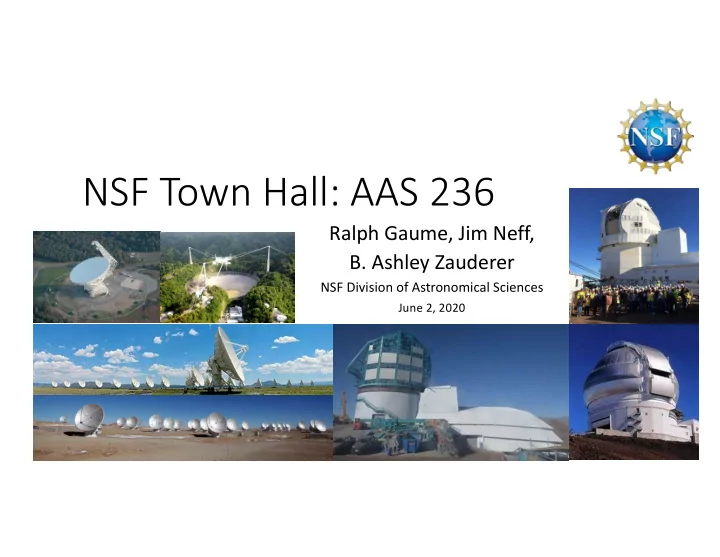
NSF Town Hall: AAS 236 Ralph Gaume, Jim Neff, B. Ashley Zauderer - - PowerPoint PPT Presentation
NSF Town Hall: AAS 236 Ralph Gaume, Jim Neff, B. Ashley Zauderer NSF Division of Astronomical Sciences June 2, 2020 Agenda COVID-19 Impacts AST Personnel NSF Personnel Science Highlights from AST Facilities Budget Status
Ralph Gaume, Jim Neff,
NSF Division of Astronomical Sciences
June 2, 2020
Recipients are authorized to continue to charge salaries, stipends, and benefits to currently active NSF awards consistent with the recipients’ policy of paying salaries (under unexpected or extraordinary circumstances) from all funding sources, Federal and non-Federal.
funding for large ground-based programs.
policy.
remotely, 2 POs per panel plus Admin support, AST continued as scheduled.
Division of Astronomical Sciences (AST)
Management Team Facilities, Mid-Scale, & MREFC Projects Administration ESM
National Radio Astronomy Obs.; ALMA Large Synoptic Survey Telescope AAG; CDS&E; cross- NSF programs Extragalactic Astronomy & Cosmology (EXC) AstroLab Ops. MSO,Individual Investigator Programs (IIP)
Richard Barvainis Program Director Galactic Astronomy Glen Langston Program Director Ralph Gaume Division Director Jim Neff Deputy Division Director REU; EXC; ESP Matthew Benacquista Program Director Kenneth Johnston Expert CAREER; AAG Matthew Viau Program Analyst Allison Farrow Program Analyst Renee Adonteng Program Analyst (Pathways Student) Craig McClure Program Support Manager Donna O’Malley Financial & Operations Specialist Harshal Gupta Program Director Hans Krimm Program Director Peter Kurczynski Program Director Christopher Davis Program Director Joe Pesce Program Director David Boboltz Program Director Edward Ajhar Program Director Ashley Zauderer Program Director Nigel Sharp Program Director Ashley Zauderer Program Director Jonathan Williams Program Director Mid-Scale Innovations Program (MSIP) MSRI-1, MSRI-2 Richard Barvainis Program Director Luke Sollitt Program Director Harshal Gupta Program Director Green Bank Observatory Planetary Astronomy Martin Still Program Director Gemini Observatory Elizabeth Pentecost Project Administrator Sarah Higdon Program Director AAG Zoran Ninkov Program Director Advanced Technologies & Instrumentation MPS, left NSF May 1, to become the GSFC Deputy Director in May 2020.
Division of Mathematical Sciences is acting Deputy AD.
NSF Director March 31.
President to be 15th NSF Director (07 Jan. 2020).
Director on April 1. Current Director of OSTP and former member of the National Science Board.
highest resolution images of Jupiter
program with the Hubble Space Telescope in support of NASA’s Juno mission.
atmosphere as a system; revealing winds, gases, heat, and weather phenomena.
some of the largest storm systems that create them, are formed in and around large convective cells over deep clouds of water ice and liquid.
the Great Red Spot are gaps in the cloud cover and not due to cloud color variations.
Jupiter at 4.7 μm, compiled from a mosaic of separate pointings
Observatory/NOIRLab/NSF/AURA, Wong et al. (2020) ApJS, 247, 2
NEWFIRM on the Mayall telescope on Kitt Peak have identified several
ionized by some of the first stars formed after the cosmic dark ages, a mere 680 million years after the Big Bang.
in the group discovered via NEWFIRM narrow-band imaging.
Rendition of ionized bubble formed by three galaxies, as imaged by the Mayall. Credit: V. Tilvi et al./NOIRLab/ KPNO/AURA.
neighboring the Milky Way, is revealed in this stunning image from the Blanco 4-m telescope.
intense star formation and a scattering of immense cosmic bubbles.
formation distributed throughout Barnard’s Galaxy indicate that star formation is widespread.
Barnard’s Galaxy imaged with NOIRLab’s 4-m Blanco Telescope at CTIO. Credit:
Image processing: Travis Rector (University of Alaska Anchorage), Mahdi Zamani & Davide de Martin
GBT Detects Faint Repeating Fast Radio Burst
radio emission originating from unknown extragalactic sources, and most were thought to be non-repeating
some 9 and 20 months after brighter bursts were found by the Australian Square Kilometre Array Pathfinder (ASKAP) – showing that this FRB repeats in time
fainter signals
Artist’s impression of FRB detection with the GBT (Credit: GBO/AUI/NSF; P. Vosteen)
less sensitive observations may be detectable with the GBT, helping to elucidate the nature of FRBs
GBT and ASKAP detections of FRB 171019 (Kumar et al. 2019, ApJL, 887, L30) (James et al. 2020, ApJL, 895, L22)
AAS NOVA Highlight, 29 January 2020
NS NSF’s Arecibo
continued during challenging past few months
Earth this year
distance
AO radar image of the potentially hazardous object, asteroid 1998 OR2.
Image Credit: Arecibo Observatory
Planetary Radar team led by Anne Virkki
(Image Credit: UCF)
AO Management Team led by the University of Central Florida
ALMA Discovers Massive Rotating Disk in Early Universe
Millimeter/submillimeter Array (ALMA) show a massive disk galaxy, similar to our Milky Way, but at ~12.3 billion light years (the most distant rotating galaxy every
measurement of the galaxy’s disk, indicating a rotation velocity of 272 km/sec (comparable to the Milky Way).
Hubble Space Telescope show a star formation rate 10x more than that of the Milky Way.
in the history of the universe – only 1.5 billion years after the Big Bang.
Top Right : An artist’s impression of the Wolfe Disk Bottom Right: The ALMA radio image of the disk galaxy.
Credit: NRAO/AUI/NSF, S. Dagnello (top) and ALMA (ESO/NAOJ/NRAO), M. Neeleman; NRAO/AUI/NSF, S. Dagnello (bottom)
$6,737M).
$20M - $70M range).
recent fiscal year appropriations.
2020s.
Committee Republicans introduced Securing American Leadership in Science and Technology Act
challenges: competition with China and climate change.
Vi Visit the he NSF F Booth h at AAS 236!